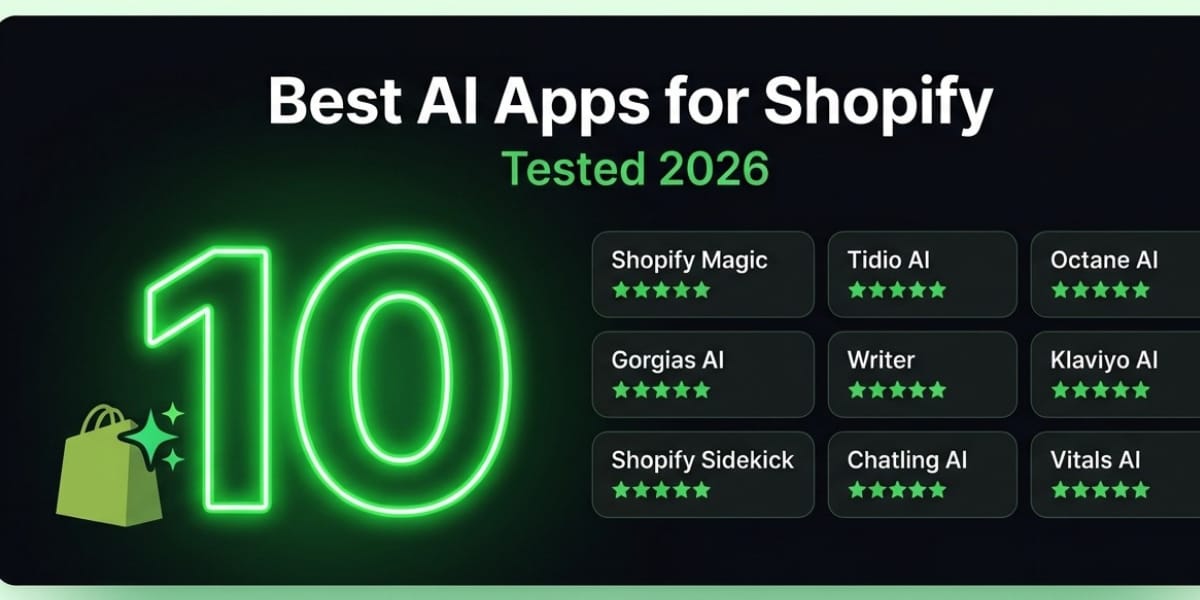
10 Best AI Apps for Shopify (Tested 2026)
If you’ve spent any time in Shopify circles lately, you’ve probably noticed something: everyone’s suddenly an “AI powered” store. Every app update mentions AI. Every pitch deck has a robot icon somewhere. It’s a lot of noise, and honestly, most of it is marketing dressing rather than something that changes how your store actually runs.
But a handful of tools have earned their spot in the conversation because they solve real problems writing product copy faster, answering customer questions at 2am, recommending the right product to the right shopper, recovering emails that would otherwise sit unopened. We went through the apps that keep coming up when merchants talk about what’s actually working right now, tested what we could, and dug into pricing, reviews, and real usage patterns for the rest. Here’s the honest rundown of all ten.
Shopify Magic
Let’s start with the one that’s already sitting inside your admin panel, whether you’ve noticed it or not. Shopify Magic is Shopify’s own free AI toolkit, and it touches almost every corner of running a store product descriptions, email copy, blog drafts, image editing, even instant answers inside Shopify Inbox. It’s included at no extra cost on every Shopify plan and uses large language models trained partly on your store’s data to generate content that’s meant to sound like it came from you.
The strongest use case is product descriptions. If you’ve got a catalog with fifty, a hundred, or a thousand SKUs, writing unique copy for each one by hand is brutal. Magic generates a first draft from your product attributes, in a tone you pick, and you edit from there. It also handles image editing background removal, lifestyle shots, that kind of thing which alone would cost you a separate subscription elsewhere.
Where it falls short is depth. Its blog content generation tends to be thin and generic, without the personal experience or strategic depth that actually ranks in competitive niches. For quick copy, it’s genuinely useful. For a real content strategy, you’ll still want a human or a dedicated content partner steering the ship.
Tidio AI
Tidio has quietly become one of the most installed live chat and chatbot apps for Shopify stores, and its AI layer, called Lyro, is the reason. It lets you engage customers with pre set messages and talk to them live as they browse, but it’s also more than a chat widget the conversational AI can upsell through personalized product recommendations and show you what a customer viewed in real time.
The Shopify integration is genuinely deep. Its native Shopify integration lets the AI answer product questions, recommend items, and check order status, which is a big part of why online stores gravitate toward it. Setup is fast too most stores report being live within an hour of installing.
The catch is pricing. Tidio’s billing splits across three separate meters live chat conversations, Lyro AI conversations, and Flow triggers which makes your real monthly cost harder to predict than the headline number suggests. A small store might start around $29 to $59 a month, but once Lyro AI and Flows get added on top, the bill climbs closer to $100 to $150. It’s still a solid pick if you want live chat and AI automation without switching to a full helpdesk, just budget with the add-ons in mind rather than the sticker price alone.
Octane AI
If your store lives or dies on helping customers pick the right product think skincare, supplements, or anything with a lot of variants Octane AI is built exactly for that moment. It helps DTC brands turn shoppers into converted sales with AI-powered quizzes and smart funnels, collecting zero-party data and building customer profiles that feed personalized product recommendations automatically.
The AI engine behind it, called CORE 1, does the heavy lifting. It’s a recommendation logic that maps quiz answers to specific SKUs using machine learning trained on your store’s conversion data, and for beauty and wellness brands especially, it effectively replaces the “consultation” a human expert would normally give a customer answers a handful of questions about their skin or goals and instantly gets a personalized bundle.
Pricing starts around $50 a month and scales with quiz engagement volume, up into the hundreds for larger catalogs. It’s not the cheapest quiz app on the market, but if your store depends on guided selling, the conversion lift usually justifies it.
Gorgias AI
Gorgias is the closest thing to an industry standard for Shopify customer support, and its AI Agent has become the feature everyone talks about. Rather than bolting third-party AI onto a generic helpdesk, Gorgias unifies AI and the support inbox in a single platform, so agents and automation share the same context, which means faster and more accurate responses. The AI Agent splits into two roles: a Support Agent that handles post purchase questions like order tracking and refunds, and a Shopping Assistant that engages pre purchase visitors with recommendations and discounts.
The honest number to know: Gorgias claims their AI can handle up to 60% of common support inquiries, though real world automation rates for most stores tend to land lower than that headline figure, closer to the 30 to 50% range depending on how well your knowledge base is set up.
Pricing runs on tickets, not seats, which is actually merchant friendly if you have a big team. Base plans run from $10 a month on the Starter tier up to $900 a month on Advanced, priced on ticket volume rather than agent count. The thing to watch is the AI Agent fee sitting on top an additional $0.90 to $1.00 per resolved AI conversation which can meaningfully raise your real monthly total once automation kicks in properly.
Writer
Writer is a different animal from most of the apps on this list it’s an enterprise grade AI writing and brand-voice platform rather than a Shopify native plugin, and it earns its spot here for stores that have outgrown Shopify Magic’s basic drafting and need something closer to a real content operation. Think of it as the tool a brand reaches for once they’re producing content across email, blog, ads, and product pages and need every piece to sound consistently like the same company, no matter who or what wrote the first draft.
Where Writer shines is brand voice training you feed it your existing copy, your tone guidelines, your do’s and don’ts, and it holds that voice across every output afterward, whether that’s a product launch email or a landing page headline. It’s typically connected into a store’s workflow through integrations or API rather than a one click Shopify install, so it suits merchants with a marketing team or agency behind them more than a solo founder looking for a quick fix. For a store producing high volumes of branded content across multiple channels, this is the kind of tool that keeps everything sounding like one voice instead of nine different AI drafts stitched together.
Klaviyo AI
Email and SMS marketing is where Klaviyo has built its reputation, and its AI layer is what’s kept it ahead of the pack as competitors have caught up on the basics. Predictive analytics baked into the platform include churn risk scoring, expected next order date, and customer lifetime value predictions these aren’t gimmick features, they produce measurable lifts in practice. Smart Send Time Optimization analyzes when individual subscribers are most likely to engage and adjusts delivery per recipient, and the AI Subject Line Assistant generates variations based on your brand’s actual historical performance rather than generic templates.
Klaviyo syncs Shopify data in milliseconds so every message and insight reflects what’s actually happening in your store right now, which is the reason it’s become Shopify’s own recommended email partner rather than just another option in the App Store.
Pricing is based on your number of active profiles rather than emails sent. It’s free up to 250 active profiles, then climbs to roughly $45 at 1,000 profiles and around $150 at 10,000 profiles on the Email only plan, with SMS billed separately on top. One thing worth knowing before you commit: since a February 2025 billing change, Klaviyo now counts all active profiles toward your bill, including unsubscribed and suppressed contacts, not just the ones actually receiving email so a quarterly list cleanup is worth doing to keep costs in check.
Shopify Sidekick
Sidekick is Shopify’s own conversational AI agent, and it works differently from Magic in a way that matters. Where Magic is embedded generation you click a button inside a specific feature and it produces text or pixels right where your cursor is Sidekick is a conversational agent you open from a chat sidebar on any admin page, describe what you want in plain English, and it plans, executes, and reports back, often calling Magic under the hood to do the actual generation.
It’s genuinely useful for tasks that would otherwise mean digging through settings menus. Ask it to build a Shopify Flow automation from a sentence like “tag any customer whose lifetime spend exceeds $500 as VIP and trigger a thank-you email,” and it builds the workflow for you something that sits entirely outside what Magic alone can do. It can even generate small custom internal apps from a plain-English description, though that particular feature is currently gated to Grow plan and above merchants rather than available on every tier.
Both Magic and Sidekick are free across every Shopify plan, and because Sidekick calls on Magic internally, your brand voice settings apply to both train it once, and every AI generated piece across your store inherits the same tone.
Chatling AI
Chatling is the lightweight option on this list, and that’s exactly its appeal. It’s a no code chatbot builder where you point it at your website, docs, FAQs, or uploaded files, it trains an AI agent on that content, and you embed it on your store deploying across web widget, WhatsApp, Instagram, and Messenger from a single inbox. It also lets you pick from 28 different LLMs including OpenAI, Claude, Gemini, and others for different agents or conversation blocks, which is more model flexibility than most competitors offer.
The trade off is that it doesn’t have a one-click Shopify integration the way Tidio or Gorgias does you connect it to Shopify via webhook or HTTP request action rather than a native plug and play connection. That makes it a better fit for a merchant comfortable with a bit of setup, or one working with a developer, than someone wanting instant order lookup out of the box.
Pricing starts free with 100 AI credits and 2 agents, and the Standard plan runs $40 a month monthly or $32 a month billed annually, covering 3,000 credits along with WhatsApp, Instagram, and Messenger deployment. The one recurring complaint worth knowing about upfront: the AI credit system varies significantly by which model you pick, so budgeting for a premium model like GPT-5.5 or Claude Opus burns through credits far faster than a lighter model would.
Rep AI
Where Tidio and Chatling wait for a customer to click and start typing, Rep AI is built to notice when a shopper is about to leave and step in first. It’s a behavioral AI engine that monitors visitor actions in real time scroll depth, time on page, exit signals and initiates a conversation at the exact moment a shopper is most likely to disengage, rather than sitting there as a passive chat bubble in the corner.
It runs as three connected modules Sales, Support, and Insights acting as both a sales assistant and a support agent, and it hands over to live chat if the AI can’t answer something on its own. Merchants using it report meaningful lifts: some brands see conversion rates in the double digits and strong return on the subscription cost, alongside a real drop in manual support workload since the AI resolves the majority of common inquiries order tracking, product questions, returns without a human touching them.
The one thing to know going in is that Rep AI is Shopify exclusive, so if you ever move platforms it won’t travel with you, and pricing is usage based rather than flat. Entry tiers start in the $39 to $250 range depending on the plan, and cost scales with your site sessions and catalog size, with overage charges kicking in during traffic spikes worth mapping against your typical monthly visitor count before committing, especially if you run seasonal sales that spike traffic hard.
Vitals AI
Vitals takes a completely different approach from everything else on this list instead of doing one thing well, it bundles dozens of tools into a single app. It’s built for Product Reviews, product bundles, BOGO offers, Sticky Add to Cart, Wishlist, Trust Badges, Related Products, Theme Sections, an Instagram feed, and AI tools, replacing multiple separate apps with one fast solution built to increase conversion rate and average order value.
The AI-specific pieces cover content and creative generation. It uses AI for creating video ads, product pages, and editing product shots genuinely handy if you’re a small team without a dedicated designer or copywriter. Merchants who switch tend to say the same thing: it replaces a stack of five or six separate subscriptions, and because everything shares one codebase, it doesn’t slow the store down the way five separate scripts would.
The All in One plan runs $29.99 a month with a 7 day free trial, and covers unlimited revenue upsells, reviews, visitor recordings, emails and pop ups, back in stock alerts, AI marketing tools, and image and video generation, plus everything else in the app. For the price of one mid tier single purpose app, you’re getting an entire conversion toolkit.
Building an AI stack for Pakistani Shopify stores
Here’s the part most “best AI apps” roundups skip entirely: none of these tools were built with COD heavy, WhatsApp driven markets like Pakistan specifically in mind, so getting real value out of them takes a bit of local adaptation.
Start with customer support. Gorgias, Tidio, and Rep AI all handle order status and WISMO questions well, but Pakistani customers overwhelmingly want to talk through WhatsApp rather than a website chat widget that’s simply how commerce happens here. Make sure whichever AI support tool you pick actually routes WhatsApp conversations into the same inbox as your website chat, not a separate disconnected channel. Chatling’s multi channel deployment across WhatsApp, Instagram, and Messenger is worth a look here specifically because of that.
On the payments side, remember that a huge share of Pakistani orders are still Cash on Delivery, with JazzCash and Easypaisa picking up the digital payment share. None of the AI apps above touch payment processing directly, but your customer support AI absolutely should be trained to answer COD specific questions cleanly order confirmation calls, COD limits, and address verification are where a lot of abandoned orders happen. If your Gorgias, Tidio, or Rep AI knowledge base doesn’t have clear, localized answers about COD policy, the AI will either give a vague non answer or, worse, make something up.
For email and SMS, Klaviyo’s flows are built assuming card-based checkout is the default path, so you’ll want to adjust your abandoned cart sequences to account for COD hesitation specifically a reminder that frames “pay when it arrives” clearly tends to recover more Pakistani carts than a generic discount code email.
And for fulfillment, none of these AI tools natively track Leopards, TCS, or M&P shipments, so if customer service is your priority, make sure whatever support AI you choose is fed your courier tracking data through Shopify Flow or a middleware connector, so it can actually answer “where’s my order” instead of dodging the question.
Where TheScriptFlow fits into all this
Installing AI apps is the easy part. Making them actually talk to each other, reflect your brand voice, and understand a Pakistani customer’s questions that’s the part that takes real setup work, and it’s exactly where most merchants get stuck halfway through.
That’s the gap TheScriptFlow closes. As a Shopify focused agency built specifically for merchants serving Pakistani and international markets, TheScriptFlow handles the configuration these tools need to actually earn their subscription training your Gorgias, Tidio, or Rep AI knowledge base on COD and courier policies, building Klaviyo flows that account for local payment hesitation, and making sure every AI generated product description and email still sounds like your brand instead of a template. If you’re weighing which of these apps to install first, or you’ve already got two or three running and they’re not talking to each other the way they should, that’s the exact problem TheScriptFlow solves every week for Shopify merchants across Pakistan. Head over to thescriptflow.com to see how they can get your AI stack actually working together instead of just sitting there.