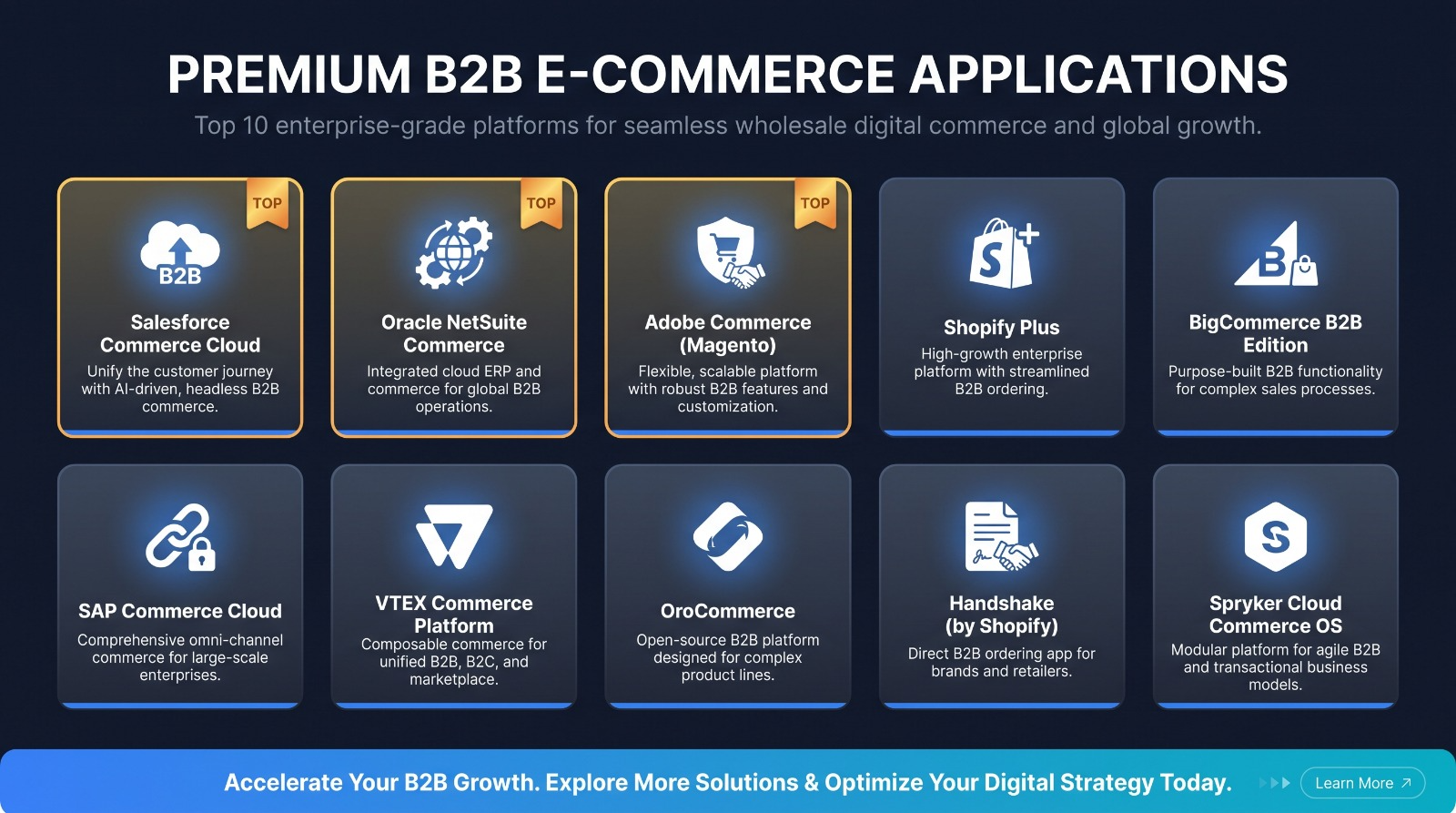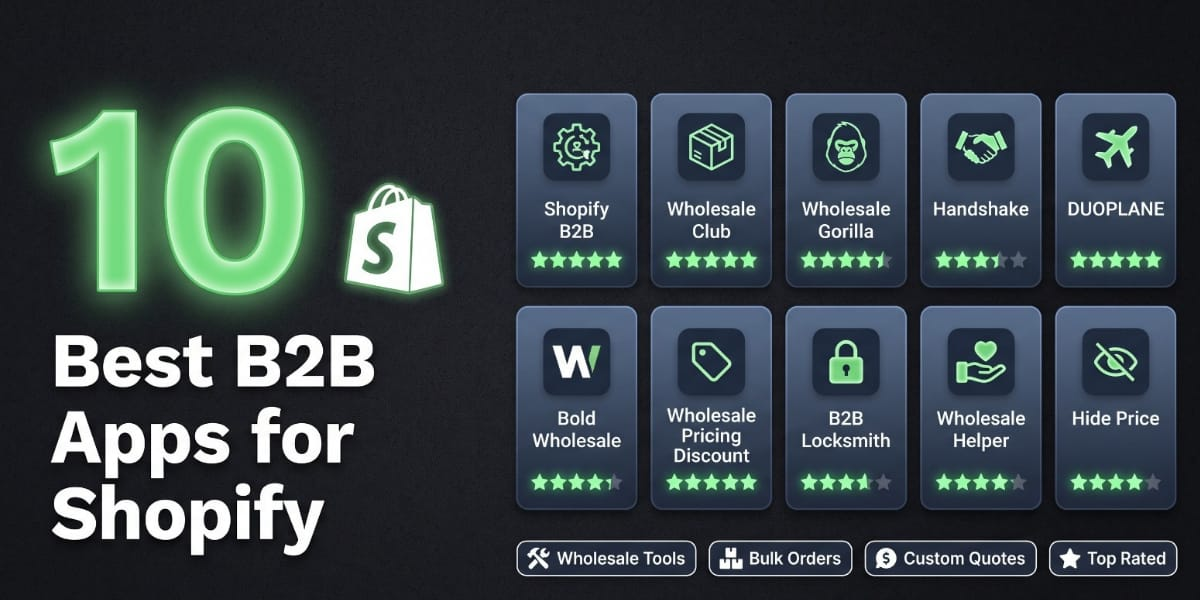
10 Best B2B Apps for Shopify
You sent over a graphic listing ten specific B2B apps for Shopify, so let’s go through exactly those ten, one by one, and then talk honestly about which one deserves your time and money. This list mixes native Shopify tools, well established wholesale apps, and a few more specialized ones, so the “best” answer really depends on what you’re trying to fix.
1. Shopify B2B (Native)
This is Shopify’s own built in wholesale system, and it’s the natural starting point for almost every merchant. It gives you company profiles for your wholesale buyers, custom price lists, catalogs, quantity rules, and net payment terms, all managed from the same admin panel you already use for your regular store.
Here’s something worth knowing that changed recently: as of April 2, 2026, Shopify rolled these native B2B features out to every paid plan, not just Shopify Plus, including company profiles, up to three custom catalogs with their own pricing, volume discounts, and basic payment terms. Shopify Plus still goes further with unlimited pricing catalogs, direct catalog assignment, partial payments and deposits, and deeper customization through Shopify Functions and Checkout Extensibility.
The catch is that native B2B has real limits. There’s no self-service registration form for new wholesale buyers, no way to enforce minimum order quantities or pack sizes at checkout without custom development, no tag based or per customer pricing beyond what a catalog offers, and no cart level discounts.
Best for: any merchant just starting to formalize wholesale, since it costs nothing beyond your existing plan.
2. B2Bridge B2B Wholesale Pricing
B2Bridge is a strong pick for Shopify merchants looking to scale their wholesale or B2B operations with an enterprise-level experience. The app offers customer-specific pricing, including B2B price per variant, wholesale discounts, tiered pricing, and VAT dual pricing, so every B2B customer sees rates tailored to their account or customer group.
It also comes with a dedicated B2B sales rep portal and a company account portal, allowing sales reps to place orders on behalf of assigned customers, while companies can invite team members and manage their own accounts. On the checkout side, B2Bridge supports net payment terms (net30, net60) and credit limits, both essential for wholesale buyers.
For bulk ordering, the app provides a quick order page along with CSV upload support, letting merchants process large orders in minutes. Store owners can also generate quotes and convert them into PDF invoices for record-keeping.
What makes B2Bridge stand out is its deep integration with Shopify POS, Markets, and Translate, plus API access for connecting with ERP/CRM systems. It works on any Shopify plan and offers a free plan to start, making it a solid choice for both small and growing wholesale businesses alike.
3. Wholesale Gorilla
Wholesale Gorilla is built around the idea that wholesale buyers expect a proper business buying experience, not a retail checkout with a discount tag slapped on. It covers advanced pricing structures like pack pricing, tiered discounts, and customer specific rates, plus net checkout so buyers can order now and pay later, a branded quick order form, and a dedicated wholesale buyer portal.
It’s frequently mentioned alongside Sami B2B and SparkLayer as one of the stronger options for merchants who specifically want to upgrade the buyer facing side of their wholesale channel rather than just the backend pricing logic.
Best for: merchants who want their wholesale buyers to actually enjoy using the ordering system instead of tolerating it.
4. Handshake
This one needs an honest flag rather than a recommendation. Handshake was Shopify’s own wholesale marketplace, originally acquired by Shopify in 2019 and relaunched in 2020 as a curated directory connecting independent brands with retail buyers. It reported tens of thousands of retailers at its peak, but it was US-only and never reached the scale Shopify wanted.
In 2023, Shopify made a strategic investment in Faire, the dominant independent wholesale marketplace, and shortly after, Handshake was phased out entirely. The app may technically still appear in some listings, but it’s no longer accepting new brands or orders, and Shopify has since pointed merchants toward Faire instead.
Best for: nobody, at this point. If you’re looking for a wholesale marketplace to discover new retail buyers rather than manage your existing wholesale accounts, Faire is the actual current option to look at instead.
5. Duoplane
Duoplane is a bit different from the rest of this list. It’s not really a pricing or storefront app, it’s an order routing and multi vendor management tool. If you dropship products from multiple vendors or warehouses, Duoplane automates sending purchase orders to each supplier in whatever format they need, whether that’s CSV, XML, EDI, or JSON, and it also handles shipment tracking imports, inventory syncing, and vendor invoicing.
This makes it more relevant to the supply and fulfillment side of a B2B operation than the buyer-facing pricing side. If part of your B2B challenge is managing orders across multiple suppliers or 3PL warehouses, Duoplane solves that specific operational headache.
Best for: merchants juggling multiple vendors or dropship suppliers, not merchants looking for wholesale storefront pricing.
6. Bold Wholesale
Bold Wholesale (part of Bold’s suite of Shopify apps) is generally positioned around applying automatic wholesale pricing to approved customers, letting you set percentage or fixed discounts and control which products or collections those discounts apply to. It’s a functional, no-frills way to get tiered pricing running without building a whole separate wholesale channel.
Best for: merchants who mainly need automatic tiered pricing applied to tagged customers, without needing a full buyer portal.
7. Wholesale Pricing Discount
Apps in this category focus specifically on the pricing mechanics of wholesale selling, applying percentage based or fixed price discounts at the product, collection, or storewide level, often with quantity break support built in natively. These apps tend to be lighter weight than full platforms like Wholesale Gorilla, which makes them appealing if pricing logic is genuinely your only pain point.
Best for: merchants who already have a buyer portal or ordering flow sorted and just need flexible discount rules layered on top.
8. B2B Locksmith
Apps in this “locksmith” category do one specific job: they restrict storefront access so only approved customers can see prices or add items to their cart. This is ideal if you’re running a private wholesale catalog alongside a public retail store and you don’t want casual visitors seeing wholesale pricing at all.
It’s important to be clear that this kind of app isn’t a full wholesale solution by itself. It’s an access control layer, not a pricing or ordering system, so it works best paired with something that actually handles your pricing logic.
Best for: merchants who need to keep wholesale pricing completely hidden from the public and already have pricing handled elsewhere.
9. Wholesale Helper
Apps positioned as general “helper” tools for wholesale usually round out gaps left by bigger platforms, things like simplifying registration forms, adding quick reorder options, or supporting basic quantity rules without a huge feature set attached. These tend to be lighter, more affordable options for merchants who don’t need an enterprise level wholesale platform.
Best for: smaller wholesale operations that need a few specific features without paying for a full B2B suite.
10. Hide Price
This type of app does exactly what it says: it hides pricing and “add to cart” buttons from customers who aren’t logged in or approved, usually replacing them with a “request access” or “contact us” prompt instead. It’s a popular, low cost way to gate your wholesale catalog from public view without building out full B2B infrastructure.
Best for: merchants in the very early stages of testing a wholesale channel who just need pricing hidden from the general public.
So Which One Is Actually the Best?
Here’s the honest answer: out of this specific list, Shopify B2B (native) is the best starting point for almost everyone, simply because it’s now free on every paid plan and covers company accounts, custom catalogs, pricing, and payment terms without adding another app or subscription to your stack. There’s no reason to pay for a third-party app to duplicate something Shopify already gives you.
Once you outgrow native B2B, meaning you need a self service registration form, more than three price tiers, quantity rules enforced at checkout, or a genuinely polished buyer portal, Wholesale Gorilla is the strongest option from this list to layer on top. It’s specifically built around the buyer experience, which is usually the thing that determines whether your wholesale clients actually adopt the system or keep falling back on WhatsApp and phone calls.
Wholesale Club is a perfectly reasonable middle ground choice if you want something simpler and cheaper than Wholesale Gorilla but still more capable than native B2B alone.
Duoplane deserves a mention on its own terms. If your actual bottleneck isn’t pricing or checkout but managing orders across multiple vendors or warehouses, it solves a completely different problem than the rest of the list and is worth adding regardless of which pricing app you choose.
And Handshake, to be direct about it, isn’t a real option anymore. If discovery and finding new wholesale buyers is what you’re actually after rather than managing your existing accounts, Faire is the platform that replaced it.
What This Means If You’re Running a Pakistani Ecommerce Store
If most of your wholesale buyers are local shops, boutiques, or resellers you already know personally, starting with native Shopify B2B makes even more sense. Your PKR pricing works fine inside catalogs, your existing local courier setup can extend to wholesale shipments, and the net payment terms feature lines up naturally with the trust-based credit arrangements that are already common in local wholesale relationships. You’re not replacing an existing system, you’re just giving that same relationship a proper digital home.
If you’re actively trying to formalize and scale that wholesale channel to dozens of accounts across the country, that’s the point where adding an app like Wholesale Gorilla for the buyer portal, or Duoplane if you’re routing orders across multiple suppliers, starts to genuinely pay for itself.
A Word on Testing Before You Commit
Whatever combination you land on, sign up as a test wholesale customer on your own store before rolling anything out to real buyers. Place a test order, try a reorder, and check that your minimum quantities and payment terms behave exactly the way you expect. It’s far easier to catch a pricing mistake during testing than after a real client has already placed an order at the wrong price.
Final Thoughts
Out of the ten apps in your list, the real answer isn’t a single “best” app, it’s a stack: start with Shopify B2B natively since it’s now free on every plan, add Wholesale Gorilla or Wholesale Club once you need a better buyer experience, bring in Duoplane specifically if multi-vendor order routing is your bottleneck, and skip Handshake entirely since it’s no longer active.
If you want help figuring out exactly which combination makes sense for your specific wholesale buyers, catalogs, and pricing structure, that’s exactly the kind of planning TheScriptFlow can walk through with you from the ground up.