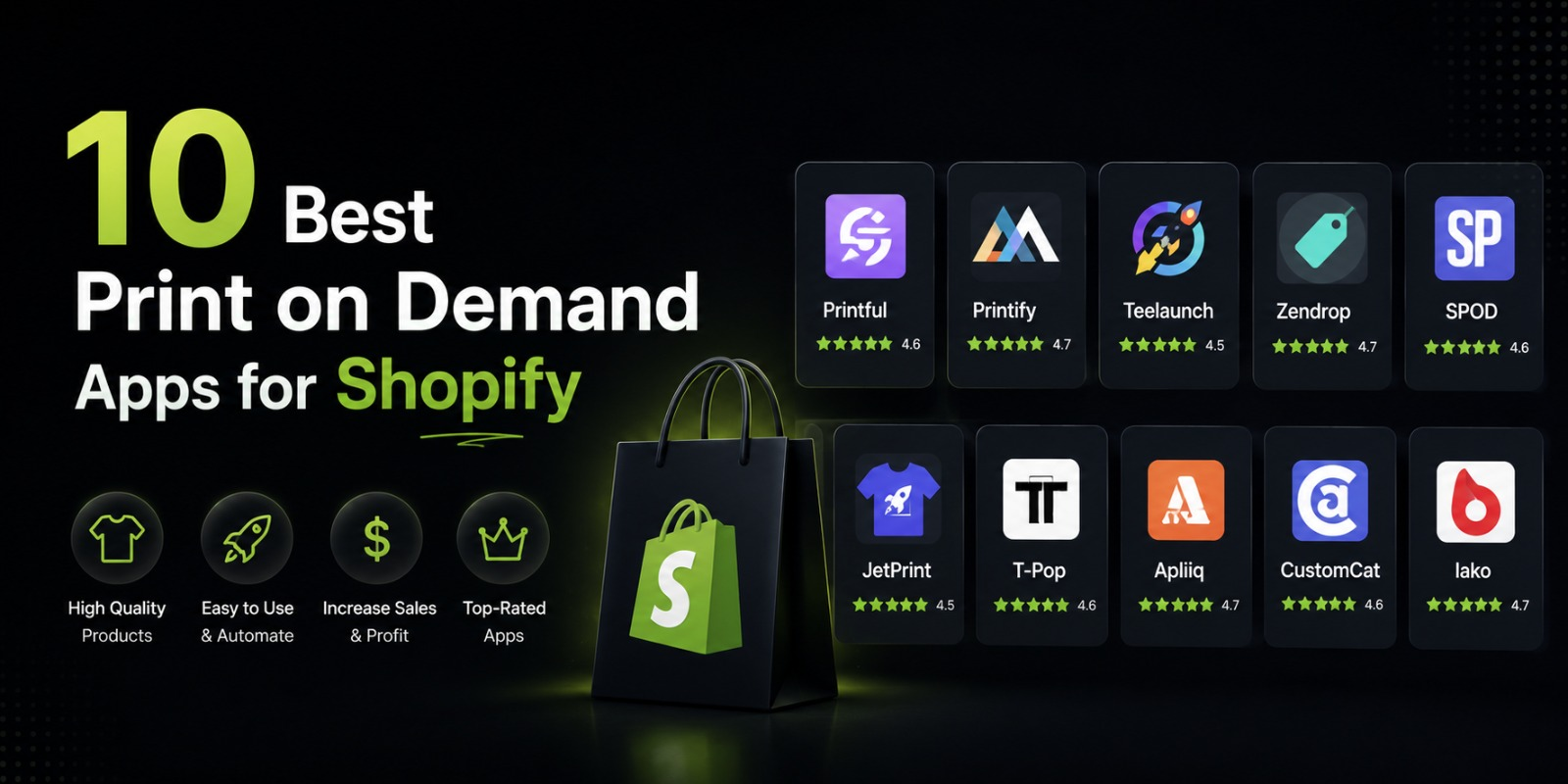
10 Best Print on Demand Apps for Shopify
The Only POD App Comparison You Need Before Connecting Your Store
Choosing the right print on demand app for your Shopify store is one of the most important decisions you will make as a POD seller. The app you connect determines the quality of your products, how fast orders get fulfilled, what your margins look like, and ultimately how your customers feel after receiving their order.
The problem is there are a lot of options out there and most comparison articles just list features without telling you what actually matters for a real store doing real volume. This guide is different. We are going to walk through the ten best print on demand apps for Shopify in plain language, covering what each one is good at, where it falls short, who it is best suited for, and what you should know before connecting it to your store.
Whether you are just setting up your first POD store or you are already selling and thinking about switching suppliers, this guide will help you make a confident decision.
What to Look for in a Print on Demand App
Before getting into the list, it helps to know what criteria actually matter when evaluating a POD app. Here is what separates a good POD partner from a frustrating one.
Product quality is the foundation. Everything else can be optimized over time but if the products coming out of your supplier look bad or feel cheap, your customers will not come back and your reviews will suffer.
Fulfillment speed matters more than most beginners expect. Customers today are used to fast shipping. A POD supplier that takes two weeks to fulfill an order before it even ships is going to generate a lot of customer service headaches.
Pricing and margins determine whether your store is actually profitable. Cheap supplier prices give you more room to be competitive or earn more per sale. High supplier prices mean thinner margins and harder decisions at checkout.
Product catalog breadth tells you how much you can grow within the platform. A supplier with fifty products limits what you can build. A supplier with five hundred gives you room to expand as your store evolves.
Shopify integration quality affects your daily workflow. A clunky app that is hard to use, slow to sync, or prone to errors adds friction to everything you do. A smooth, well-built integration makes running your store significantly easier.
Print locations and shipping coverage determine how well you can serve your audience. A supplier that only ships from one country in the US will be expensive for international customers. One with facilities across multiple continents can keep shipping times and costs under control globally.
With those criteria in mind, here are the ten best print on demand apps for Shopify right now.
1. Printful
Printful is the most widely used print on demand app in the Shopify ecosystem and for most beginners, it is the default recommendation for good reason.
Printful operates its own production facilities in the United States, Europe, Mexico, and Latvia. Because they control the production process themselves rather than working through third party printers, quality is more consistent compared to suppliers that use a network model. What you get in your sample order is what your customers will receive, which matters a lot for building trust in your brand.
The product catalog on Printful is extensive. They offer apparel including t shirts, hoodies, sweatshirts, leggings, and hats, as well as accessories, home and living items, wall art, and more. They also offer embroidery on select products which opens up a more premium product line for stores that want to position above the typical POD market.
The Shopify integration is one of the smoothest in the category. Products sync automatically, orders are pushed to Printful the moment they are placed, and tracking information is sent back to Shopify and the customer without you having to do anything manually.
The main trade off with Printful is price. Their products cost more than many alternatives, which means your margins are thinner unless you price at the higher end of your market. For stores in competitive niches where price sensitivity is high, this can be a real challenge. For stores targeting customers who are buying based on design and brand rather than price, it is much less of an issue.
Printful also has a free plan with no monthly fee. You only pay for the products you order when customers buy. They offer a premium membership that gives you a discount on product costs if your volume is high enough to make it worthwhile.
Best for: Beginners who want reliable quality and a smooth setup. Stores positioning at a premium price point. Sellers who want embroidery options.
2. Printify
Printify takes a fundamentally different approach from Printful. Instead of owning production facilities, Printify acts as a marketplace connecting you with a global network of independent print providers. When you create a product on Printify, you choose which provider in their network will fulfill it.
This model has one major advantage and one significant trade off.
The advantage is price. Because there is competition among providers in the Printify network and because some providers have lower overhead than Printify’s own facilities, you can often find significantly lower product costs on Printify compared to Printful. This translates directly into better margins, which gives you more pricing flexibility and more profit per sale.
The trade off is quality consistency. Since different providers have different equipment, processes, and standards, the quality of your products can vary depending on which provider you choose and even between batches from the same provider. This is manageable but it means you need to be more careful. Always order samples from any provider you plan to use before making them your primary fulfillment partner.
Printify has a very large product catalog in some categories, the largest of any POD platform. They also have a free plan and a paid Premium plan that gives you a discount on all product costs, which becomes very attractive once your store is doing consistent volume.
The Shopify integration works well. Products sync reliably and orders flow through without major issues in most cases.
Best for: Sellers who want to maximize margins. Stores that are price-sensitive in their niche. Sellers willing to do the research to find the best providers in the network.
3. Gelato
Gelato has emerged as one of the most interesting POD platforms in recent years, built around a concept that makes a lot of practical sense. Instead of shipping every order from a central facility, Gelato connects you with local printing partners in over thirty countries. When a customer places an order, it gets fulfilled by a partner close to them geographically.
The result is faster shipping at lower shipping costs, which is a genuine competitive advantage especially for stores with an international customer base. A customer in Germany ordering from your store gets their product printed and shipped in Germany rather than waiting for it to arrive from a US facility. That difference can mean three days instead of three weeks.
Gelato’s product catalog has grown significantly over the past few years and now covers apparel, wall art, phone cases, mugs, bags, and stationery among other categories. Quality has improved consistently and is now competitive with the major players for most product types.
The platform is also well designed and the Shopify integration is reliable. Their pricing is competitive, especially when you factor in shipping costs, which are often lower than alternatives due to the local fulfillment model.
One area where Gelato still lags slightly is in the breadth of apparel options compared to Printful or Printify. But for stores that sell a mix of product types and serve a global audience, Gelato is a genuinely strong choice.
Best for: Stores with global audiences. Sellers where shipping speed is a competitive priority. Those who sell wall art, cards, and non-apparel POD products heavily.
4. SPOD
SPOD, which stands for Spreadshirt Print on Demand, is owned by the Spreadshirt group and is built around one core proposition speed. Their average fulfillment time is claimed to be under 48 hours, which is faster than almost any other major POD supplier.
For customers who have been trained by Amazon to expect fast delivery, that fulfillment speed is a real selling point. It lets you market delivery times that feel comparable to non-POD retailers, which is a significant trust builder.
SPOD’s product catalog is more limited than Printful or Printify. They focus primarily on apparel t shirts, hoodies, tanks, and a smaller selection of accessories. If your store is built around a varied product mix, SPOD alone will not cover everything you need.
Their pricing is competitive and their print quality is solid, particularly for direct to garment printing on apparel. They also have a design tool built into their app that can be useful for quick product creation.
SPOD is not the best standalone choice for most stores due to the catalog limitations, but it is worth considering as a secondary supplier paired with a platform that has better catalog breadth.
Best for: Apparel focused stores where speed is a key differentiator. Sellers who want to offer faster delivery as a competitive advantage.
5. Gooten
Gooten operates similarly to Printify in that it connects you with a network of manufacturing partners rather than operating its own facilities. It has been around since 2012, making it one of the more established players in the POD space.
Where Gooten stands out is in its product variety. They have one of the most diverse catalogs in POD, covering categories like apparel, home decor, pet products, baby items, phone cases, wall art, and several niche product types you will not find on every platform. If you want to build a store around unique product types, Gooten is worth exploring seriously.
Gooten also positions itself as a strong option for stores doing higher volume and wanting more control over the fulfillment process. They have API access and more advanced routing options which makes them a solid choice for stores that have grown past the basic plug and play setup.
The trade off is that Gooten is slightly less beginner friendly than Printful or Printify. The interface is functional but not as polished, and getting the most out of the platform takes a bit more learning.
Their Shopify integration is reliable and order routing is generally smooth once set up correctly.
Best for: Stores with diverse product needs. Higher volume sellers who want more fulfillment control. Sellers looking for unique or niche product types.
6. Apliiq
Apliiq is the print on demand app to consider if you want to build something that feels like a real streetwear or fashion brand rather than a generic POD store. They specialize in premium apparel with options that most other POD platforms simply do not offer.
Their differentiating features include private label options, where you can add your own woven labels to garments rather than the blank manufacturer label. They also offer fabric patches, pocket printing, lining customization, and other details that elevate a product from looking like a POD item to looking like something from an actual clothing brand.
The pricing is higher than standard POD suppliers, which reflects the additional work that goes into these products. But the premium positioning justifies higher retail prices, which can mean better margins despite the higher supplier cost.
Apliiq’s catalog is more focused on apparel and does not have the breadth of a Printful or Gooten. But within apparel, the quality and customization options are among the best in the POD space.
The Shopify integration works well for their core product line.
Best for: Fashion forward brands that want premium product options. Sellers building a real clothing brand identity. Stores willing to invest more per product for better brand presentation.
7. Teelaunch
Teelaunch is a solid mid tier POD option that covers a good range of products at competitive prices with reliable quality. It is not the flashiest platform but it is consistent, which matters when you are running a store at scale.
Their product catalog includes apparel, home and kitchen items, phone cases, jewelry, pet products, and several other categories. One area where Teelaunch stands out is their jewelry and accessory range, which is better than most competing platforms. If your store includes jewelry or custom accessories as part of the product mix, Teelaunch is worth a look specifically for those categories.
Pricing is generally competitive and quality is consistent across their core product range. Their fulfillment times are reasonable, though not as fast as SPOD.
The Shopify integration is straightforward and works reliably. Product creation and syncing are smooth, and order management is handled cleanly through the app.
Teelaunch does not have the same name recognition as Printful or Printify but it has a loyal base of sellers who appreciate the consistency and the product variety in specific categories.
Best for: Stores that want to include jewelry and accessories in their POD lineup. Sellers looking for a reliable alternative to the main platforms. Mid-volume stores wanting good pricing without sacrificing quality.
8. CustomCat
CustomCat is one of the most underrated POD apps in the Shopify ecosystem, particularly for sellers who are focused on apparel and doing meaningful volume.
Their pricing is among the lowest for apparel products in the POD space, which means your margins can be significantly better than with Printful or Printify if you are selling t shirts, hoodies, and similar items at scale. They charge a monthly fee for access to their lowest prices, but for stores doing consistent volume that fee pays for itself quickly.
CustomCat has a large catalog focused primarily on apparel but also covering mugs, phone cases, and a few other product types. Their print quality is good, particularly for direct to garment printing, and fulfillment times are competitive.
The platform is functional but the interface is less polished than newer platforms like Printful. It is worth noting that some sellers have reported the app requires a bit more manual attention to set up correctly compared to the big players.
If you are building an apparel-focused store and you care about maximizing margins at scale, CustomCat deserves a serious look.
Best for: High volume apparel focused stores. Price sensitive sellers who want the best margins on t shirts and hoodies. Sellers comfortable with a slightly steeper setup process.
9. Printbase and ShopBase
Printbase is a POD platform built by the same team behind ShopBase, which is an ecommerce platform popular among drop shippers particularly in markets like Vietnam and parts of South Asia. Printbase integrates with Shopify and offers a straightforward POD fulfillment service with competitive pricing.
Their catalog covers the core POD product types apparel, mugs, phone cases, and home items. Pricing is competitive and quality is reasonable for the price point.
What makes Printbase worth mentioning is that they have done a good job of making the platform accessible for sellers outside of the US and Western Europe, including sellers in Asia and South Asia who may find some of the larger platforms less accommodating for their specific business setup.
For Pakistani sellers in particular, Printbase is worth exploring alongside the main platforms as it tends to be more accessible from a business setup and payment perspective.
The Shopify integration works and order management is handled within the platform.
Best for: Sellers in South Asia and Southeast Asia who want a more accessible platform. Budget conscious sellers looking for competitive pricing on core products.
10. Prodigi
Prodigi rounds out this list as a strong option for sellers focused on wall art, fine art prints, photo products, and premium paper goods. While platforms like Printful and Printify offer wall art as part of a broader catalog, Prodigi specializes in it and the quality difference is noticeable.
They work with professional grade printing facilities and offer products like giclée art prints, framed prints, canvas prints, photo books, and greeting cards at a quality level that appeals to buyers in the art and photography market. If your POD store is built around selling original artwork, photography prints, or design-driven wall art, Prodigi is worth serious consideration.
Their global network of print partners also means competitive shipping times internationally, similar in concept to Gelato’s approach.
Pricing is positioned toward the premium end, which makes sense given the quality level. Margins are workable if you price appropriately for the market you are in.
The Shopify integration is functional and order management is handled reliably through the app.
Best for: Artists, photographers, and designers selling wall art and fine art prints. Stores built around premium paper products and home decor. Sellers who want the best possible quality for printed artwork.
How to Choose the Right App for Your Store
With ten solid options in front of you, the question becomes how to choose. Here is a simple framework to help you decide.
Start with your product focus. If you are primarily selling apparel, Printful, Printify, CustomCat, and SPOD are the strongest options. If you are selling wall art or fine art prints, Gelato and Prodigi are more relevant. If you want a diverse product mix, Printify, Gooten, or Teelaunch give you the most catalog breadth.
Think about your audience location. If your customers are primarily in the US, almost any platform works. If you have a global audience or you are targeting markets in Europe, Gelato’s local fulfillment model becomes very attractive. If you are in Pakistan and selling to Pakistani customers, you will need to factor in international shipping from most suppliers, which affects your price calculation.
Consider your margin requirements. If you are in a price sensitive niche, start with Printify or CustomCat to find lower supplier costs. If quality is more important than price because your brand is positioned as premium, Printful or Apliiq are better fits.
Do not be afraid to use more than one. Many successful POD stores use two or even three suppliers one for apparel, one for wall art, one for accessories. You can connect multiple POD apps to the same Shopify store and route different products through different suppliers.
Always order samples before going live. Every supplier looks good in screenshots and marketing materials. The only way to know what your customers will actually receive is to order samples yourself. Do this before you run any ads or drive significant traffic to your store.
Using Multiple POD Apps on One Shopify Store
It is completely possible to use more than one print on demand app on a single Shopify store and many experienced sellers do exactly this. The way it works is that each product in your store is fulfilled by whichever supplier you assigned it to when you created the listing. Orders for product A go to Printful, orders for product B go to Printify, and so on.
The main thing to be aware of is that if a customer orders products from two different suppliers in one order, they will arrive in separate packages. Most customers are fine with this as long as you are transparent that products may ship separately, but it is something to communicate clearly in your shipping policy.
Managing multiple supplier apps does add some complexity to your store operations, but the benefits better pricing on certain product types, access to products that not every supplier carries, and redundancy if one supplier has a fulfillment issue usually make it worth it for stores past the early stage.
How TheScriptFlow Helps POD Store Owners Get Set Up Right
At TheScriptFlow, we have worked with print on demand sellers at every stage from first time store owners who need a complete setup to established POD brands that want to improve their conversion rate, page speed, or supplier configuration.
We help with everything from Shopify store setup and theme customization to app installation, supplier integration, and overall store performance. If you are setting up a new POD store and want it done properly from day one, or if you have an existing store that is not performing the way it should, we can help.
Visit thescriptflow.com to get in touch with the team and talk about your store.
Final Thoughts
There is no single best print on demand app for every Shopify store. The right choice depends on your niche, your product mix, your target audience’s location, your pricing strategy, and how much you value margin versus quality versus speed.
What the ten apps on this list have in common is that they are all genuinely capable of powering a successful POD store. The difference is in the details — and now that you know what those details are, you are in a much better position to choose the right one for what you are building.
Start with one supplier, order samples, get your first products live, and make decisions from there. The best POD app is ultimately the one that helps you deliver a product your customers are happy to pay for and happy enough with to come back and buy again.