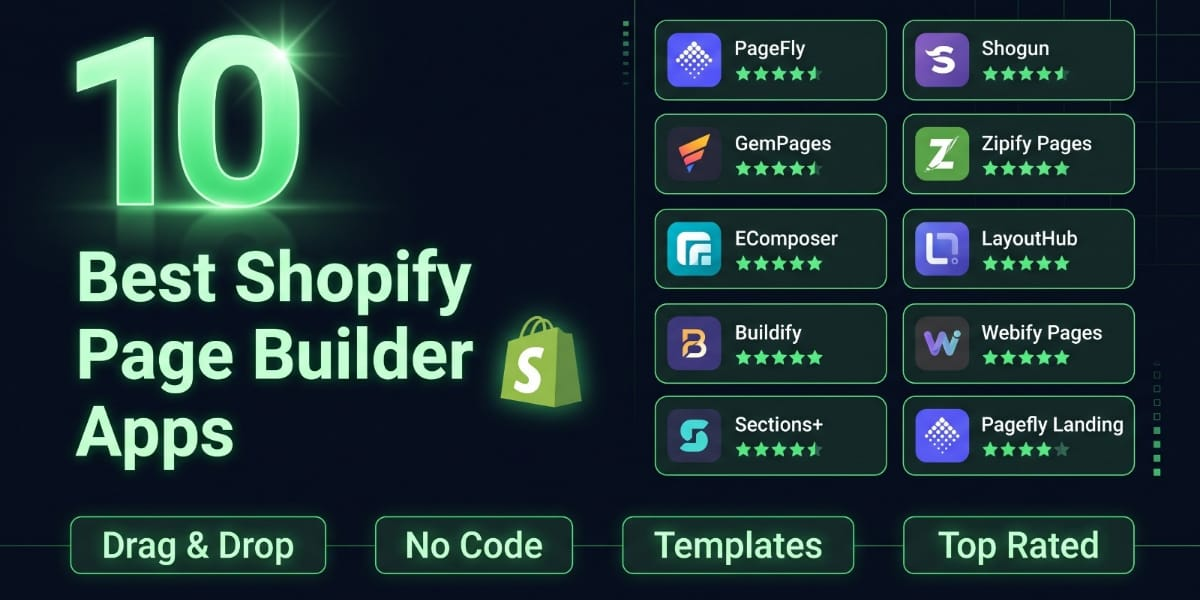
10 Best Shopify Page Builder Apps
If you’ve spent any real time inside Shopify’s default theme editor, you’ve probably run into the same ceiling most merchants eventually hit. You can rearrange sections, swap out images, and tweak some colors, but the moment you want something genuinely custom, a landing page with a completely different layout, a product page built around a specific promotion, a homepage that actually looks like your brand instead of a template, the native editor just doesn’t give you enough room to move.
That’s exactly the gap page builder apps were built to fill. They let you design pages visually, dragging and dropping elements without touching code, while still publishing something that works properly inside your Shopify store. The catch is that the Shopify App Store is absolutely packed with these tools, and they’re not all built the same way. Some prioritize speed and clean code, some are stacked with conversion features, and some are honestly better suited to agencies than solo store owners.
We went through the current landscape of page builder apps to put together this list, based on real feature sets, pricing, and how each app actually performs rather than just marketing claims. Here are ten worth knowing about.
1. PageFly
PageFly has become something of the default recommendation in this category, and for good reason. It’s one of the most reviewed page builder apps on the Shopify App Store, sitting at a very high rating with thousands upon thousands of reviews behind it. What makes PageFly stand out is how balanced it is, it works well for beginners building their first landing page, and it holds up for more advanced users who need finer control over layout and elements.
PageFly gives you a large library of templates, covers pretty much every page type you’d want to build, product pages, collection pages, landing pages, and blog posts, and includes AI powered conversion tools that go beyond simple page building by helping identify where your pages might be losing conversions. It also offers a genuinely usable free plan that publishes one live page, which is a good way to test the editor before committing.
If you only try one page builder on this list, PageFly is a safe place to start.
2. Shogun
Shogun has been around the Shopify ecosystem for a long time and has built a reputation as a solid choice for businesses ranging from small stores all the way up to large enterprise brands and agencies. Its drag and drop editor is straightforward, and it comes with a solid template library covering homepages, landing pages, blogs, and product pages.
Where Shogun tends to shine is in its advanced analytics and testing tools, including multivariate testing on higher tier plans, which lets you test more than just two page variations at once. This makes it a strong pick for data driven teams that want to make decisions based on real performance numbers rather than just gut feeling.
The tradeoff is that Shogun’s more advanced features live behind premium pricing, so it tends to make the most sense for stores with a bit more budget to work with or agencies managing multiple client builds.
3. GemPages
GemPages is another heavyweight in this space, and it’s particularly strong for merchants who want more than just a page builder. Alongside its drag-and-drop editor and large template library, GemPages bundles in AI content generation and a funnel builder, which means you’re getting features that would normally require two or three separate apps rolled into one subscription.
One of its standout features is Image to Layout, an AI tool that takes an uploaded image and turns it into an editable, customizable section, which can be a huge time saver if you already have a design reference in mind. The one thing worth knowing going in is that GemPages isn’t built natively inside Shopify’s own editor, so you’ll be doing your page design on a separate platform before publishing it back to your store.
GemPages tends to work especially well for medium sized stores that want a large template selection along with conversion-focused tools baked in.
4. Zipify Pages
Zipify Pages is particularly popular among stores that are heavily focused on funnel style selling and upsell strategies. It’s built with conversion rate optimization at its core, and it’s one of the few page builders on the market that offers built-in A/B testing, though this feature is generally reserved for its higher tier Plus plan.
If your store relies on structured sales funnels, post purchase upsells, or highly optimized checkout flows, Zipify’s feature set leans specifically toward that kind of strategic page building rather than general purpose design. It’s also worth knowing that Zipify tends to be more affordable than some of its direct competitors when it comes to publishing a larger number of pages.
5. EComposer
EComposer has built a strong reputation as one of the more beginner friendly page builders available, largely because its editor doesn’t feel that different from Shopify’s own native customizer. If you’ve used Shopify’s built in editor before, EComposer’s drag and drop interface will feel familiar almost immediately.
It comes packed with over a hundred templates and a wide range of built in extensions like swatches, cross selling widgets, and an Ajax cart, meaning you can skip installing several smaller apps that would normally handle those features separately. EComposer also includes an SEO audit tool and an AI content generator, which is handy if you’re building a lot of pages and want some help with the copy along the way.
For newer store owners who want an approachable builder without a steep learning curve, EComposer is one of the strongest free plan options out there.
6. LayoutHub
LayoutHub is built around speed and simplicity, offering a library of professionally designed layouts that you can select and customize quickly rather than building everything from a blank canvas. It’s aimed at store owners who want to get a polished looking page live fast without spending hours designing from scratch.
Alongside its layout library, LayoutHub emphasizes performance, aiming to keep the code it generates lightweight so it doesn’t drag down your site speed, and it offers round the clock customer support, which is useful if you run into issues outside normal business hours.
For store owners who want expert designed layouts without a steep learning curve, LayoutHub is worth a look.
7. Buildify
Buildify is a solid, budget friendly drag and drop builder that covers all the essential page types, homepages, landing pages, collections, and product pages, using pre made templates and widgets like media blocks, icons, buttons, and social elements. It’s built to be approachable for merchants with zero design or coding background, and its editor keeps things simple without overwhelming you with options you’ll never use.
Buildify also offers multilingual support and SEO friendly page structures, which makes it a reasonable pick for stores expanding into international markets on a tighter budget. As with any smaller app, it’s worth testing thoroughly on a duplicate theme before relying on it for your live store, since like most page builders it makes direct changes to your theme files.
8. Foxify
Foxify takes a slightly different approach compared to most builders on this list, using a free-form canvas editor rather than a rigid row-and-column layout. If you’ve ever felt boxed in by traditional page builder structures, Foxify’s canvas style gives you more freedom over exact positioning and layout.
Its AI layout generator is a genuinely useful feature, where instead of manually browsing a template library, you can describe what you want and let the AI generate a full page layout as a starting point. Foxify also bundles in conversion tools like quick view popups, color swatches, and cross-sell widgets, similar to EComposer’s approach of reducing how many separate apps you need installed. It’s also known for being one of the more budget-friendly options in this category, with paid plans starting quite low.
9. Beae
Beae has carved out a niche as one of the cleanest, most affordable paid page builders available, while still maintaining a high rating from users. If your priority is a solid, reliable drag-and-drop experience without needing AI content tools or built-in A/B testing, Beae covers the fundamentals well without overwhelming you with extra features you might not use.
It’s a good option for store owners who want something dependable and easy to learn, particularly if budget is a bigger consideration than having every advanced feature under the sun.
10. Section Store
Section Store takes a different approach from most of the apps on this list, it’s not a standalone page builder with its own separate editor, but a huge library of plug-and-play sections that install directly into Shopify’s native theme editor. Instead of learning a new interface, you’re adding professionally designed sections, banners, carousels, testimonials, countdowns, and more, directly into the editor you already know.
This approach tends to be lighter on page speed since you’re not layering an entirely separate builder’s code on top of your theme, and it’s a great option if you like your current theme’s foundation but want a bigger library of ready-made sections to build out landing pages and product pages faster.
How to Actually Choose Between These Apps
With this many solid options, the right choice really comes down to what your store actually needs rather than picking whichever app has the flashiest feature list. If you’re just getting started and want something approachable with a genuinely useful free plan, PageFly or EComposer are both excellent starting points. If you want AI-assisted design and a funnel builder bundled together, GemPages is worth the investment. If your store leans heavily on upsell funnels, Zipify Pages is purpose-built for that. And if you’d rather stay inside Shopify’s native editor entirely, Section Store is worth a look before you commit to a full separate builder.
It’s also worth thinking about how many pages you actually plan to build. Some of these apps price based on the number of published pages, which can get expensive fast if you’re building a large content library or running frequent seasonal campaigns. Always check the current pricing tiers directly on the Shopify App Store before committing, since these plans and prices tend to shift over time as apps get updated.
A Note for Pakistani Shopify Merchants
If you’re running a Shopify store from Pakistan, especially one where a large chunk of your traffic is coming through mobile devices on inconsistent network connections, page speed deserves extra weight in your decision. A page builder that looks great but loads slowly on a budget Android phone with a weak 4G signal is going to cost you sales, no matter how nice the design is.
It’s worth actually testing a builder’s output speed before committing long term, most of these apps offer free plans or trials specifically so you can check this yourself. Pairing a well-optimized page builder with good image compression practices and a clean, lightweight theme will make a real difference for customers browsing your store from anywhere in Pakistan, not just major cities with strong connectivity.
Wrapping It Up
Page builder apps have genuinely changed what’s possible for Shopify store owners who don’t want to touch code every time they need a new landing page or a redesigned product page. Whether you go with a widely trusted all-rounder like PageFly, a feature packed option like GemPages, or something more specialized like Zipify Pages or Section Store depending on your store’s specific priorities, the right builder can save you an enormous amount of time and give your store a much more polished, professional feel.
If you’d rather skip the trial and error of testing apps yourself, or if you want a custom-built theme and page structure that doesn’t rely on a third party app at all, that’s exactly the kind of work we help with at TheScriptFlow. We work with Shopify store owners across Pakistan and internationally to build fast, well structured storefronts, whether that means recommending and setting up the right page builder for your needs or building something fully custom from the ground up.