10 Best Shopify SEO Apps to Boost Your Rankings
Let’s be real for a second.
SEO on Shopify is not something you can fully handle just by tweaking a few product titles and hoping for the best. There’s a lot going on under the surface technical issues, missing meta tags, broken links, slow page speeds, duplicate content, schema markup, image optimization and keeping track of all of it manually while also trying to actually run your business is genuinely overwhelming.
That’s exactly why SEO apps exist.
The right SEO app can automate a huge chunk of the work, catch problems you’d never find on your own, and make sure your store is consistently optimized without you having to become an SEO expert overnight. Some apps focus on one specific area really well. Others take a broader approach and cover multiple aspects of SEO in a single dashboard.
But here’s the thing not all Shopify SEO apps are created equal. Some are genuinely powerful tools that will make a real difference to your rankings. Others are dressed up nicely but don’t actually do much. And some are just plain outdated.
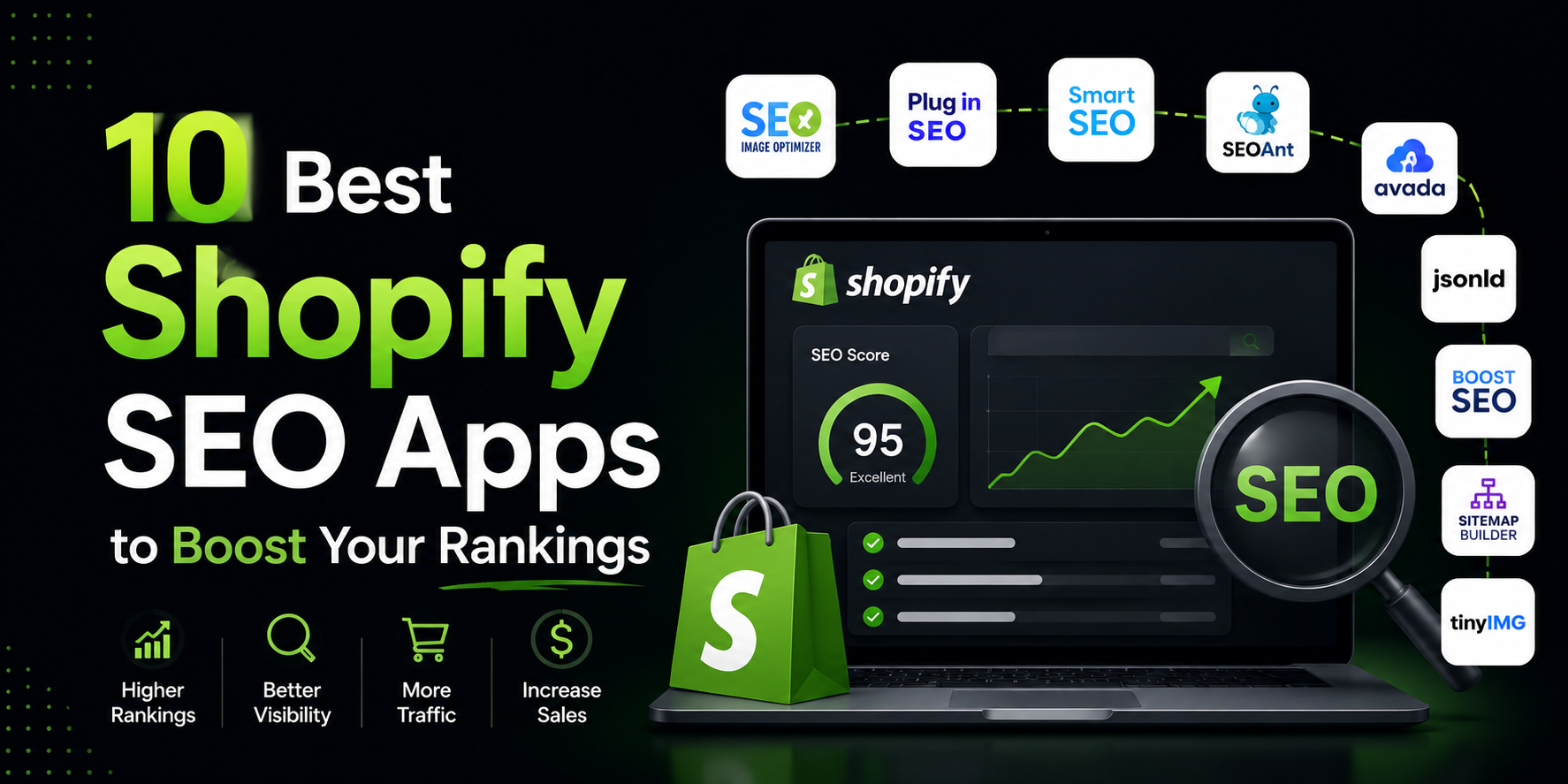
So I went through the options and put together this list of the ten best Shopify SEO apps worth your time and money. For each one I’ll tell you what it does, what it’s best for, and who should consider using it.
Let’s get into it.
1. Plug In SEO
If you’re just getting started with SEO on Shopify and you want a straightforward tool that tells you what’s wrong and what to fix, Plug In SEO is one of the first apps you should look at.
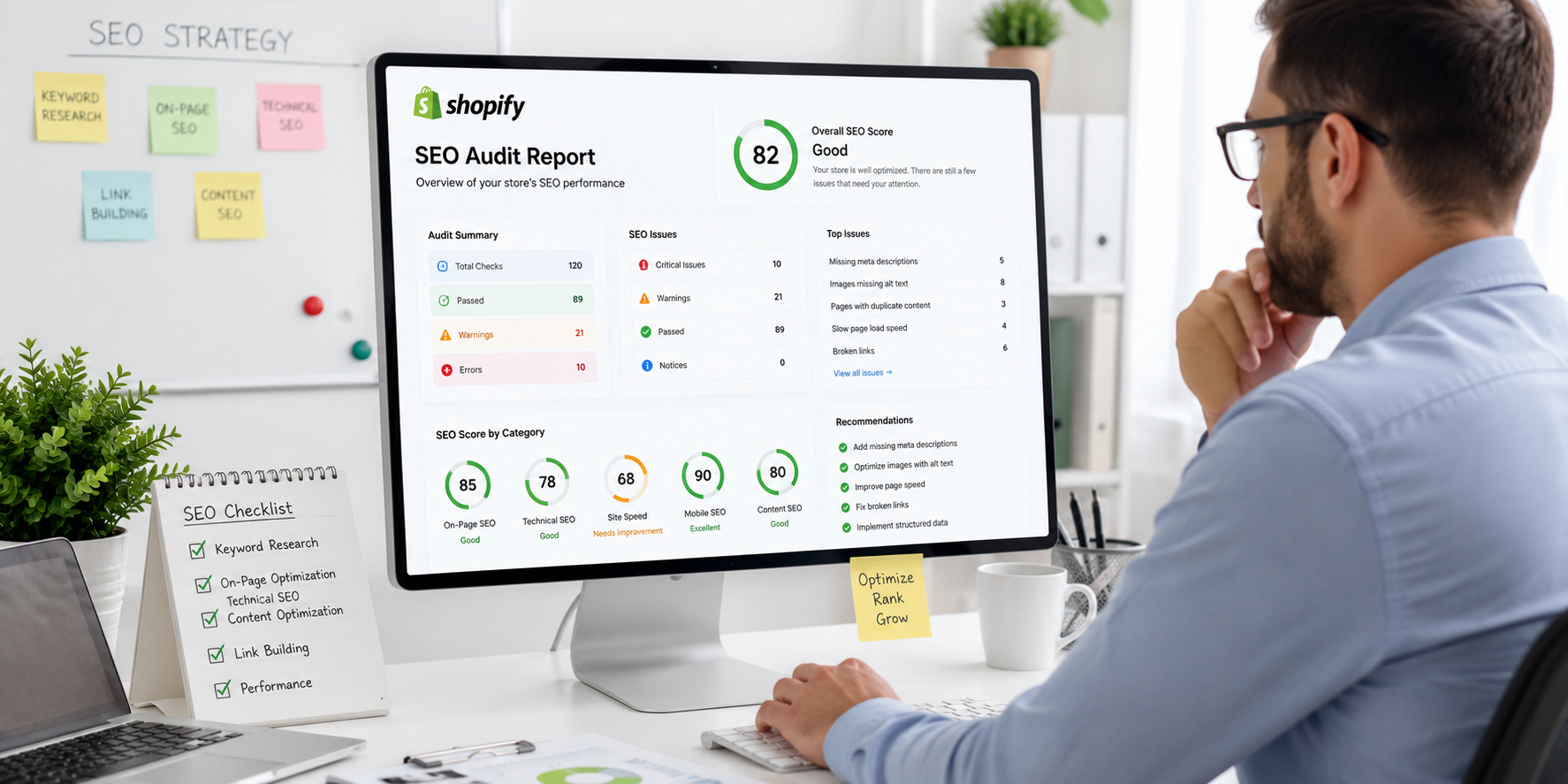
What it does is run a comprehensive audit of your store and give you a clear, prioritized list of SEO issues. It checks things like meta titles and descriptions, heading structure, page speed, broken links, structured data, and more. The dashboard is clean and easy to understand, which makes it a great starting point for store owners who aren’t super technical.
One of the things that makes Plug In SEO particularly useful is that it doesn’t just tell you there’s a problem it tells you how to fix it. For many issues it provides the actual code or copy you need, so you’re not left scratching your head wondering what to do next.
It has a free plan that covers the basic audit functionality, which is great if you want to try it before committing. The paid plan unlocks more detailed features including automated fixes, bulk editing tools, and ongoing monitoring so you get notified when new issues appear.
Plug In SEO is best for newer store owners who want a guided approach to SEO without feeling completely lost, and for stores that want a reliable ongoing monitoring tool to catch issues as they come up.
2. SEO Manager
SEO Manager has been around for a long time in Shopify terms, and it’s built up a strong reputation for being one of the most comprehensive all in one SEO tools on the platform.
What sets SEO Manager apart is the sheer number of things it handles in one place. It covers meta tag management, keyword suggestions, Google Search Console integration, JSONLD schema markup, 404 error detection and redirect management, image alt text optimization, and a lot more. If you want one app that touches as many SEO bases as possible, this is a strong contender.
The keyword suggestion feature is particularly useful. When you’re working on a product page, SEO Manager gives you keyword ideas based on what real people are searching for, and shows you how competitive those keywords are. This helps you make smarter decisions about what to target without having to open a separate keyword research tool.
The Google Search Console integration means you can see your search performance data impressions, clicks, rankings directly within the app dashboard without having to jump back and forth between platforms.
SEO Manager is a paid app with no permanent free tier, but the pricing is reasonable given how much it covers. It’s best suited for store owners who want a centralized SEO hub and are willing to invest in a tool they’ll use regularly and deeply.
3. Smart SEO
Smart SEO takes a slightly different approach from the other apps on this list, and it’s genuinely clever in how it does it.
The core idea behind Smart SEO is automation. Instead of requiring you to manually write meta tags and alt text for every single product, page, and collection on your store, Smart SEO generates them automatically using templates and your existing product data. You set up your templates once, and the app applies them across your entire store.
For stores with large catalogs hundreds or thousands of products this is an absolute game changer. Writing unique meta titles and descriptions for 500 products individually is not something most store owners are ever going to do. Smart SEO makes it realistic.
It also handles structured data, sitemap optimization, and broken link detection. The structured data feature covers product schema, breadcrumb schema, and organization schema, all applied automatically.
The template system does have a learning curve. You need to understand how the variables work to get the templates outputting exactly what you want. But once you’ve got them set up properly, the automation saves an enormous amount of ongoing time.
Smart SEO is best for stores with large product catalogs that need scalable SEO solutions, and for store owners who want to automate as much of the repetitive SEO work as possible.
4. Schema Plus for SEO
If schema markup specifically is your focus and after reading the previous blog in this series, it really should be then Schema Plus for SEO deserves a spot at the very top of your list.
This app is built with one primary purpose: implementing the most complete, accurate, and Google friendly schema markup possible on your Shopify store. It handles product schema, offer schema, breadcrumb schema, organization schema, review schema, and more all following Google’s latest requirements.
What makes Schema Plus stand out from other apps that include schema as one feature among many is the depth and accuracy of its implementation. It’s built specifically around schema, so the team behind it stays on top of every change Google makes to its structured data requirements. When Google updates its guidelines, Schema Plus updates its implementation.
It also works seamlessly with the most popular review apps like Judge.me, Yotpo, and Stamped.io, automatically pulling in your review data so it gets included in your schema markup. This is what enables those star ratings to appear in Google search results.
Schema Plus is a paid app, but for stores that are serious about maximizing their rich results in Google, it’s genuinely worth every penny. It’s best for stores that already have the basics of SEO handled and want to take their search appearance to the next level through properly implemented structured data.
5. TinyIMG Image Optimizer and SEO
Page speed is one of Google’s official ranking factors, and on most Shopify stores, images are the single biggest cause of slow load times. That’s where TinyIMG comes in.
TinyIMG automatically compresses your product images when you upload them, reducing file sizes significantly without any visible loss of quality. This alone can dramatically improve your page load times, especially on mobile, which is where most of your customers are browsing.
But TinyIMG goes beyond just compression. It also handles image alt text optimization, which as we’ve discussed in earlier blogs is important both for your regular search rankings and for Google Image Search. You can set up templates for alt text that automatically apply to new images as you upload them.
It also has a lazy loading feature, which means images only load as the user scrolls down to them rather than all at once when the page first loads. This makes your pages feel faster from the very first second a customer lands on them.
For stores with lots of product images which is basically every Shopify store TinyIMG addresses one of the most impactful technical SEO issues in a very hands-off way. You install it, set your preferences, and it works in the background.
TinyIMG has a free plan that handles a limited number of images per month, with paid plans for larger volumes. It’s best for any store that hasn’t specifically addressed image optimization yet, which honestly is most Shopify stores.
6. SEO Booster
SEO Booster is one of the more beginner friendly apps on this list, designed for store owners who want real SEO improvements without having to understand the technical details behind each one.
It covers the core SEO fundamentals really well meta tag management, keyword optimization, image alt text, structured data, and sitemap management. But what makes it particularly accessible is the way it presents everything. Instead of overwhelming you with a list of technical tasks, it breaks your SEO down into a simple health score and shows you exactly which actions will have the biggest impact on improving that score.
SEO Booster also has a bulk editing feature that lets you update meta titles, descriptions, and alt text across multiple pages at once rather than going one by one. For a store with a decent sized catalog this saves a significant amount of time.
One standout feature is the keyword rank tracking. You can enter the keywords you want to rank for and SEO Booster monitors your position in Google over time, so you can actually see whether your optimization efforts are moving the needle.
There’s a free plan available that covers basic features, with a paid plan for more advanced functionality. SEO Booster is best for store owners who are newer to SEO and want a guided, score based approach that makes it clear what to focus on and why.
7. Avada SEO and Image Optimizer
Avada is one of the most downloaded SEO apps on the Shopify App Store, and it’s not hard to see why. It combines a wide range of SEO features with image optimization in a single, well-designed app at a price point that’s very accessible for smaller stores.
On the SEO side, Avada handles meta tags, structured data, HTML sitemap generation, broken link detection, and redirect management. It also has a page speed optimization feature that goes beyond just images it addresses things like render blocking JavaScript and CSS that can slow down your pages in ways that are harder to notice but genuinely impact your rankings.
The image optimization component works similarly to TinyIMG it compresses images automatically and handles alt text but having it bundled with the broader SEO features means you’re getting more value from a single app rather than paying for two separate ones.
Avada also has a particularly strong Google Search Console integration that surfaces important data about how your pages are performing in search, including which queries are bringing people to your store and which pages have the most impressions versus actual clicks.
There’s a free plan with solid basic features, and the paid plans are reasonably priced. Avada is best for store owners who want a broad SEO toolkit at an affordable price and want to consolidate image optimization and general SEO into one place.
8. Judge.me Product Reviews
Now, you might be looking at this one thinking that’s a review app, not an SEO app. And you’re right that it’s primarily a review app. But I’ve included it on this list because reviews have a more significant impact on your SEO than most people realize, and Judge.me handles the SEO side of reviews better than almost any other review app on Shopify.
Here’s why reviews matter for SEO. First, as we’ve covered in this blog series, customer reviews add fresh, unique content to your product pages automatically. That content often contains the exact phrases and keywords that other customers are searching for.
Second, Judge.me automatically adds review schema markup to your product pages. This is what enables star ratings to appear in Google search results. And Judge.me does this reliably and accurately, which is why it’s compatible with most of the other SEO apps on this list.
Third, the volume of review content that accumulates on a well reviewed product page can help that page rank for long tail keywords it might never have ranked for based on the product description alone.
Judge.me has a free plan that’s genuinely usable, not just a stripped down teaser. The paid plan adds more features for follow up emails, review displays, and cross store review sharing.
Judge.me is best for any store that wants to leverage customer reviews both for social proof and for the meaningful SEO benefits that come from review content and review schema.
9. Ahrefs Shopify App
If you’re already familiar with Ahrefs as a standalone SEO tool one of the most powerful and widely used in the industry you’ll be interested to know they have a Shopify app that brings some of their capabilities directly into your store’s admin panel.
The Ahrefs Shopify app focuses on keyword research and opportunity identification specifically for your store. It analyzes your existing content and tells you which keywords you could realistically rank for, which pages are closest to breaking into the top ten results (these are called “striking distance” keywords and going after them is one of the highest ROI activities in SEO), and where your competitors are ranking that you currently aren’t.
This level of competitive insight is something that simpler SEO apps simply don’t provide. Most apps tell you how to optimize what you already have. Ahrefs tells you what new opportunities you’re missing entirely.
It also provides backlink data for your store, which matters because backlinks other websites linking to your store are one of Google’s most important ranking signals. Knowing which pages on your store have the most backlinks helps you understand where your authority is concentrated and how to build on it.
The Ahrefs app is on the pricier end compared to other Shopify SEO apps, which makes sense given the power of the underlying tool. It’s best suited for more established stores that are ready to go beyond basic optimization and start making data-driven strategic decisions about their SEO.
10. Yoast SEO for Shopify
If you’ve ever run a WordPress website, you’ve almost certainly used Yoast SEO. It’s arguably the most famous SEO plugin in the world. And now it’s available for Shopify too.
Yoast for Shopify brings the same guided, traffic light approach that made the WordPress version so popular. For every product page, blog post, and collection, it gives you a readability score and an SEO score, with specific suggestions for improving both. Green means you’re good. Orange means there’s room for improvement. Red means there’s a real problem that needs fixing.
This real-time feedback as you’re writing and editing content is genuinely useful, especially if you’re not yet confident in your own SEO judgment. It takes the guesswork out of on-page optimization and tells you clearly whether your content is doing what it needs to do from both a search engine and a reader perspective.
Yoast also handles meta tag management, canonical URLs, structured data, and XML sitemaps. The breadth of coverage combined with the user friendly interface makes it one of the more complete options on this list.
The Yoast brand name carries a lot of trust, and the team behind it has decades of SEO expertise baked into how the tool works. The main downside is that it’s a paid app with no free tier, which might put it out of reach for very new stores operating on a tight budget.
Yoast is best for store owners who are already familiar with Yoast from WordPress and want a consistent experience, and for anyone who wants real time content guidance as they write rather than just post publication audits.
How to Choose the Right App for Your Store
Okay, so now you’ve got ten solid options in front of you. How do you decide which one or ones to actually use?
Here’s how I’d think about it.
If you’re brand new to SEO and just getting started, begin with either Plug In SEO or SEO Booster. Both are beginner friendly, both have free tiers, and both will point you toward the most important fixes without overwhelming you.
If you have a large catalog and need scalable solutions, Smart SEO’s automation features are going to save you a huge amount of time compared to any approach that requires manual page by page editing.
If schema markup and rich results are your priority, Schema Plus for SEO is the specialist tool that handles this better than anyone else.
If page speed is your main issue and for many stores it genuinely is TinyIMG is the most focused and effective solution for tackling image related speed problems.
If you want one app that does a solid job across all the main SEO bases at an affordable price, Avada is probably your best all-rounder.
If you’re at a more advanced stage and ready to make data-driven strategic decisions, Ahrefs gives you the kind of competitive intelligence that basic SEO apps simply can’t match.
And whatever else you use, add Judge.me for reviews. The SEO benefits of a good review system are too significant to ignore, and it plays nicely with every other app on this list.
A Word of Warning About App Overload
Before I wrap up, I want to say something important.
Do not install ten SEO apps at once.
I know that might sound obvious, but it’s a trap a lot of store owners fall into. They read a list like this one and think “more apps equals better SEO.” It doesn’t work that way.
Every app you install adds code to your store. Too many apps can actually slow your store down, which hurts your SEO. Apps can also conflict with each other for example, two apps both trying to manage meta tags or schema markup at the same time can create confusion and errors.
Pick one or two apps that address your most pressing SEO needs right now. Get those set up properly, learn how to use them well, and see the results. Then if you need something additional, add another tool.
Quality of implementation beats quantity of tools every single time.
What No App Can Do for You
I also want to be honest about the limits of SEO apps, because no honest conversation about this topic would be complete without it.
Apps can automate tasks, catch technical errors, and make optimization more efficient. But they can’t write genuinely great product descriptions for you. They can’t build backlinks to your store. They can’t create a content strategy. They can’t understand your customers the way you do and translate that into SEO that actually connects with real people.
The best SEO results come from combining good tools with genuine effort. Use the apps to handle the technical and repetitive stuff that’s what they’re for. But invest your own time and creativity in the things that actually require a human touch, like writing original content, understanding what your customers are searching for, and building real connections with other websites in your industry.
Apps are a lever. You still have to pull it.
Final Thoughts
The Shopify App Store has no shortage of SEO tools, and it can feel overwhelming trying to figure out what you actually need. But when you break it down, the fundamentals are simple.
You need something to audit and monitor your store’s technical SEO. You need something to handle meta tags and on page optimization efficiently. You need schema markup implemented correctly. You need your images optimized for speed. And you need customer reviews generating fresh content and enabling rich results.
The ten apps on this list cover all of those bases. Pick the ones that match where your store is right now, use them properly, and combine them with genuine effort on the content side.
Do that consistently and your rankings will improve. Your organic traffic will grow. And your store will start bringing in customers who find you through search not because you paid for every click, but because you built something that Google genuinely wants to show people.
That’s the goal. And the right apps make getting there a whole lot more achievable.