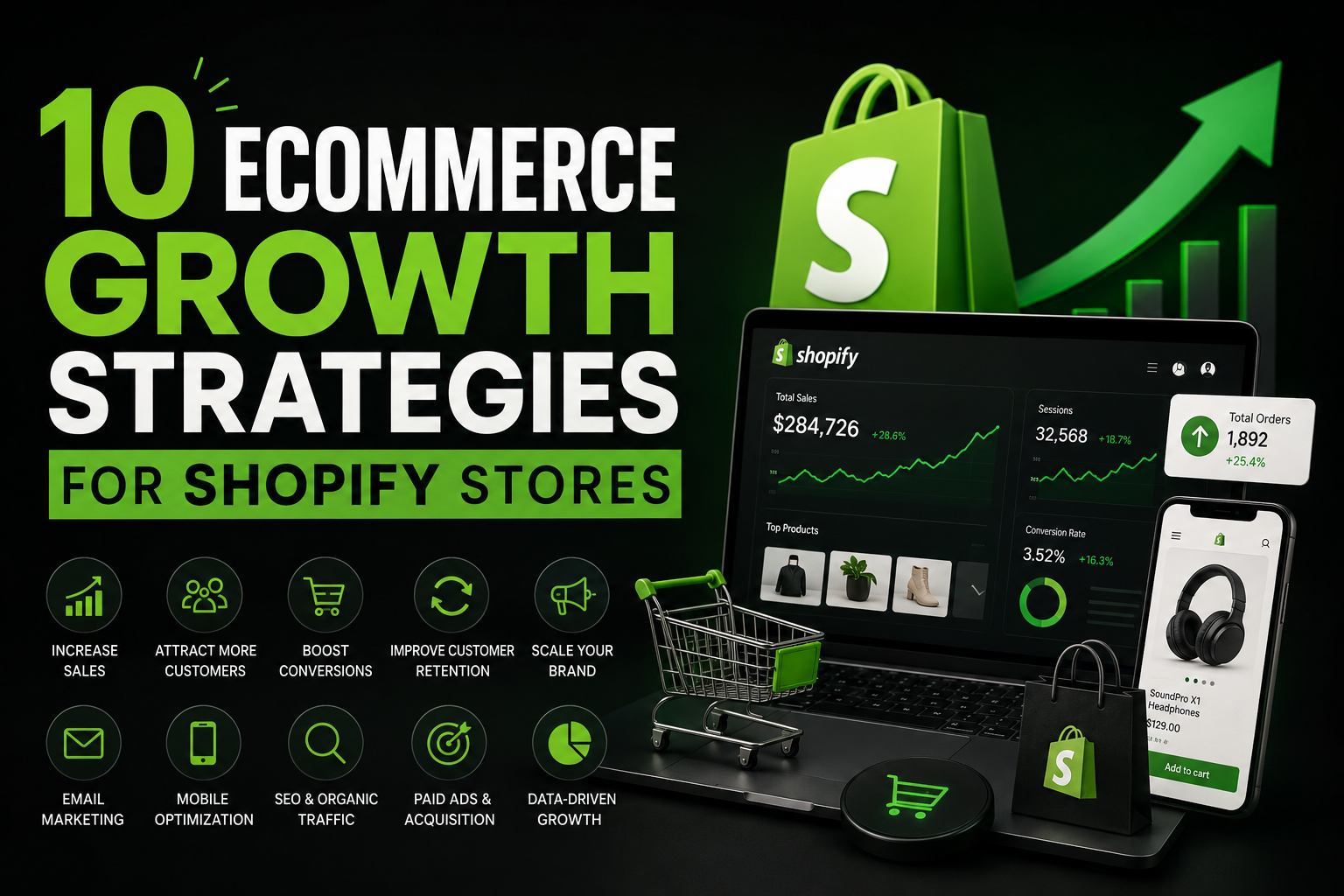
10 eCommerce Growth Strategies for Shopify Stores
INTRODUCTION
Building a Shopify store is the beginning of the journey, not the destination. Once your store is live and you have made your first few sales, the next challenge is growth. How do you go from a few orders a week to a few orders a day? How do you go from a side income to a full time business? How do you build something that keeps growing month after month rather than plateauing and stagnating?
Growth does not happen by accident. It happens because of deliberate, consistent strategies applied over time. The stores that grow from zero to six figures and beyond are not doing anything magical or secret. They are applying proven growth principles with discipline and patience, measuring what works, doubling down on it, and cutting what does not.
This blog covers ten specific ecommerce growth strategies that work for Shopify stores in 2026. These are not theoretical concepts. These are practical, actionable strategies that real store owners are using right now to grow their revenue, their customer base, and their brand. Each strategy is covered in enough depth that you can understand not just what to do but why it works and how to implement it in your own store.
Some of these strategies are about acquiring new customers. Some are about getting more value from existing customers. Some are about improving the efficiency of what you are already doing. The most powerful growth happens when you implement strategies across all three of these areas simultaneously.
STRATEGY NUMBER ONE MASTER YOUR CUSTOMER ACQUISITION COST
Before you can grow profitably, you need to understand your numbers. Specifically, you need to know how much it costs you to acquire each new customer and compare that to how much each customer is worth to your business over time.
Customer acquisition cost, which is commonly called CAC, is the total amount you spend on marketing and advertising divided by the number of new customers that spending generates. If you spend one thousand dollars on Facebook ads in a month and acquire fifty new customers, your CAC is twenty dollars per customer.
Customer lifetime value, commonly called LTV or CLV, is the total revenue a customer generates for your business over the entire time they remain a customer. If the average customer buys from you three times and spends fifty dollars each time, their lifetime value is one hundred and fifty dollars.
The relationship between these two numbers determines whether your business is fundamentally healthy or fundamentally broken. If your CAC is higher than your LTV, you are losing money on every customer you acquire and no amount of scaling will fix that. If your LTV is significantly higher than your CAC, you have a business that can grow profitably.
Most successful ecommerce businesses aim for an LTV to CAC ratio of at least three to one. That means for every dollar spent acquiring a customer, the business gets at least three dollars back over that customer’s lifetime.
Understanding these numbers tells you how aggressively you can afford to spend on customer acquisition. It tells you which marketing channels are profitable and which are not. It tells you whether improving retention or improving acquisition is the higher priority for your specific situation.
Calculate your CAC and LTV for your Shopify store. Look at them honestly. If your LTV to CAC ratio is below three to one, focus on either reducing acquisition costs or increasing lifetime value before scaling your spending.
STRATEGY NUMBER TWO BUILD A RETENTION MACHINE
Most ecommerce businesses focus the majority of their attention and budget on acquiring new customers. This is understandable because new customers feel like growth. But the most capital efficient growth strategy available to any ecommerce business is getting existing customers to buy again.
Repeat customers cost significantly less to sell to than new customers. They already know your brand, they already trust you, and they have already experienced your products and service. The conversion rate for marketing to existing customers is dramatically higher than for cold audiences. And as we discussed in the previous section, increasing customer lifetime value improves your LTV to CAC ratio which makes your entire business more profitable.
The foundation of a retention strategy is email marketing. Every customer who buys from you should be enrolled in a post purchase email sequence that keeps your brand top of mind, provides value, and creates natural opportunities to purchase again. Win back campaigns for customers who have not bought in a while, product launch announcements to your customer list, and personalised recommendations based on past purchases are all highly effective retention tactics.
A loyalty program is another powerful retention tool. When customers earn points or rewards for every purchase, they have an ongoing incentive to return to your store rather than buying from a competitor. We covered loyalty programs in depth in the automation tools blog but the key point here is that a well designed loyalty program can meaningfully increase both purchase frequency and average order value among your existing customer base.
Exceptional post purchase experience also drives retention. Fast shipping, beautiful packaging, a personalised thank you note, and a smooth return process if needed all create positive impressions that make customers want to come back. In a world where most online shopping experiences are anonymous and transactional, a store that treats customers like valued individuals stands out powerfully.
Track your repeat purchase rate in Shopify analytics. This is the percentage of your customers who have bought more than once. If your repeat purchase rate is below twenty five percent, improving retention should be one of your top priorities.
STRATEGY NUMBER THREE INCREASE YOUR AVERAGE ORDER VALUE
Growing revenue does not only mean getting more customers. It also means getting more revenue from each transaction. Increasing your average order value is one of the highest leverage growth strategies because it improves revenue from every single sale without increasing your marketing costs.
There are several proven tactics for increasing average order value on Shopify stores.
Upselling means offering the customer a more premium or higher priced version of the product they are looking at or have added to their cart. A customer looking at a basic version of a product sees a suggestion for the premium version with additional features at a higher price point. When presented well, upsells convert at a meaningful rate because the customer is already in a buying mindset.
Cross selling means suggesting complementary products that go well with what the customer is buying. A customer buying a camera is offered a camera bag, an extra memory card, and a cleaning kit. A customer buying a pair of running shoes is offered running socks and a water bottle. Cross sells that are genuinely relevant to the purchase convert well because they offer real additional value.
Bundle offers encourage customers to buy multiple products together at a slight discount compared to buying each item separately. Bundles increase average order value while also giving customers a sense of getting a deal. They work particularly well when the bundled products naturally belong together.
Free shipping thresholds are one of the simplest and most effective average order value tactics. When customers know they are close to qualifying for free shipping, they will often add more items to their cart to reach the threshold. Set your free shipping threshold at a level slightly above your current average order value to maximise this effect.
Volume discounts, where customers get a lower per unit price when they buy multiple quantities, work well for consumable products or products customers naturally use multiple of.
Apps like Rebuy and Bold Upsell make implementing upsells and cross sells on Shopify straightforward without requiring custom development.
STRATEGY NUMBER FOUR EXPAND YOUR SALES CHANNELS
Relying on a single sales channel is a business risk. If that channel becomes more expensive, more competitive, or simply underperforms for a period, your revenue suffers. Expanding to multiple sales channels diversifies your revenue and exposes your products to audiences you would not reach through your Shopify store alone.
Shopify makes multichannel selling relatively straightforward because it integrates with most major sales channels directly from your admin.
Amazon is the largest ecommerce marketplace in the world and being present there exposes your products to a massive audience actively searching to buy. Amazon has its own competitive dynamics and fees, but for the right products, it can be a significant additional revenue stream alongside your Shopify store.
eBay remains a relevant marketplace for many product categories, particularly for unique, vintage, or collectable items. The Shopify eBay integration lets you list products on eBay and manage orders from your Shopify admin.
Etsy is the dominant marketplace for handmade, vintage, and craft products. If your products fit the Etsy aesthetic, the platform’s highly engaged buyer community can be a powerful additional channel.
Instagram Shopping and TikTok Shop allow you to tag products directly in your social media posts and videos, creating a seamless path from content to purchase. These are particularly powerful channels for visually appealing products with strong organic social media presence.
Google Shopping puts your products in front of people actively searching for them on Google. Setting up Google Shopping through the Google channel app in Shopify is one of the most direct ways to reach high intent buyers.
The key to multichannel selling is managing inventory carefully across all channels so you do not oversell and disappoint customers. Shopify’s inventory management system syncs across channels when properly integrated, which helps prevent this.
STRATEGY NUMBER FIVE INVEST IN SEARCH ENGINE OPTIMISATION
We covered SEO in the marketing blog but it deserves its own discussion here as a growth strategy because of the compounding nature of its returns. SEO is not a quick win. It takes months of consistent effort before you see significant results. But once those results arrive, they compound over time and generate free organic traffic month after month without ongoing advertising spend.
The key to an effective SEO growth strategy for Shopify stores is understanding that SEO is not just about your homepage or your main product pages. It is about building a comprehensive presence in search results across all the queries your potential customers are making.
Keyword research is the foundation. Use tools like Ahrefs, SEMrush, or even free tools like Google Search Console to identify the search terms your potential customers are using. Look for keywords with meaningful search volume that are relevant to your products and that you have a realistic chance of ranking for given your current domain authority.
Build content that targets these keywords. Product pages and collection pages should be optimised for transactional keywords, the terms people use when they are ready to buy. Blog content should target informational keywords, the terms people use when they are researching and learning. Both types of content contribute to your overall SEO authority and bring in different segments of your potential audience at different stages of their buying journey.
Link building is the other critical component of SEO growth. Links from other reputable websites to your store signal to Google that your site is trustworthy and authoritative, which improves your rankings across all your pages. Getting featured in relevant blogs, online publications, and industry websites through digital PR, guest posting, and creating genuinely shareable content are all legitimate link building tactics.
Be patient with SEO. Stores that invest consistently in SEO for twelve months or more typically see compounding traffic growth that becomes one of their most valuable and cost effective acquisition channels.
STRATEGY NUMBER SIX BUILD AND LEVERAGE SOCIAL PROOF
We touched on social proof as a conversion optimisation tactic but as a growth strategy it goes much deeper. Social proof is not just about having reviews on your product pages. It is about building a reputation that precedes you and does your selling before a potential customer even arrives at your store.
The most powerful form of social proof for ecommerce growth in 2026 is user generated content. When real customers share photos and videos of your products on social media, they are essentially providing free advertising to their entire network. Each piece of user generated content is an authentic endorsement that reaches people who have never heard of your brand, from someone they actually trust.
Building a culture of user generated content around your brand requires intentional effort. Make it easy and rewarding for customers to share. Encourage them explicitly in your post purchase emails. Create a branded hashtag. Feature customer content prominently on your social media and website. Run campaigns that actively invite customers to share their experiences with your products.
Reviews on your Shopify store build social proof for people who arrive at your store. But reviews in other places build awareness and trust before people even search for you. Google reviews, Trustpilot reviews, and reviews on marketplace platforms all contribute to a broader reputation that helps potential customers feel confident before they visit your store.
Press mentions and media coverage are high value social proof that carries significant weight. Getting featured in relevant online publications, being quoted as an expert in your niche, or having your products reviewed by relevant bloggers and journalists reaches new audiences and builds credibility that advertising simply cannot replicate.
As your store grows, the accumulation of social proof becomes a compounding asset. A store with thousands of positive reviews, abundant user generated content, and media mentions has a significant trust advantage over a newer competitor that is very difficult to overcome quickly.
STRATEGY NUMBER SEVEN IMPLEMENT A REFERRAL PROGRAM
Word of mouth is the oldest and most effective marketing channel in existence. People trust recommendations from friends and family far more than they trust any form of advertising. A referral program formalises this natural word of mouth behaviour and gives your happy customers an incentive to actively recommend your store to their network.
The mechanics of a referral program are straightforward. When an existing customer refers a friend who makes a purchase, both the referrer and the new customer receive a reward. The reward might be a discount code, store credit, a free product, or cash back depending on what makes sense for your margins and brand.
The power of referral marketing for growth is in its compounding nature. Each new customer acquired through a referral has the potential to refer additional customers, who then refer more customers, creating a viral growth loop that compounds over time. The acquisition cost for referred customers is also typically much lower than through paid advertising because the referral does the trust building work that advertising has to do through repeated expensive impressions.
Referral programs also tend to bring in higher quality customers. People referred by existing customers arrive with some existing trust in your brand inherited from their friend’s recommendation. They tend to convert at higher rates, return more often, and have higher lifetime values than customers acquired through cold advertising.
Apps like ReferralCandy and Smile.io make setting up and managing a referral program on Shopify straightforward. The key to a successful referral program is making the reward compelling enough to motivate action and making the sharing process as simple as possible so there is minimal friction between a customer deciding to refer and actually doing it.
STRATEGY NUMBER EIGHT OPTIMISE FOR MOBILE COMMERCE
Mobile commerce is not the future of ecommerce. It is the present. In 2026, the majority of online shopping traffic comes from mobile devices and in many markets mobile devices account for the majority of actual purchases as well. A store that is not properly optimised for mobile is leaving a significant portion of its potential revenue untapped.
Mobile optimisation goes beyond having a responsive theme. It means genuinely designing and testing the entire customer experience with mobile as the primary context.
Mobile specific conversion rate optimisation should be a dedicated focus. Look at your Shopify analytics and compare your mobile conversion rate to your desktop conversion rate. For most stores, mobile conversion rate is lower than desktop, often significantly so. This gap represents an enormous growth opportunity because you have the traffic but you are not converting it efficiently.
Common mobile conversion issues include slow page load times on mobile connections, buttons and links that are too small to tap accurately, checkout forms that are difficult to complete on a small keyboard, and images that do not display well on smaller screens. Each of these issues causes mobile visitors to abandon their session without purchasing.
Accelerated mobile pages and progressive web app technology can improve the mobile experience significantly for larger stores. These technologies make mobile browsing feel faster and more app like, which improves engagement and conversion rates.
Payment optimisation for mobile is particularly important. Enable Apple Pay and Google Pay so mobile customers can complete purchases with a single biometric authentication rather than typing out their card details on a small keyboard. The reduction in checkout friction this creates on mobile can meaningfully improve your mobile conversion rate.
Regularly test your store on multiple actual mobile devices rather than just in a desktop browser emulator. The experience on a real device with a real mobile connection is often different from what an emulator suggests.
STRATEGY NUMBER NINE DEVELOP A CONTENT MARKETING ENGINE
Content marketing is one of the most sustainable and compounding growth strategies available to ecommerce stores. Unlike paid advertising where traffic stops the moment you stop spending, content marketing builds assets that continue generating traffic and sales long after they are created.
The concept behind content marketing for ecommerce is simple. You create genuinely useful content that attracts your ideal customers, builds trust and authority in your niche, and creates natural pathways for them to discover and buy your products.
For a Shopify store, content marketing typically takes the form of blog articles, video content, social media content, and email newsletters. The key is that the content must be genuinely valuable and relevant to your target audience, not just thinly veiled product promotion.
The most effective content marketing strategies for ecommerce follow what is sometimes called the hub and spoke model. The hub is your website and blog where you publish in depth, search engine optimised content. The spokes are your social media channels, email list, and video platforms where you distribute that content to your audience and bring them back to the hub.
For example, if you sell outdoor camping equipment, your hub content might include detailed guides on topics like how to choose the right sleeping bag for different temperatures, the best national parks for first time campers, or a complete beginner’s guide to camping. These articles rank in search engines, attract people interested in camping, and naturally introduce your products in a helpful non pushy context.
The video version of the same content goes on YouTube and TikTok. Excerpts and summaries go on social media. Highlights go to your email list. Each piece of content touches your audience through multiple channels and reinforces your brand’s authority.
The compounding effect of content marketing becomes significant after twelve to eighteen months of consistent effort. At that point, you have hundreds of pieces of content working simultaneously to attract visitors, and the collective authority of all that content makes new content rank faster and easier than it did in the early days.
STRATEGY NUMBER TEN BUILD STRATEGIC PARTNERSHIPS
Growth does not have to happen in isolation. Strategic partnerships with complementary businesses, brands, and creators can accelerate your growth significantly by putting your brand in front of established, relevant audiences that would take you years to build on your own.
The most accessible form of strategic partnership for most Shopify store owners is influencer and creator partnerships. We covered this in the marketing blog but the growth strategy angle is important here. The most valuable influencer partnerships are not one off sponsored posts. They are ongoing relationships where a creator becomes a genuine ambassador for your brand, regularly featuring your products to their audience over an extended period.
These long term ambassador relationships build far more brand equity and customer trust than sporadic sponsored content. When an audience sees their favourite creator consistently using and recommending a product over many months, the product becomes genuinely associated with the creator in a way that drives meaningful purchasing behaviour.
Brand collaborations with complementary non competing businesses are another powerful growth lever. Two brands with similar target customers but different products can create co marketing campaigns that expose each brand to the other’s audience. A coffee brand and a specialty mug brand have the same target customer but do not compete with each other. A collaboration between them can benefit both parties.
Affiliate marketing programs turn relevant publishers, bloggers, and content creators into a performance based sales force for your store. You only pay a commission when a sale is actually made, which means the risk is minimal and the upside is significant. Apps like Refersion and Impact make running an affiliate program through Shopify straightforward.
Wholesale and B2B partnerships can also be powerful growth drivers for the right product categories. Supplying your products wholesale to retailers who already have established customer relationships is a completely different business model from direct to consumer ecommerce but it can significantly increase your overall revenue and brand reach.
HOW TO PRIORITISE THESE STRATEGIES
Reading through ten growth strategies can feel overwhelming, especially when you are already busy running a store. The temptation is to try to implement everything at once and end up making minimal progress on many fronts rather than meaningful progress on a few.
The right approach is to prioritise based on where your specific business is right now and where the highest leverage opportunities are.
If you are just getting started and your biggest challenge is getting any customers at all, focus on customer acquisition strategies. Content marketing, SEO, and targeted paid advertising are where you should be spending your time and money.
If you have a growing customer base but your revenue is not growing proportionally, focus on retention and average order value. Getting more from existing customers is often faster and cheaper than acquiring new ones.
If you have strong unit economics and healthy conversion rates but you are not growing as fast as you want, focus on scaling your acquisition. Expand your sales channels, increase your advertising spend, and build your referral and partnership programs.
The key is honest self assessment about where the bottleneck in your business actually is. Growth is constrained by something specific at every stage. Identify that constraint and focus your energy on removing it before moving to the next one.
THE MINDSET OF SUSTAINABLE GROWTH
There is a difference between growth that is fast and growth that is sustainable. Many ecommerce stores grow quickly through aggressive tactics that undermine the long term health of the business. Buying reviews, making misleading claims, cutting corners on product quality, and sacrificing customer experience for short term sales are all examples of growth tactics that eventually backfire.
Sustainable growth is built on genuine value. Great products that deliver on their promises. Marketing that is honest and targeted. Customer experiences that exceed expectations. A brand that people genuinely like and trust. These things take longer to build but they create a business that compounds over time rather than one that burns bright and then collapses.
In 2026, customers are more informed, more discerning, and more willing to share both positive and negative experiences than ever before. A business built on genuine value accumulates positive reviews, loyal repeat customers, and word of mouth referrals that compound into increasingly valuable assets. A business built on shortcuts accumulates the opposite.
Build for the long term. Make decisions that your future self will be grateful for. The ecommerce landscape in 2026 still has enormous room for businesses that are genuinely good at what they do. Be one of them.
MEASURING YOUR GROWTH
None of these strategies can be optimised without proper measurement. You need to know what is working and what is not so you can make intelligent decisions about where to focus your time and resources.
The key metrics to track for ecommerce growth are monthly revenue and its trend over time, customer acquisition cost by channel, customer lifetime value, repeat purchase rate, average order value, conversion rate, traffic volume and sources, and return on ad spend for paid channels.
Set up a simple dashboard that shows you these numbers at a glance. Shopify analytics covers many of them. Google Analytics adds additional depth. Your email platform and advertising platforms provide channel specific data.
Review these metrics regularly, at minimum monthly and ideally weekly. Look for trends and anomalies. When a metric improves, understand why so you can replicate it. When a metric deteriorates, investigate quickly before it becomes a serious problem.
The most successful Shopify store owners are not necessarily the most creative or the most aggressive marketers. They are the ones who are most honest with themselves about what the data is telling them and most disciplined about acting on it.
FINAL THOUGHTS
Growing a Shopify store from where it is today to where you want it to be is a journey that requires patience, consistency, and a willingness to keep learning and adapting. The ten strategies covered in this blog are not shortcuts. They are proven approaches that work when applied consistently over time.
Master your unit economics so you know your growth is profitable. Build retention systems that maximise the lifetime value of every customer you acquire. Increase average order value through intelligent upselling and cross selling. Expand your sales channels to diversify revenue and reach new audiences. Invest in SEO for compounding free traffic. Build social proof that does your selling before customers even arrive at your store. Implement a referral program that turns happy customers into growth drivers. Optimise relentlessly for mobile. Build a content marketing engine that compounds over time. And develop strategic partnerships that accelerate your reach.
Apply these strategies thoughtfully, measure everything, and stay patient. The stores that commit to this kind of disciplined, data driven, customer focused approach are the ones that are still growing two, three, and five years from now. That is the kind of growth worth building.