10 Email Automation Flows Every Shopify Store Needs
Let me tell you what is quietly happening in the background of the most successful Shopify stores right now.
While the store owner is sleeping, emails are going out. While they are working on new products, emails are converting subscribers into first-time buyers. While they are running ads to bring in new traffic, a completely separate system is bringing old customers back without spending a single extra dollar.
That system is email automation.
And if you are not using it in your Shopify store right now, you are leaving a significant amount of revenue on the table every single day.
Here is what makes email automation so powerful. You set it up once. You connect it to your Shopify store. And then it runs. Continuously. Around the clock. Without you having to write a single email, press a single send button, or monitor a single campaign in real time.
Every new subscriber gets a welcome series. Every abandoned cart gets a follow up. Every first time buyer gets a post purchase sequence designed to bring them back. Every lapsed customer gets a win back campaign. All of it happens automatically, triggered by your customers’ own behavior, personalized to their specific situation, and timed to land at exactly the moment when they are most likely to respond.
This is not theoretical. Automated email flows consistently generate some of the highest revenue per email of any marketing activity in e commerce. A well built cart abandonment flow alone can recover ten to twenty percent of carts that would otherwise be lost forever. A properly structured welcome series can double or triple the conversion rate from new subscriber to first time buyer compared to no follow-up at all.
The stores that have these flows in place have a structural advantage over the ones that do not. They are generating revenue from their email list on autopilot while everyone else is starting from scratch with every campaign.
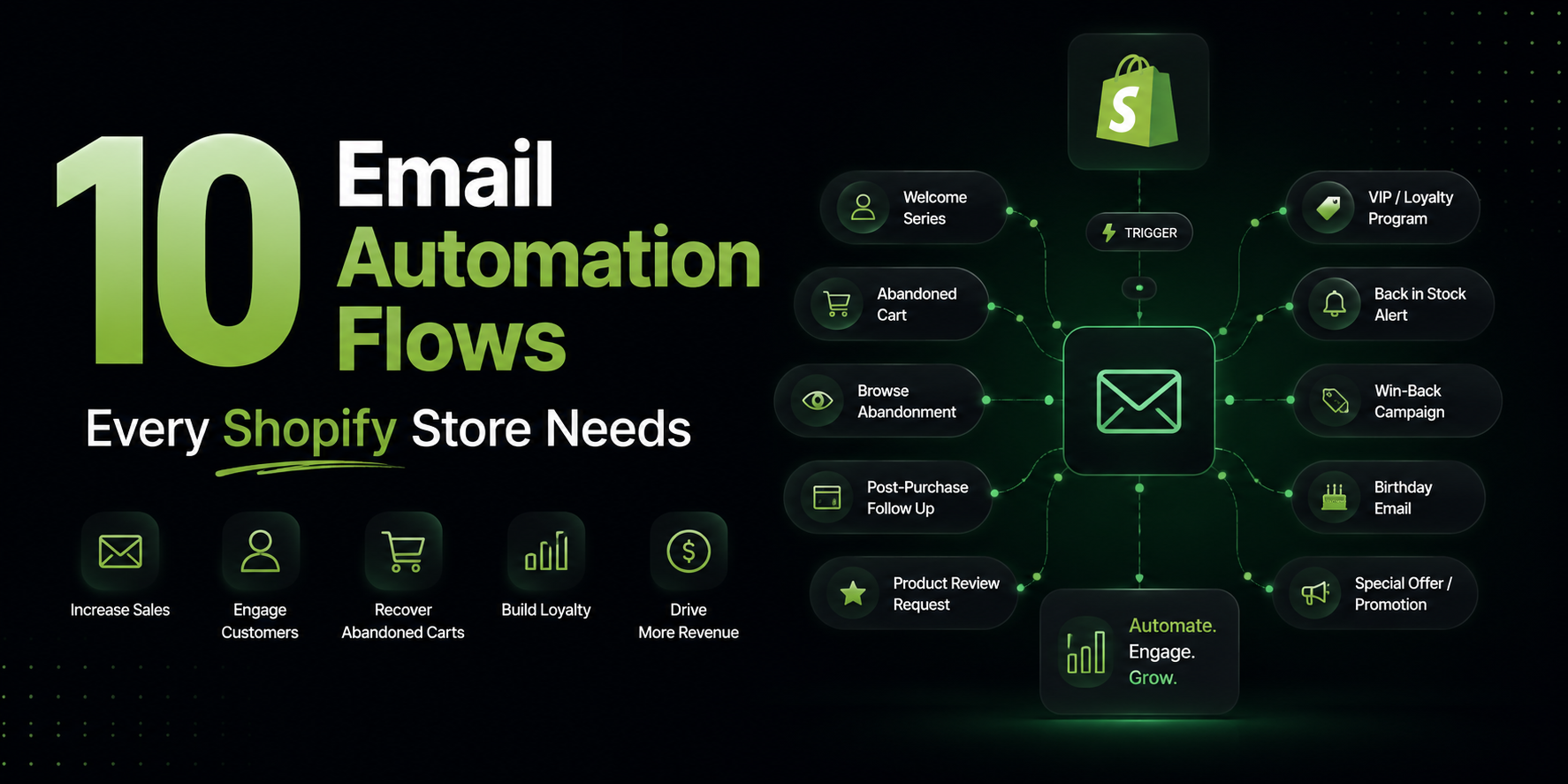
This post is going to walk you through the ten email automation flows every Shopify store needs. Not just what each one is, but why it matters, exactly how to structure it, what each email should say, and how to make sure it actually converts.
By the end of this, you will have a complete blueprint for your email automation strategy. Let us get into it.
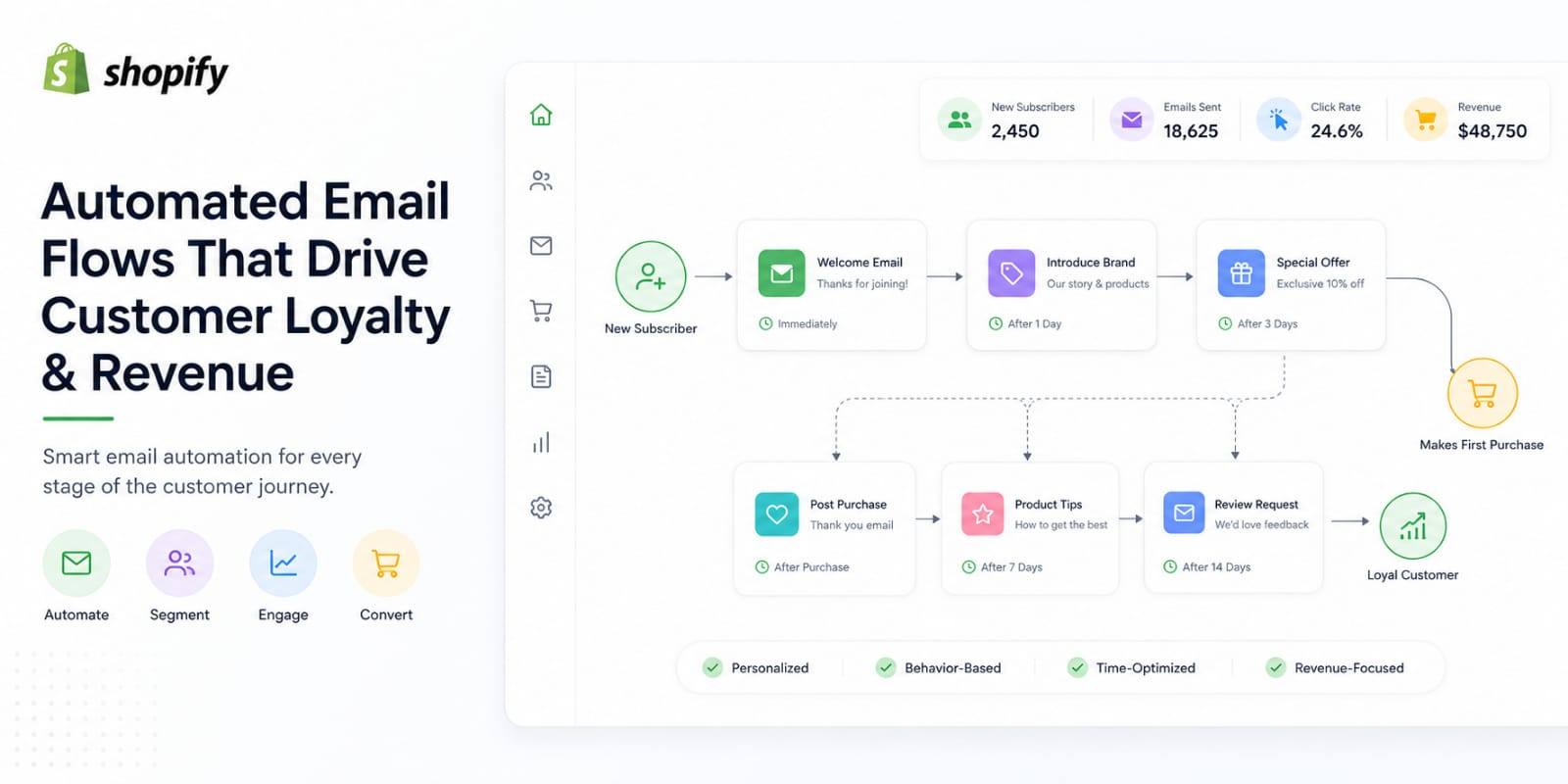
1. The Welcome Series
The welcome series is the most important automation flow you will ever build for your Shopify store.
Think about what happens when someone joins your email list. They have taken a deliberate action. They saw your store, they were interested enough to give you their email address, and now they are waiting to hear from you. Their attention is at its highest point. Their curiosity about your brand is at its peak.
That window of high attention does not last forever. If you do nothing, or if you send one generic welcome email and then go quiet for two weeks, that opportunity evaporates. They move on. They forget about you. And the next time one of your emails lands in their inbox, they struggle to remember who you are.
A well-structured welcome series uses that initial window of attention to do several things at once. It introduces your brand properly. It builds trust. It showcases your best products. It delivers on whatever promise brought them to your list in the first place. And it guides them, gently but deliberately, toward making their first purchase.
How to structure your welcome series.
The welcome series should consist of between three and five emails sent over the first seven to fourteen days after someone subscribes. Here is how each email should work.
Email one goes out immediately after sign up, ideally within the first few minutes. This email does three things. First, it delivers whatever the subscriber was promised when they signed up, whether that is a discount code, a free resource, free shipping, or access to exclusive content. Second, it introduces your brand with warmth and personality. Tell them who you are, what you sell, and what makes your store different in a way that feels human rather than corporate. Third, it gives them a clear, easy next step, usually a link to your bestsellers or most popular collection.
Email two goes out two to three days later and focuses on building credibility and social proof. This is where you share customer reviews, testimonials, user generated content, or any press coverage your brand has received. You are answering the question that is forming in the back of every new subscriber’s mind: “Can I actually trust this store?” Show them that other real people have bought from you and loved it.
Email three goes out four to five days later and focuses on your products themselves. Highlight your bestsellers or your most loved items. Use great product photography. Include real customer quotes about specific products. Make the email feel like a recommendation from a knowledgeable friend rather than a product catalogue. Include a clear call to action pointing to your store.
Email four, if you include it, goes out six to seven days later and tells your brand story. Why did you start this store? What problem were you trying to solve? What values drive the way you operate? People buy from brands they connect with. Sharing the human story behind your store builds the kind of emotional connection that turns one-time buyers into loyal customers.
Email five is the final nudge. If the subscriber has not yet used their welcome offer or made a purchase, remind them that the offer is expiring soon. Create genuine urgency without being aggressive. Something like “Your welcome discount expires in 48 hours” with a simple, clear call to action is often all that is needed to convert a fence-sitter into a buyer.
The welcome series sets the tone for the entire relationship between your brand and your subscriber. Make it your most carefully crafted, most thoughtfully designed email sequence. It will pay dividends for as long as your store exists.
2. The Abandoned Cart Flow
If there is one automation that every Shopify store needs to have running before anything else, it is the abandoned cart flow.
Here is why. On average, somewhere between sixty and eighty percent of online shopping carts are abandoned before the purchase is completed. People add items, get distracted, get cold feet, hit an unexpected shipping cost, or simply run out of time. They leave without buying. And without any follow up, most of them never come back.
But here is the other side of that statistic. A significant percentage of those abandoners intended to buy. They were interested. They were close. They just needed a nudge.
That nudge is your abandoned cart flow. And for most Shopify stores, it is consistently one of the highest-revenue automations in their entire email program.
How to structure your abandoned cart flow.
Your abandoned cart flow should consist of three emails sent over a forty eight to seventy two hour window after the cart is abandoned.
Email one goes out within one to three hours of the abandonment. The timing is important here. The sooner you follow up, the higher your chances of recovery, because the purchase intent is still fresh. This first email should be simple, friendly, and low pressure. Show them exactly what they left behind, with product images, names, and prices displayed clearly. Make it extremely easy to return to their cart with one prominent button. Do not lead with a discount in this email. Many people abandon for reasons that have nothing to do with price, and offering a discount too early trains your customers to abandon carts on purpose in order to receive a discount later.
Email two goes out twenty-four hours after the first email if the cart is still abandoned. This email does more than just remind them about the cart. It addresses potential hesitations. Include several strong customer reviews for the specific products they left behind. Highlight your return policy, your shipping times, and any guarantees you offer. Answer the questions and concerns that might be holding them back. End with a clear, easy link back to their cart.
Email three goes out forty-eight hours after the abandonment if the cart is still not converted. This is the email where a modest incentive makes sense. A ten percent discount code or free shipping offer with a clear expiry time can be the final push that converts a hesitant abandoner into a buyer. Keep the email concise and the call to action prominent. The offer should feel like a genuine gesture rather than a desperate plea.
A three-part abandoned cart flow consistently outperforms a single reminder email because it works through multiple layers of hesitation. The first email catches the easy wins, people who just forgot or got distracted. The second email addresses people who had genuine questions or concerns. The third catches the price sensitive buyers who needed a stronger incentive.
Set this up. Measure it. The revenue recovery will likely surprise you.
3. The Post Purchase Flow
Most Shopify store owners put all their energy into getting the first sale. They run ads, optimize their store, build their email list, and do everything they can to convert visitors into buyers. And then, when someone finally makes a purchase, they essentially go silent.
The order confirmation email goes out. The shipping notification follows. And then nothing. The customer is left to their own devices, wondering if the product will be worth it, waiting for it to arrive, and gradually drifting away from any emotional connection with the brand.
That silence after the first purchase is one of the most costly mistakes in e-commerce. Because that post purchase window is when your customer’s attention is at its absolute highest. They just bought something from you. They are anticipating its arrival. They are open and receptive. It is the perfect moment to deepen the relationship and set the foundation for their next purchase.
A post-purchase flow takes advantage of that window deliberately.
How to structure your post purchase flow.
Your post-purchase flow should start immediately after the purchase and run for two to four weeks depending on your product type.
Email one goes out immediately after purchase and is a genuine thank you email that is distinct from the automated order confirmation. The order confirmation is transactional and necessary. This email is personal and emotional. It expresses real gratitude for their trust, sets expectations for what happens next, and begins building the kind of warm relationship that makes customers want to come back.
Email two goes out two to three days later and focuses on helping the customer get the most out of what they bought. If they purchased a physical product, share usage tips, care instructions, or styling advice. If they bought a consumable, share recipes, routines, or best practices. This email positions your brand as helpful and knowledgeable, not just a transaction processor. It also reduces buyer’s remorse by reinforcing what a good decision they made.
Email three goes out around day seven and introduces complementary products based on what they purchased. If they bought a face wash, introduce them to the matching moisturizer. If they bought a coffee grinder, show them your premium coffee beans. This is your first cross-sell opportunity and it should feel natural and helpful rather than pushy. Frame it as a recommendation, not a sales pitch.
Email four goes out around the time the product is expected to have arrived and been used. Ask for a review. Keep this email short, direct, and easy to act on. Explain why reviews matter to your brand and make the process as simple as one click. Reviews and user-generated content are among the most valuable assets an e-commerce store can have, and the post-purchase flow is the perfect moment to collect them.
Email five, sent around week two to four depending on your product’s replenishment cycle, is a gentle prompt to return to the store. Highlight new arrivals, bestsellers they have not explored yet, or a personalized recommendation based on their first purchase. By this point the relationship has been properly nurtured and a return visit feels natural.
The post purchase flow transforms a transactional relationship into an ongoing one. And that ongoing relationship is what separates stores with high one time buyer rates from stores with strong customer lifetime value.
4. The Browse Abandonment Flow
Most store owners know about cart abandonment. Far fewer take advantage of browse abandonment, which is a shame because it is a genuinely powerful automation that targets people at a critical stage of the buying journey.
Browse abandonment captures a different type of intent than cart abandonment. These are subscribers who visited your store, spent time looking at specific product pages, and then left without adding anything to their cart.
They were interested. They were considering. They were not quite ready.
A browse abandonment flow reaches out to these people with a gentle, relevant prompt that keeps the product top of mind and removes any friction standing between them and a purchase decision.
How to structure your browse abandonment flow.
Browse abandonment emails should be simpler and softer in tone than cart abandonment emails because the buying intent is less explicit.
Email one goes out one to three hours after the browse session ends and focuses on the specific product or products the subscriber viewed. Show them the product with a great image, highlight a few key features or benefits, and include a link directly to the product page. Keep the tone conversational and curious rather than sales heavy. Something like “Still thinking about this?” works well as an opener.
Email two, if the first does not convert within 24 to 48 hours, can add more context. Include customer reviews specifically for that product. Highlight what makes it different or special. If there is a limited quantity or a temporary price, mention it naturally without being alarmist.
The key with browse abandonment is not to overdo it. These subscribers were browsing, not committing. The follow up should feel like a helpful reminder, not a pressure campaign. Nail that tone and browse abandonment becomes one of your quietest but most consistently effective automations.
5. The Win Back Flow
Every email list has a group of people who used to engage, used to open, used to buy, and then went quiet.
Some of them went quiet recently. Some of them have not opened an email or made a purchase in six months or more. These lapsed subscribers and customers represent a genuinely valuable opportunity because they already know your brand, they already bought from you at some point, and re engaging them is far cheaper than acquiring a brand new customer.
But they need a fundamentally different kind of communication to bring them back.
The win-back flow is specifically designed for this group. Its goal is to reignite interest, remind them of what they loved about your brand, and give them a compelling reason to come back.
How to structure your win back flow.
Your win back flow should consist of three to four emails sent over a two to three week period.
Email one opens the conversation with acknowledgment and genuine warmth. Something like “We have missed you” or “It has been a while since we have seen you” works well as an opener because it is honest and human rather than salesy. Share what is new since they last engaged. New products, new collections, new features, improvements to your service. Give them a reason to be curious again.
Email two, sent four to five days later, takes a slightly different approach. Instead of telling them about new products, invite them to come back by giving them something. A meaningful discount, a free gift with their next purchase, or early access to an upcoming sale. Make the offer feel generous and genuine, not desperate. This is an investment in recovering a customer relationship that has real long term value.
Email three, sent another four to five days later, creates gentle urgency around the offer from email two. “Your exclusive comeback offer expires soon” with a clear call to action and a reminder of the offer is often all it takes to convert someone who was considering coming back but needed a final nudge.
Email four is the decision email. If the subscriber has still not re engaged after three attempts, be honest with them. Something like “Should we stay in touch?” with two clear options, one to stay subscribed and one to unsubscribe, is a powerful final email. It feels respectful of their time and their inbox. Surprisingly, it often reactivates subscribers who had been passively ignoring the previous emails.
If someone does not engage after the full win back sequence, move them out of your active list. Continuing to email truly disengaged subscribers harms your deliverability and your sender reputation. A clean, active list is always more valuable than a large, unresponsive one.
6. The Replenishment Flow
This automation is one of the most underused flows in e commerce, and for stores that sell consumable or regularly-replaced products, it might be the most directly revenue-generating flow you can build.
The replenishment flow is simple in concept. You identify products that customers typically use up or replace within a predictable timeframe. You then set up an automated email that goes out to buyers of those products at just the right moment, before they run out, prompting them to reorder.
Think about what products in your store have a natural replenishment cycle. Skincare and beauty products get used up in thirty to sixty days. Coffee, supplements, and food products have predictable consumption rates. Cleaning products, personal care items, and pet food all run out on a regular schedule. Even non consumable products like workout clothes or shoes wear out eventually.
If you sell any product with a predictable usage cycle, you should have a replenishment flow.
How to structure your replenishment flow.
Email one goes out a few days before the customer is likely to run out based on their purchase date and the typical usage timeline for that product. The tone should be helpful and anticipatory rather than pushy. Something like “Time to restock?” with a direct link to reorder is often all this email needs to be. Keep it short, make the path to reorder effortless, and let the product’s own value proposition do the work.
Email two, if the first does not convert within a few days, can add a small incentive. A ten percent loyalty discount or a free sample with reorder can tip the balance for customers who were already thinking about it.
The power of the replenishment flow is that it reaches customers at the exact moment they are most likely to buy again. The timing is doing most of the work for you. A customer who is running low on their favorite face wash does not need to be convinced to buy face wash. They just need to be reminded that yours is the one they love and given an easy way to get more.
7. The New Customer Onboarding Flow
Wait. Is this not the same as the post purchase flow?
Not quite.
The post-purchase flow is about the immediate transaction. It thanks the customer, helps them with their new purchase, gathers reviews, and encourages a second visit.
The new customer onboarding flow is broader. It is about educating your customers on everything your brand offers, ensuring they discover all the ways they can engage with you, and building the kind of long-term brand loyalty that turns a one time buyer into someone who considers your store their go-to for a particular category of products.
This flow is especially valuable for brands with a wide product range, a strong brand community, or a loyalty program.
How to structure your new customer onboarding flow.
Email one introduces your brand universe. Beyond just the products they bought, what else do you offer? What categories have they not explored yet? Tell them about your bestsellers in other collections, your brand values, and the community around your brand.
Email two introduces your loyalty program or referral scheme if you have one. Explain how it works, what rewards are available, and how they can start earning points or benefits immediately. Customers who are enrolled in a loyalty program have significantly higher lifetime value and purchase frequency than those who are not.
Email three showcases your content and community. Do you have a blog with helpful articles? A YouTube channel with tutorials? An Instagram community full of user-generated content? Introduce your new customers to all the ways they can stay connected with your brand beyond just the transactional emails.
Email four might introduce your subscription option if you offer one, or highlight your most popular bundles. Customers who buy bundles or subscribe to regular deliveries have dramatically higher lifetime value than single purchase customers.
The onboarding flow turns a new buyer into a fully informed brand participant. It is how you make sure that every customer knows the full breadth of what you offer, not just the one product they happened to find first.
8. The VIP and Loyalty Flow
Your most loyal customers are your most valuable business asset. They buy more often. They spend more per order. They refer friends. They leave reviews. They stick with you even when competitors offer a lower price.
And most stores treat them exactly the same as everyone else.
The VIP and loyalty flow is how you change that. It is a series of automations specifically triggered by loyalty milestones and designed to make your best customers feel genuinely valued and recognized.
How to structure your VIP and loyalty flow.
The trigger for this flow is typically a behavioral threshold. A customer makes their third purchase. Or their fifth. Or they cross a total spend threshold. Or they have been a customer for one full year. Whatever milestone feels meaningful for your brand, use it as the trigger.
Email one is a milestone acknowledgment email. It recognizes the customer’s loyalty explicitly and warmly. Something like “You have now been a part of our community for a year and we wanted to say a genuine thank you” is the right tone. Make it feel personal, not automated, even though it is. Include their name. Reference their history with your brand if possible.
Email two delivers their VIP reward. This might be an exclusive discount, a free product, early access to a new collection, or an invite to a private sale. Whatever it is, it should feel genuinely special, something that non-VIP customers do not get access to.
Ongoing VIP communications should reach this segment before anyone else when you have important news or launches. They should receive better offers than your general list. They should feel like insiders.
When you treat your best customers like the VIPs they are, they become even more loyal. And loyalty, in e commerce, is the most powerful driver of long term profitability.
9. The Review and Referral Request Flow
Social proof is one of the most powerful conversion tools available to a Shopify store. Customer reviews, testimonials, and personal recommendations from real people consistently outperform any marketing copy you could write yourself.
But reviews and referrals do not happen automatically. Most happy customers do not spontaneously leave a review or tell their friends about you unless they are prompted at the right moment in the right way.
The review and referral request flow makes that prompt automatic and well-timed.
How to structure your review and referral request flow.
The review request email should go out after the customer has had enough time to receive and meaningfully use their purchase. For most physical products, seven to fourteen days after delivery is the right window. For products with a longer usage cycle, extend that timeline.
Keep the review request email short and warm. Explain why reviews matter to your small business. Make the process as frictionless as possible with a single clear button that takes them directly to the review form. If your platform supports it, use a star rating widget directly in the email that lets them start the review with one click.
Once you have collected a review, a follow up email thanking them for their feedback and inviting them to refer a friend is a natural next step. The review request and the referral ask work well together because both require a happy customer who is already engaged with your brand.
Your referral email should clearly explain how the referral program works, what both the referrer and their friend receive, and how simple it is to share. A direct, sharable referral link they can send via text or social media removes all the friction.
Reviews feed your conversion rate. Referrals feed your acquisition. Both are powered by the same group of happy customers who just need to be asked at the right time.
10. The Back in Stock and New Arrival Flow
The final automation flow on this list is one that captures a very specific type of buying intent: the person who wanted something you did not have available.
If you sell limited inventory products or items that regularly sell out, you are sitting on a goldmine of unmet demand. Every time someone lands on a product page and finds it out of stock, that is a potential customer who wanted to buy but could not.
The back-in-stock flow captures those people before they go find the same product somewhere else.
How to structure your back in stock flow.
On the out of stock product page, include a “Notify me when this is back” email capture form. When a visitor submits their email through that form, they are added to a waitlist segment for that specific product.
The moment that product comes back in stock, an automated email goes out to everyone on the waitlist. The email should be urgent and direct. “Good news, the item you wanted is back in stock” with a direct link to the product page and a note that stock is limited. Urgency is appropriate here because it is real. People who have been waiting will move quickly if they know supply is limited.
The new arrival flow works on a similar principle but targets your most engaged subscribers and past buyers with early access to new products before they go live to the general public. Announce new arrivals to your VIP segment or most engaged email segment first, giving them a twenty-four to forty-eight hour head start. This rewards loyalty, creates excitement, and often generates a burst of early sales that can create social proof before the wider launch.
Together, these two flows ensure that unmet demand does not quietly evaporate. They turn would-be buyers who could not purchase into delighted customers who felt taken care of.
How to Get All 10 Flows Set Up
Reading through this list can feel like a lot. Ten flows. Dozens of emails. Countless triggers, timing decisions, and copy variations to think through.
Here is the honest truth. You do not need to build all ten flows this week.
What you need to do is prioritize based on where your store is right now and where the biggest revenue opportunities are.
If you have not built any automations yet, start with the welcome series and the abandoned cart flow. These two alone will have the most immediate impact on your revenue. Get them live, optimized, and performing well before you move on.
Next, add your post-purchase flow. This is the automation that has the biggest impact on customer lifetime value and repeat purchase rates. It is the foundation of your customer retention strategy.
Then build your win-back flow, your browse abandonment flow, and your replenishment flow. Each of these adds another layer of revenue recovery and customer retention.
Work through the remaining flows as your capacity allows. Each one you add compounds the effect of the ones before it. The cumulative revenue impact of all ten flows working together is significantly greater than the sum of each individual flow.
For tools, Klaviyo and Omnisend are both excellent for building and managing these flows on Shopify. Both offer pre-built templates for most of these automations that give you a strong starting point you can customize to match your brand voice and product range.
Final Thoughts
Email automation is not a nice-to-have for a Shopify store. It is a fundamental part of how modern e-commerce businesses generate consistent, scalable revenue from their existing customer base.
Every flow on this list is a conversation your store is already failing to have with customers who are ready to hear from you. New subscribers who need a reason to buy. Abandoners who need a reminder. Loyal customers who deserve recognition. Lapsed customers who can be brought back. Happy buyers who would refer friends if someone just asked.
The flows in this guide are how you start having those conversations automatically, at scale, without you having to manually write and send every email yourself.
Build them one at a time. Start with the highest impact. Optimize as you go. Let the data tell you what is working and what needs improvement.
And then, once they are all running, step back and appreciate what you have built.
A marketing system that works for your store twenty-four hours a day, seven days a week, three hundred and sixty-five days a year. Without you having to do anything.
That is the power of email automation. And your store deserves to have it working for you starting today.