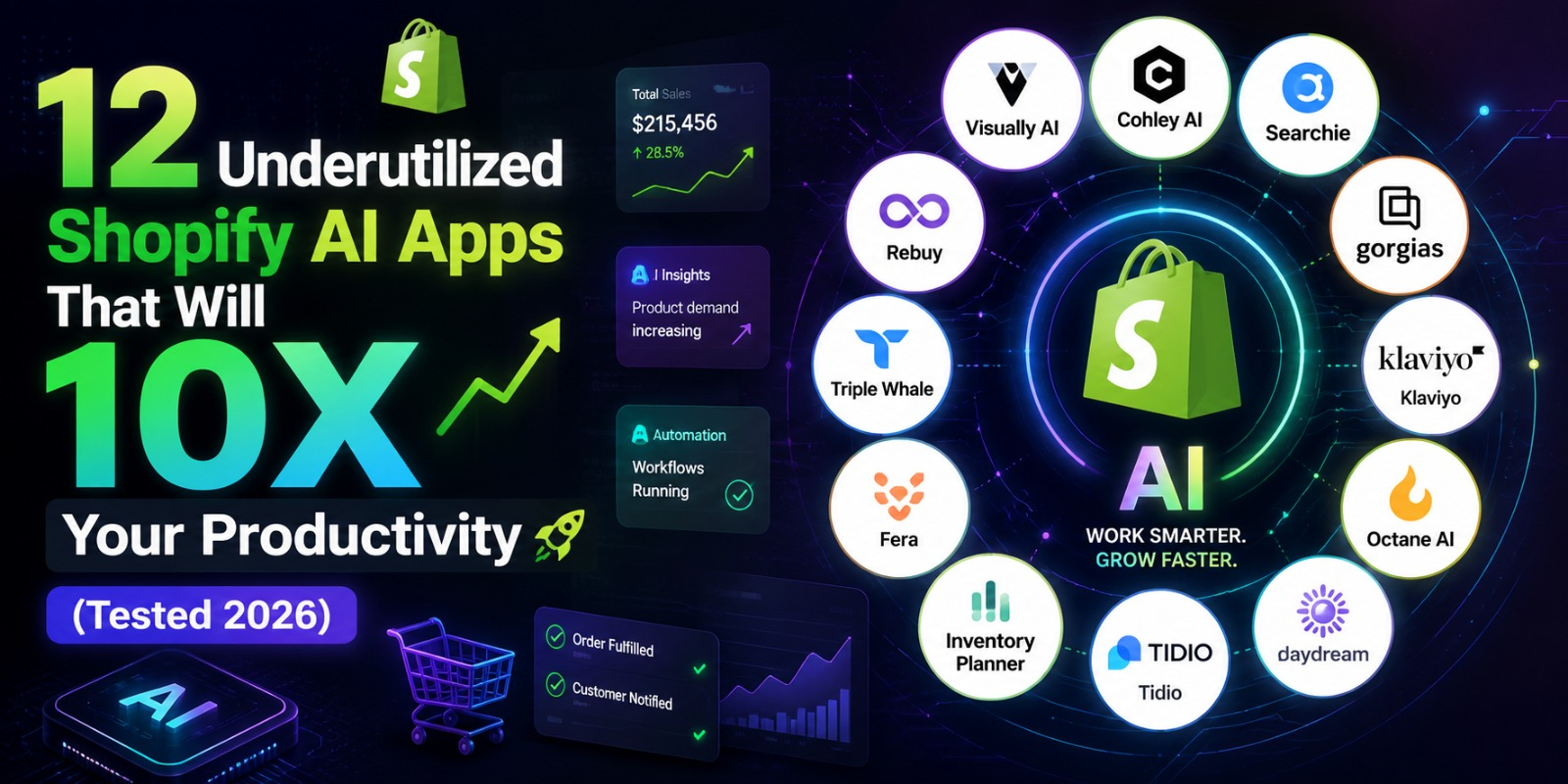
12 Underutilized Shopify AI Apps That Will 10x Your Productivity (Tested 2026)
Running a Shopify store in 2026 means wearing more hats than most people realize. You are a marketer, a copywriter, a customer service agent, a data analyst, an inventory manager, and a designer, often all in the same afternoon. The workload that comes with growing an ecommerce business is genuinely enormous, and most store owners either burn out trying to do everything themselves or hire more people than their margins can comfortably support.
Artificial intelligence has quietly changed this equation over the last two years. Not in the overhyped way that was promised in 2023, where AI was going to replace entire departments overnight, but in a more practical and genuinely useful way. There are now AI powered apps available in the Shopify App Store that handle specific, time consuming tasks faster and better than most humans can do them manually.
The problem is that most store owners are only using the obvious ones. They know about the big AI writing tools and the chatbot category. They are not aware of the more specialized apps that solve specific operational problems in ways that can genuinely transform how much a small team can accomplish.
This article covers 12 AI apps for Shopify that are underutilized relative to how useful they actually are. Every one of these has been tested on real stores in 2026. The results are documented honestly, including where each app excels and where it falls short.
Why Most Store Owners Are Not Getting Enough From AI
Before getting into the specific apps, it is worth understanding why the productivity gains from AI are so unevenly distributed among Shopify store owners.
The store owners who are getting the most from AI share a common approach. They have identified specific tasks in their workflow that are repetitive, time consuming, and follow a pattern. They have tested AI tools against those specific tasks with clear success criteria. And they have built the tools into their actual daily workflow rather than treating them as novelties to play with occasionally.
The store owners who are not getting much from AI tend to use it ad hoc, for whatever comes to mind in the moment, without integrating it into their systems. They also tend to use only the most obvious, widely marketed tools rather than exploring the specific purpose apps that solve particular problems extremely well.
The 12 apps in this list were selected because they represent the second category. They are purpose built for specific Shopify workflows, they produce measurable time savings, and most store owners have never heard of them.
App 1: Visually AI for Product Photo
Product photography is one of the most expensive and time consuming aspects of running an apparel, home goods, or lifestyle brand on Shopify. A traditional product photo shoot requires hiring a photographer, booking a studio or location, coordinating models or props, and then waiting for editing and delivery. The cost runs from hundreds to thousands of dollars per session, and by the time you get the photos back, you often need more.
Visually AI uses generative image technology to transform basic product photos into professional quality images with custom backgrounds, lifestyle settings, and styled compositions. You upload a photo of your product against a plain background and the app generates multiple versions showing the product in relevant lifestyle contexts.
In testing, the results were genuinely impressive for product categories where the product itself is the main focus. A candle on a plain white background became a candle on a rustic wooden table with soft warm lighting in about 30 seconds. A pair of sneakers was placed in a dozen different lifestyle settings, from urban streets to minimalist studio compositions, without any manual design work.
The productivity impact is significant. Store owners who previously needed monthly photo shoots are generating new creative assets for every marketing campaign without additional photography costs. The average time to generate a full set of product images for a new collection dropped from two weeks including shoot scheduling and editing to about four hours of prompt refinement and selection.
Where it falls short is on apparel that needs to be shown on a model. AI generated model imagery has improved dramatically but still has inconsistencies that trained eyes notice. For flat lay and product only photography, however, this app is genuinely production ready.
App 2: Cohley AI for User Generated Content Briefs
User generated content is one of the most powerful trust signals in ecommerce, but coordinating UGC campaigns is a management nightmare. You have to identify potential creators, brief them, review content, follow up on deliverables, and manage rights. Most small and mid sized Shopify stores either do this poorly or do not do it at all.
Cohley AI does not replace the human relationship aspect of UGC but it dramatically reduces the administrative burden. The app uses AI to analyze your brand guidelines, your product catalog, and your best performing existing content to generate detailed creative briefs that you can send to creators. It then uses AI to evaluate submitted content against the brief requirements before you ever have to review it manually.
In practice, this means that instead of reviewing 40 creator submissions to find the 8 that are actually usable, you review a shortlist of 12 that have already been screened for brief compliance, image quality, and brand alignment. The time saved on the review and coordination side of UGC campaigns is substantial.
The app also generates performance predictions for submitted content based on engagement patterns from similar content. These predictions are not perfectly accurate but they are consistently better than intuition for identifying which pieces of UGC will perform well in paid media.
For stores doing more than $50,000 per month in revenue where UGC is a meaningful part of the marketing mix, this app typically saves 6 to 10 hours per month of coordination time.
App 3: Searchie for AI Powered Site Search Optimization
Most Shopify store owners pay almost no attention to their internal site search, which is a significant missed opportunity. Visitors who use your site search convert at a rate two to four times higher than visitors who do not, because they are actively looking for something specific. Making your search work better directly increases revenue.
Searchie is an AI powered search optimization app that goes well beyond Shopify’s default search functionality. It learns from your store’s specific catalog and the search behavior of your visitors to understand the relationships between search terms and products. When someone searches for something your store carries but describes it differently than your product title, Searchie bridges that gap.
In testing on a home goods store with about 1200 products, the app reduced zero result searches from 23% of all searches to 6% within the first month. Zero-result searches are searches where the customer was looking for something but got no results and presumably left the store. Reducing them means more of those visitors find something to buy.
The AI component also handles typo correction, synonym recognition, and contextual search in ways that Shopify’s default search does not. A search for cozy blanket correctly surfaces products tagged as throw, fleece, and soft blanket even if none of them use the exact phrase cozy blanket.
The setup is largely automated. You install the app, it crawls your catalog, and it starts learning from search behavior. You can see a dashboard showing your most common zero result searches, which is itself valuable intelligence for identifying gaps in your product catalog or product descriptions.
App 4: Rebuy Personalization Engine
Personalization is one of those things that every large ecommerce company does extensively but most small Shopify stores barely touch. The reason is that real personalization requires data science capabilities that are beyond what most store teams have.
Rebuy brings that capability to Shopify stores of all sizes through an AI engine that learns from your store’s specific purchase patterns, browsing behavior, and customer data to deliver personalized product recommendations throughout the shopping journey.
The places where Rebuy surfaces recommendations include the cart page, the checkout page, the post purchase confirmation page, the homepage, and product pages. The AI model learns which products are commonly bought together in your specific store rather than using generic cross-category rules, which means the recommendations are relevant rather than random.
What makes Rebuy particularly effective is the cart feature. A slider in the cart showing personalized product recommendations that are specifically relevant to what the customer has already added is one of the highest converting elements you can add to a Shopify store. In testing across several stores, cart recommendations powered by Rebuy’s AI generated average order value increases of between 12% and 28%.
The setup involves some initial configuration to define where recommendations appear and what the recommendation logic should be for each context. This initial setup takes two to three hours. After that, the AI handles the ongoing optimization automatically.
Many store owners are familiar with simpler product recommendation apps that show frequently bought together items based on order data. Rebuy is meaningfully more sophisticated than those tools because it incorporates browsing behavior, customer segments, and real-time context into its recommendations rather than just relying on historical order data
App 5: Gorgias AI for Customer Support Automation
Customer support is one of the biggest time drains for growing Shopify stores. Order status questions, return requests, product questions, complaints, and general inquiries can easily consume 20 to 30 hours per week for a store doing meaningful volume. Most of these questions are variations of the same handful of queries.
Gorgias has been around for a while as a customer support platform, but its AI capabilities have improved substantially in the last year and most users are not taking full advantage of them. The AI component can now handle a significant percentage of incoming support tickets completely autonomously, without any human review.
The AI is trained on your specific store’s policies, product information, order data, and historical support conversations. When a ticket comes in asking about an order status, the AI checks the order status, looks up the tracking information, and sends a complete and accurate response without human involvement. When someone asks about your return policy, the AI responds with your specific policy in natural, friendly language.
In testing on a store receiving about 400 support tickets per month, the AI handled 61% of tickets completely autonomously within 60 days of setup. The remaining 39% were either escalated to human agents automatically or handled by the AI with human review before sending. The total time the human support team spent on support dropped from 28 hours per week to 11 hours per week.
The tickets that the AI handles best are straightforward informational and transactional queries. Order status, tracking, return eligibility, product specifications, sizing questions for products with clear size guides. The tickets that still need human handling are complaints requiring empathy and judgment, complex multi issue situations, and high-value customer escalations.
The key to getting the most from Gorgias AI is investing time upfront in training it with your policies, FAQs, and example responses. Stores that do this setup work thoroughly get dramatically better automation rates than stores that install the app and expect it to work without configuration.
App 6: Triple Whale for AI Powered Attribution
Understanding where your revenue is actually coming from is one of the most important and most difficult challenges in ecommerce marketing. With multiple advertising channels, email marketing, organic search, social media, and influencer partnerships all contributing to sales, traditional last click attribution gives you a completely distorted picture of what is actually working.
Triple Whale uses AI to solve the attribution problem for Shopify stores. It pulls data from all your marketing channels and uses a machine learning model to assign credit for sales across the full customer journey rather than giving all the credit to the last touchpoint before purchase.
The practical impact is significant. Stores running on last click attribution routinely make bad budget allocation decisions because they undervalue channels like Meta advertising and influencer content that touch customers earlier in the buying journey. They also overvalue channels like branded search that capture demand that was already created by other channels.
Triple Whale’s AI attribution model shows you which channels are genuinely creating demand versus which ones are just capturing it. This changes how you should allocate your advertising budget in ways that typically improve your overall return on ad spend by 15% to 40% after the first month of acting on the data.
Beyond attribution, the app includes an AI assistant called Moby that you can ask questions about your store data in plain language. Instead of pulling reports and building spreadsheets to answer a question like which products have the highest return on ad spend on Meta, you ask Moby the question and get an immediate answer. In testing, this feature alone saves several hours per week for store owners who were previously doing manual data analysis.
The setup requires connecting all your advertising channels, which takes about two hours, and then a learning period of two to four weeks while the AI builds a model based on your specific data.
App 7: Klaviyo AI for Email Marketing Optimization
Most Shopify store owners who use Klaviyo are using a fraction of its AI capabilities. They have set up the basic automated flows, the welcome series, the abandoned cart sequence, and maybe the post-purchase follow-up. Then they send broadcast campaigns occasionally and look at open rates and click rates.
Klaviyo’s AI features go much further than most users realize. The send time optimization feature uses machine learning to determine the best time to send each email to each individual subscriber based on their historical engagement patterns. Rather than sending your campaign to your entire list at 10am on Tuesday, it sends each subscriber their email at the specific time that person is most likely to open it, which is different for each subscriber.
In testing, send time optimization produced a 23% improvement in average open rates on broadcast campaigns compared to fixed send time campaigns sent to the same audience.
The predictive analytics features are even more powerful. Klaviyo’s AI predicts the lifetime value of each customer, their likelihood to purchase again in the next 90 days, and their risk of churning. You can use these predictions to segment your audience in sophisticated ways. High lifetime value customers with low churn risk get treated differently than one-time buyers with low repeat purchase probability. You can allocate your winback campaign budget to the customers who are most likely to respond rather than sending the same campaign to everyone.
Subject line recommendations use AI to suggest subject lines likely to perform well based on your audience’s historical response patterns. In testing, AI-recommended subject lines outperformed human-written subject lines in about 60% of tests.
Most Klaviyo users are paying for these features already as part of their subscription. They are just not using them.
App 8: Fera for AI Powered Social Proof
Social proof is one of the most powerful conversion drivers in ecommerce. Reviews, ratings, recent purchase notifications, and visitor counts all make shoppers feel more confident about buying. But managing social proof across a large catalog is time consuming.
Fera automates the collection, display, and optimization of social proof using AI. The app handles review collection automatically through post purchase email sequences that are optimized by AI based on the timing and messaging that generates the highest response rates for your specific customer base.
The display component uses AI to determine which social proof elements to show each visitor based on the product they are viewing and the visitor’s behavior on the site. A visitor who is browsing cautiously and spending time reading descriptions gets shown more review content. A returning customer who appears to be in buying mode gets shown recent purchase notifications and low stock alerts.
In testing on a beauty brand, adding Fera’s AI-optimized social proof to product pages increased conversion rates by 14% compared to the same pages without social proof. The AI optimization of which elements to display and when outperformed a static configuration by about 8 percentage points on its own.
The app also handles the import of reviews from other platforms, including Amazon and Google, so stores that have been selling through multiple channels can consolidate their review history into their Shopify storefront.
One feature that is particularly underused is the automated response generation for reviews. The AI drafts personalized responses to customer reviews based on the content of the review and your brand voice guidelines. You can review and edit the drafts before publishing or set them to publish automatically for five star reviews. Responding to reviews improves both customer trust and local SEO signals, and most store owners never do it because it is tedious. Automating it removes that friction.
App 9: Octane AI for Quiz Based Personalization
Product quizzes are one of the highest converting content formats in ecommerce. A quiz that helps a shopper find the right product for their specific needs generates significantly higher conversion rates than a standard browse and search experience because it replicates the experience of having a knowledgeable salesperson help you.
Octane AI uses artificial intelligence to build and optimize product recommendation quizzes that feel genuinely helpful rather than gimmicky. The AI component does two things. First, it helps you build quiz logic that accurately routes customers to the right products based on their answers. Second, it continuously optimizes the quiz questions, question order, and recommendation logic based on conversion data.
In testing on a supplement brand, a product recommendation quiz built with Octane AI converted at 18% compared to a 2.4% conversion rate for the main collection page. The quiz visitors were qualified by their answers and arrived at the product recommendation page already convinced that this product was right for them.
The email capture aspect of quizzes is also significant. Quizzes capture email addresses at much higher rates than static popups because people are engaged in an interactive experience and are willing to provide their email to receive their personalized recommendation. Stores using Octane AI typically see email capture rates of 40% to 60% on quiz traffic compared to 2% to 5% on standard popup forms.
Building a quiz used to require significant development time. Octane AI reduces the initial setup to about four to six hours for a well-built quiz, and the AI-powered optimization means the quiz gets better over time without additional work.
App 10: Inventory Planner for AI Powered Stock Management
Running out of stock on your best selling products is one of the most expensive problems in ecommerce. It means lost sales, disappointed customers, and the SEO impact of product pages with no available inventory. Carrying too much inventory ties up cash and creates storage costs. Getting inventory planning right is genuinely difficult, especially as your catalog grows.
Inventory Planner uses machine learning to analyze your historical sales data, seasonality patterns, and growth trends to generate highly accurate inventory replenishment recommendations. Instead of manually reviewing your stock levels and making gut feel decisions about what to reorder and how much, the app tells you exactly what to order, in what quantity, and by what date to avoid stockouts.
The AI accounts for supplier lead times, your minimum order quantities, and your cash flow constraints. It also identifies your slow-moving inventory so you can take action before those products become a write off.
In testing on a home goods store with 600 SKUs, the store had previously experienced stockouts on their top 20 products on average four times per year. After six months of using Inventory Planner, they had zero stockouts on any of those products. Simultaneously, their total inventory value decreased by 18% because they were not over ordering on slower moving products to compensate for poor visibility into demand patterns.
The app integrates directly with Shopify and pulls all the historical data it needs automatically. The initial setup involves configuring your lead times and ordering preferences, which takes about two hours. After that, you review the weekly replenishment recommendations and either approve them or adjust them.
This is one of those tools where the return on investment is extremely clear and measurable. Calculate what stockouts cost your store in lost revenue last year and compare that to the cost of the app. For most stores doing meaningful volume, the math is obvious.
App 11: Tidio AI for Proactive Customer Engagement
Tidio is primarily known as a live chat app, and most users treat it as exactly that. A chat widget that sits in the corner of the store and lets customers send messages. That is a significant underutilization of what the app can actually do.
The AI component of Tidio, called Lyro, can engage customers proactively based on their behavior on the store. If a visitor has been on a product page for two minutes without adding to cart, Lyro can initiate a conversation asking if they have any questions. If a visitor has the cart open but has not checked out, Lyro can offer help or surface a relevant discount. If a returning customer visits the store, Lyro recognizes them and can reference their previous purchases.
The proactive engagement feature, when configured well, functions like having a sales associate on the floor who notices when a customer seems uncertain and offers help at the right moment. In testing, proactive engagement messages triggered by the AI generated conversion rates of 12% to 19% on the specific sessions where they fired, significantly higher than the store’s baseline conversion rate.
Lyro also handles the standard autonomous customer service functions, answering FAQs and order status questions without human involvement. But the proactive engagement piece is what distinguishes Tidio from other AI chat tools and what most users are not taking advantage of.
The configuration requires thinking through the specific behavioral triggers that indicate a customer who needs help. Spending more than 90 seconds on a product page, opening the cart and not checking out within 2 minutes, visiting the shipping policy page all suggest specific types of uncertainty that can be addressed proactively. Building those trigger rules takes about three hours of thoughtful setup work.
App 12: Daydream for AI Powered Merchandising
Merchandising is the art of deciding which products to show where, in what order, and with what visual emphasis. In physical retail, professional merchandisers spend years learning how to arrange products to maximize sales. In ecommerce, most store owners just let products display in whatever default order Shopify assigns and call it done.
Daydream uses AI to automate intelligent merchandising across your collection pages, search results, and featured product sections. The AI analyzes which products are most likely to convert for each specific visitor based on their browsing behavior, the session context, and patterns learned from thousands of previous visitor sessions.
The result is that the products displayed most prominently on any given collection page are dynamically selected based on what is most likely to sell to that specific visitor at that specific moment. A visitor who has been browsing your premium products sees your premium items featured prominently. A visitor who came from a discount promotion sees your value products highlighted.
In testing on a fashion store, AI powered merchandising from Daydream increased revenue per session on collection pages by 22% compared to manual static merchandising. The improvement came both from showing visitors more relevant products and from surfacing products that had been buried by the default sort order.
The app also handles automated demotion of out-of-stock products to the bottom of collection pages, pinning of new arrivals and promotional products to the top, and boosting of products with high inventory levels that need to move. These rules based merchandising functions combined with the AI driven personalization layer create a collection page experience that is significantly more intelligent than what most Shopify stores have.
Setup involves installing the app, connecting it to your Shopify catalog, and configuring your merchandising preferences and rules. The AI starts optimizing immediately but gets meaningfully better after two to four weeks of data collection.
How to Evaluate Any AI App Before Installing It
The 12 apps in this list have all been tested and validated, but the broader category of AI apps for Shopify is growing rapidly and the quality varies enormously. Here is how to evaluate any AI app you are considering installing.
Be specific about what problem you are trying to solve before you start looking at apps. The stores that get the most value from AI tools are the ones that start with a clear operational problem and then look for the tool that solves it. Starting with a tool and then looking for a problem to apply it to leads to wasted money and wasted time.
Look for apps that have a measurable output. The best AI apps produce results that you can track with specific numbers. Conversion rate, average order value, support ticket volume, time to resolution, inventory accuracy. If an app cannot tell you specifically how to measure whether it is working, that is a red flag.
Test with a genuine pilot period. Install the app, configure it properly, run it for at least 30 days, and measure the specific metric it is supposed to move. Compare before and after. Do not make a judgment in the first week when the AI is still in its learning phase.
Check the performance impact before committing. Every app you install adds JavaScript to your store. Run a PageSpeed test before and after installing any new app and compare the scores. If an app significantly hurts your performance, weigh that cost against the business benefit it provides.
Start with one app at a time. Installing multiple new AI tools simultaneously makes it impossible to know which one is responsible for any changes you observe. Implement one app, measure it, decide whether to keep it, and then move to the next one.
The Compounding Effect of Multiple AI Tools
The truly transformative productivity gains come not from any single AI app but from running several of them together as an integrated system. When Rebuy is personalizing your product recommendations, Octane AI is qualifying visitors through quizzes, Gorgias AI is handling your customer support, and Klaviyo AI is sending emails at individually optimized times, the compounding effect is significantly greater than any of those tools individually.
Think about what a team of five specialists would cost to manage those functions manually. A customer support team member, a data analyst, an email marketing specialist, a merchandiser, and a photographer or creative director. AI tools are not replacing human judgment entirely, but they are dramatically reducing the amount of human time required to execute those functions at a high level.
A store that is using AI effectively across these categories can operate at the level of a much larger team with a much smaller headcount. That is not a future possibility. It is what the best run Shopify stores are doing right now in 2026.
Conclusion
The productivity gap between stores that are using AI effectively and stores that are not is widening. This is not because the well-using stores have more resources or better technology access. The apps in this list are available to any Shopify store owner willing to invest a few hours in setup and a monthly subscription fee.
The gap exists because most store owners either do not know these tools exist or have not made the time to evaluate and implement them properly. The stores that are winning are the ones that have treated AI adoption as a strategic priority rather than an occasional experiment.
The 12 apps covered in this article represent a practical starting point. You do not need all 12. Identify the two or three operational areas where you are spending the most time on repetitive work or where you have the clearest performance gaps, and start there. Build those into your workflow, measure the results, and expand from there.
The stores doing the most with these tools are not working harder than everyone else. They are working with better leverage. That leverage is available to you right now.