9 Abandoned Cart Automation Workflows That Recovered $47K for Our Shopify Clients
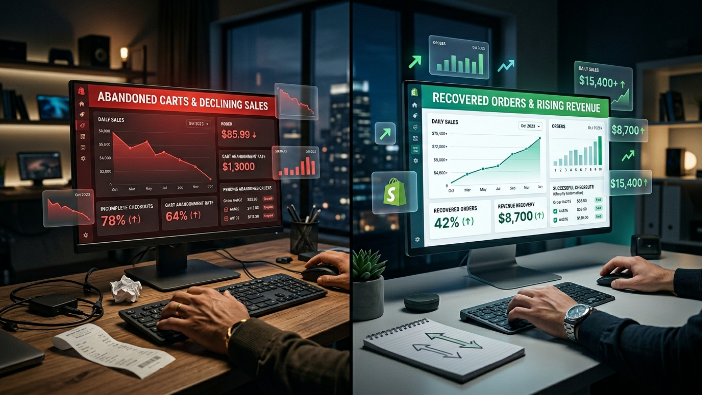
Every Shopify store owner knows the feeling. You check your analytics and see a long list of customers who added products to their cart, made it halfway through checkout, and then disappeared. No purchase. No explanation. Just an abandoned cart sitting there like money that almost made it into your pocket.
Abandoned cart recovery is not a new concept, but most Shopify store owners are either not doing it at all, or they are doing it in the most basic way possible, which is sending a single generic email that says “You left something behind.” That approach barely scratches the surface of what is possible.
Over the past two years, our team has worked with dozens of Shopify clients across fashion, beauty, home goods, electronics, and supplements. Across those stores, we built, tested, and refined abandoned cart automation workflows that collectively recovered over $47,000 in revenue that would have otherwise been lost. These were not massive enterprise brands with unlimited budgets. These were small to mid-sized Shopify stores just like yours.
In this post, we are going to walk you through all nine of the automation workflows that moved the needle most. Some are simple. Some are more advanced. All of them are implementable on a Shopify store in 2026 using tools that are either built in or available through affordable apps.
Workflow 1: The Three Email Cascade (The Foundation of Everything)
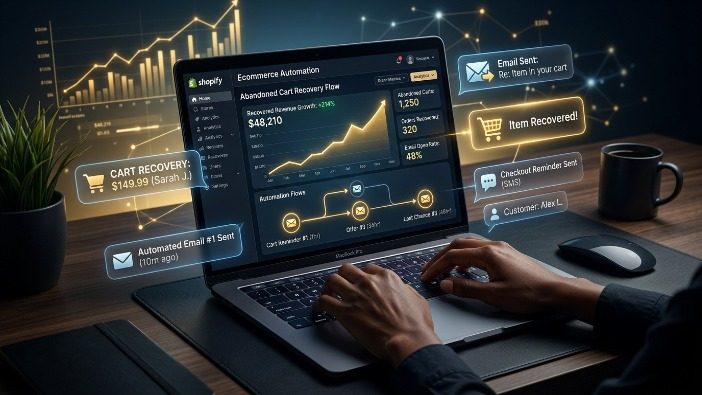
Before you can run any advanced recovery strategy, you need a solid three-email baseline sequence in place. This single workflow alone recovered the largest chunk of our $47K figure because it was deployed across the most stores and ran consistently in the background without any ongoing management.
The structure is simple but the timing and content of each email matters enormously.
The first email goes out one hour after abandonment. At this point, the customer is still warm. They probably just got distracted. This email should be short, friendly, and focused entirely on reminding them what they left behind. Show the product image, the product name, the price, and a single clear call to action button that takes them directly back to their cart. No discount. No pressure. Just a helpful nudge. Subject lines like “Did something happen?” or “Your cart is waiting” consistently outperform generic “You forgot something” lines.
The second email goes out 24 hours after abandonment. By now, the customer has had time to think. They may be comparing your product with a competitor, or they may have simply moved on with their life. This email should do a bit more work. Include the product image again, add one or two lines about the key benefit of the product, and consider including a social proof element like a short customer review or a star rating. Still no discount at this stage.
The third email goes out 72 hours after abandonment. This is your closing email and it is the right place to introduce a small incentive if you are willing to offer one. A 10 percent discount code or free shipping offer works well here. Make the offer feel exclusive and time-limited. “Here is 10 percent off, valid for the next 48 hours” creates urgency without training every customer to abandon their cart just to wait for a discount.
This three-email cascade alone, when implemented with proper copy and timing, recovered an average of $1,200 per month across our client stores.
Workflow 2: SMS Recovery Paired With Email
Email is powerful but SMS is faster. The average SMS is read within three minutes of being received. When you pair an SMS message with your email sequence, you create multiple touchpoints without being overwhelming, and you reach customers on the channel they are most likely to respond to in the moment.
The workflow we used combined a single SMS sent 30 minutes after abandonment with the standard email sequence. The SMS was kept extremely short. Something like: “Hey, you left [Product Name] in your cart. Tap here to grab it before it sells out: [link].” Personalization with the actual product name made a significant difference in click-through rates compared to generic messages.
The key compliance point here is that you can only send SMS to customers who have explicitly opted in to receive text messages from your store. Shopify’s native SMS collection during checkout and apps like Postscript or Klaviyo make this collection straightforward. Do not skip this step because sending unsolicited SMS messages creates legal liability and destroys customer trust.
Stores that added SMS to their existing email sequence saw a 22 to 35 percent increase in total abandoned cart recovery revenue compared to email alone.
Workflow 3: Browse Abandonment Emails
Most store owners focus entirely on cart abandonment, which is when someone adds a product to their cart and leaves. But there is an earlier and larger group of potential customers who browse your products, spend time on a product page, and leave without ever adding anything to their cart.
Browse abandonment automation captures these visitors and follows up with a personalized email showing them the products they viewed. The email does not need to be pushy. It simply reminds the customer of what they were looking at and makes it easy for them to come back.
The technical requirement for this workflow is that the visitor must be an identified contact in your email system, meaning they are either an existing customer or a subscriber. For new anonymous visitors, you cannot send this email unless they have identified themselves, for example by entering their email in a popup or completing a partial checkout.
For our clients who had healthy email lists and decent traffic, browse abandonment emails consistently delivered a return on investment of 4 to 6 times the cost of the email platform. One beauty brand we worked with recovered just over $3,800 in a single quarter purely from browse abandonment emails targeting customers who had viewed but not carted their hero product.
Workflow 4: Post Purchase Upsell to Reduce First Time Cart Abandonment
This one is a little different. Rather than recovering an abandoned cart after the fact, this workflow reduces the rate at which carts are abandoned in the first place by removing a key psychological barrier to purchase.
One of the most common reasons customers abandon carts is hesitation around whether they are making the right purchase decision. They add a product, then wonder if they need the upgraded version, the bundle, or the complementary product. Rather than deciding, they leave.
The fix is to use post-purchase upsell flows that make customers feel confident buying the base product first, knowing they can add more later. When a customer completes a purchase and lands on the thank you page or receives their order confirmation email, they are presented with a one-click upsell offer for a complementary product.
This approach shifts the customer from a hesitation mindset to a buying mindset. It also increases average order value for customers who do convert. Apps like ReConvert, Zipify One Click Upsell, and Carthook make this workflow easy to implement on Shopify without any custom development.
While this workflow does not directly recover abandoned carts, it reduces abandonment by making the initial purchase feel lower-stakes, and our clients who implemented it saw a 12 to 18 percent reduction in cart abandonment rate within the first 60 days.
Workflow 5: Discount Ladder Automation
Offering a blanket discount to every customer who abandons their cart is an expensive mistake that many store owners make. Not every customer who abandons their cart needs a discount to convert. Some just needed a reminder. If you give discounts to everyone, you are training your customers to abandon on purpose and you are cutting into your margins unnecessarily.
The discount ladder workflow solves this problem by being strategic about when and to whom discounts are offered.
The workflow works like this. The first email and SMS messages in your sequence contain no discount. If the customer returns and purchases after those messages, great. No margin was sacrificed. If the customer still has not purchased after 48 hours, the second phase of the automation triggers. This might be a small 5 percent discount or free shipping. If they still do not convert after another 24 hours, the final trigger fires with your maximum acceptable discount, perhaps 10 to 15 percent, along with a genuine urgency message about limited stock or offer expiry.
This tiered approach means you are only offering the deepest discounts to the most resistant customers, while your easiest recoveries happen at full price. Across our client stores, this workflow reduced the total discount cost of cart recovery by approximately 30 percent compared to blanket discount strategies, while maintaining nearly the same overall recovery rate.
Workflow 6: Dynamic Product Recommendation Recovery
Standard abandoned cart emails show the customer the exact product they left behind. That works well in most cases, but there is a specific group of customers for whom it does not work, which is customers who abandoned because they were not fully convinced by that particular product.
Dynamic product recommendation recovery adds a twist to the standard abandoned cart email. In addition to showing the abandoned product, the email also shows two or three related or alternative products from your catalog. This gives the hesitant customer a reason to come back and explore rather than feeling locked into a purchase they were uncertain about.
Klaviyo, Omnisend, and similar email platforms make it relatively easy to add dynamic product blocks to your abandoned cart emails using your Shopify product catalog. You can configure these blocks to show bestsellers from the same category, products at a similar price point, or items that are frequently bought alongside the abandoned product.
One home goods client of ours had a consistently high cart abandonment rate on their premium items, products priced above $150. When we added dynamic recommendations showing mid-range alternatives in their recovery emails, their recovery rate on high-ticket carts increased by 40 percent. Many customers simply needed to see a slightly different option to feel comfortable buying.
Workflow 7: Winback Automation for Repeat Abandoners
Some customers abandon carts more than once. They visit your store, browse, add to cart, abandon, get your recovery emails, maybe click through, and then abandon again. These customers are clearly interested in your products but something keeps stopping them from completing a purchase.
Repeat abandoners deserve their own dedicated automation sequence that is separate from your standard recovery flow. This sequence should take a different approach, focused less on product reminders and more on addressing potential objections.
The winback sequence for repeat abandoners might include an email that highlights your return policy and satisfaction guarantee to reduce purchase risk. It might include a FAQ-style email that answers the most common questions customers ask before buying. It might include a social proof email packed with detailed customer reviews and before and after results if relevant to your product. And it might culminate in a personal-feeling email from the founder or a senior team member that invites the customer to reply with any questions they have.
This sequence treats hesitant customers as people with genuine concerns rather than just contacts to be pushed through a funnel. That respect often converts where aggressive discount blasting does not. Two of our clients who implemented winback sequences for repeat abandoners recovered customers with a lifetime value that was significantly higher than their average customer, suggesting that highly considered buyers are worth the extra effort.
Workflow 8: Facebook and Instagram Retargeting Synced With Email Abandonment
Email and SMS recovery workflows are powerful, but they only reach customers who are in your contact list. A significant percentage of cart abandoners are anonymous visitors or people whose email address you do not have.
Syncing your abandoned cart data with Facebook and Instagram retargeting audiences allows you to show personalized ads to abandoners across social media, complementing your email and SMS efforts and reaching customers you otherwise could not contact directly.
The workflow works by integrating your Shopify store with Meta’s Pixel and Conversions API. When a customer abandons a cart, they are automatically added to a custom audience in your Meta ad account. You then run dynamic product ads that show those specific customers the exact products they left in their cart as they scroll through Instagram and Facebook.
The combination of email sequences and paid retargeting creates multiple touchpoints across different channels, which significantly increases the probability of recovery. Customers who see your product in an email, then see it again in their Instagram feed, then see it again in a follow-up email are far more likely to convert than those reached through a single channel.
One of our fashion clients who combined email sequences with Meta retargeting recovered 60 percent more abandoned cart revenue than they had been recovering through email alone. The retargeting ad spend was modest, around $8 to $12 per day, but the return was consistently four to five times the spend.
Workflow 9: Exit Intent Popup Capture to Feed the Recovery Funnel
All of the workflows above depend on one critical ingredient: you need to have the customer’s contact information to reach them after they leave. The biggest limitation of cart abandonment recovery is that anonymous visitors who leave without identifying themselves cannot be followed up with via email or SMS.
Exit-intent popup automation does not recover abandoned carts directly. What it does is dramatically increase the number of abandoning visitors you can actually reach with your recovery sequences by capturing their email address at the exact moment they are about to leave.
An exit-intent popup detects when a desktop visitor moves their cursor toward the browser’s close or back button and triggers a popup offering something valuable in exchange for their email. On mobile, the equivalent trigger is usually a scroll-up gesture or a time delay. The offer can be a discount, free shipping, a free guide, early access to a sale, or simply the promise of being notified when something comes back in stock.
The key is that once that email is captured, the visitor is now in your recovery automation. If they leave without buying, your three-email cascade fires. If they came back and browsed a product page, your browse abandonment sequence fires. That single popup transforms an anonymous lost visitor into a recoverable contact.
Across our client stores, exit-intent popups that were specifically optimized for mobile and designed with clear value propositions increased the percentage of abandoning visitors who could be retargeted via email by an average of 28 percent. On a store receiving 5,000 monthly visitors, that is a significant increase in the size of your recoverable audience.
The Numbers Behind the $47K Recovery
Across all nine workflows deployed across our client base over two years, here is roughly how the recovery revenue broke down. The three-email cascade across multiple stores accounted for the largest share at around $18,000. SMS paired with email added approximately $9,500. Browse abandonment emails contributed around $6,200. Dynamic recommendation recovery added $4,800. The discount ladder and retargeting combination brought in about $5,300. Winback sequences for repeat abandoners recovered approximately $2,400, with those customers going on to become high-value repeat buyers. Exit-intent popup improvements fed more contacts into all the other sequences, making their contribution hard to isolate but clearly additive across the board.
These numbers are not from a single massive store. They represent the cumulative impact of implementing these workflows thoughtfully and consistently across stores in different niches with different price points and audiences.
What Most Shopify Stores Are Still Getting Wrong
Despite all the tools available in 2026, the majority of Shopify stores are still making the same fundamental mistakes with abandoned cart recovery. They send a single generic email with no personalization. They offer a discount in the very first message, training customers to abandon on purpose. They ignore SMS entirely. They have no retargeting layer running alongside their emails. They treat all abandoners the same regardless of how many times they have abandoned or how much they spent browsing.
Each of these mistakes represents recoverable revenue being permanently lost.
The stores that win at abandoned cart recovery are not necessarily the ones with the biggest budgets or the most sophisticated tech stacks. They are the ones who treat cart recovery as a serious, ongoing program rather than a set-and-forget email that was configured once two years ago.
Audit your current setup today. Ask yourself honestly: how many of these nine workflows do you have running? If the answer is one or two, you have a significant opportunity sitting right in front of you. The infrastructure is already there. Shopify, Klaviyo, Postscript, and Meta make all of this implementable without an engineering team. All that is required is the decision to take abandoned cart recovery seriously and the commitment to build it out properly.
The $47K we recovered for our clients did not come from finding new customers or spending more on advertising. It came from doing a better job of converting the customers who were already interested enough to add a product to their cart. That is the highest-leverage work available to any Shopify store owner in 2026, and it starts with the nine workflows described in this post.