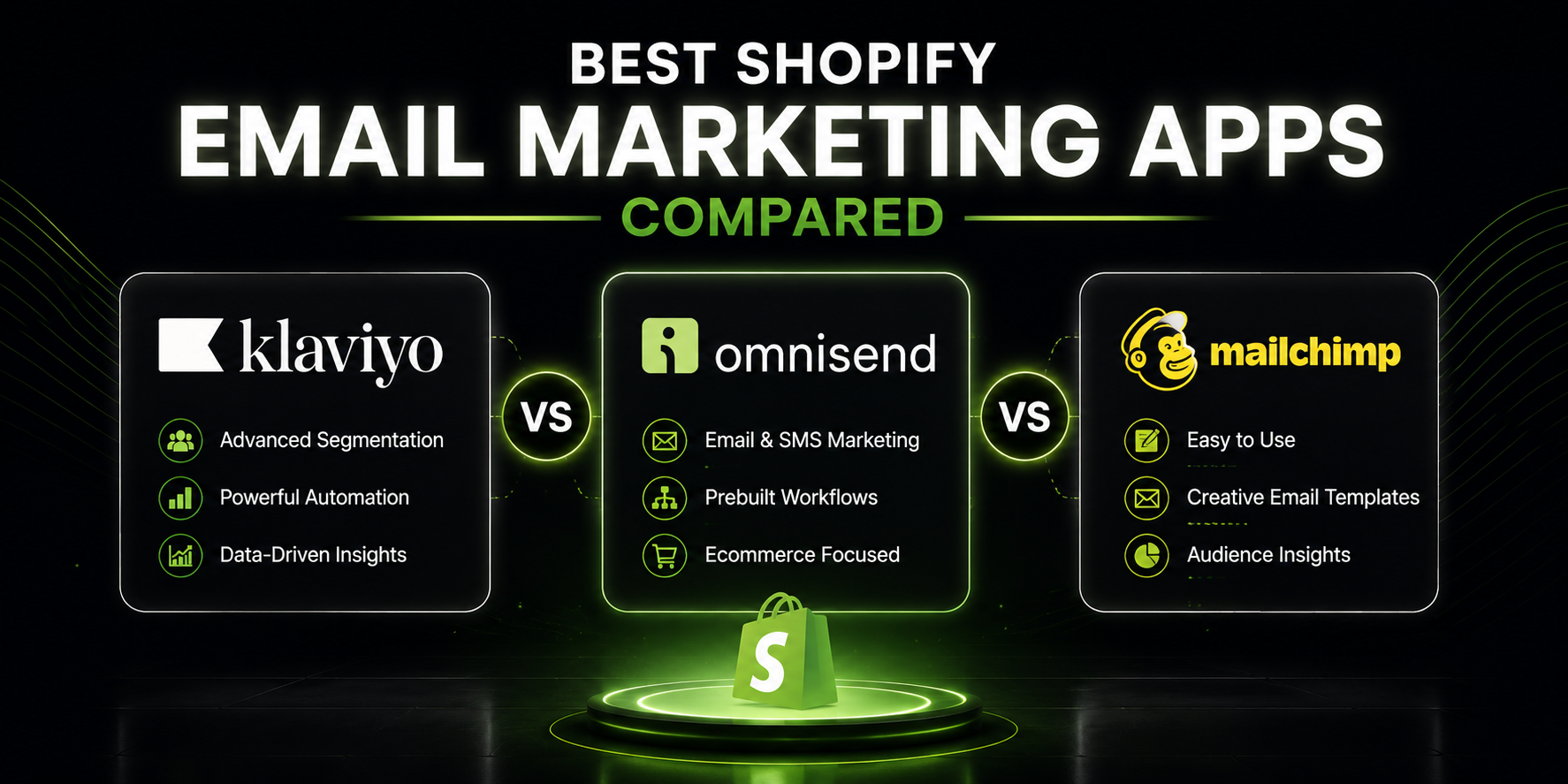
Best Shopify Email Marketing Apps Compared (Klaviyo vs Omnisend vs Mailchimp)
Let me paint a picture for you.
You have spent months building your Shopify store. You have great products. You have figured out how to drive traffic. You are getting visitors, some sales, and a growing list of customers who have already bought from you at least once.
Now what?
How do you bring those customers back? How do you turn a one time buyer into someone who purchases from you again and again? How do you stay top of mind with the people on your email list without manually writing and sending every single email yourself?
The answer is email marketing. And more specifically, the right email marketing app connected to your Shopify store.
But here is where it gets complicated. There are dozens of email marketing tools out there. And three of them come up over and over again in every conversation about Shopify email marketing: Klaviyo, Omnisend, and Mailchimp.
All three are popular. All three integrate with Shopify. All three will let you send emails to your subscribers. But they are not the same tool. They are built differently, they serve different types of businesses, and choosing the wrong one for your store can cost you time, money, and a lot of frustration down the road.
This post is going to break down all three in detail. What each one does well, where each one falls short, how their pricing works, and most importantly, which one is the right fit depending on where your store is and where you want to take it.
By the end of this, you will know exactly which tool to use and why. No guessing. No going back and forth. Just a clear, informed decision.
Let us start with the one that dominates the conversation when it comes to serious Shopify stores.
Klaviyo: The Powerhouse Built for E Commerce
If you spend any time in Shopify communities, Facebook groups, or e commerce forums, you will hear one name come up more than any other when the topic is email marketing.
Klaviyo.
There is a reason for that. Klaviyo was built specifically and exclusively for e commerce businesses. It was not originally designed as a general email marketing tool that later added some shopping cart features. It was designed from the ground up to integrate with platforms like Shopify and to help online stores drive revenue through email.
That focus shows in everything it does.
What makes Klaviyo different.
The foundation of what makes Klaviyo so powerful is its data layer. When you connect Klaviyo to your Shopify store, it pulls in a comprehensive picture of every customer. Their purchase history. The specific products they have viewed. How much they have spent in total. How often they buy. When they last purchased. What categories they browse most. Whether they are a first-time buyer or a loyal repeat customer.
All of that data is available to you in real time, and more importantly, it is all usable for segmentation and targeting.
Segmentation in Klaviyo is where the real magic happens.
You are not just sending emails to your list as one big group. You are creating highly specific audience segments based on real behavior. You can build a segment of customers who have purchased more than twice in the last 90 days. You can create a segment of people who viewed a specific product three or more times but never bought it. You can target people who spent over a certain dollar amount. You can identify customers who have not purchased in 180 days and are at risk of churning.
Then you can send each of those segments a message that is directly relevant to their specific situation. And that level of relevance is what makes the difference between email marketing that generates real revenue and email marketing that people ignore.
Klaviyo’s automation flows.
Klaviyo comes loaded with pre-built automation flows that cover the most important moments in the customer journey.
The welcome series automatically sends a sequence of emails to every new subscriber, introducing your brand, showcasing your bestsellers, and guiding them toward their first purchase. This alone can dramatically increase conversion rates from new subscribers.
The abandoned cart flow triggers when someone adds items to their cart and leaves without buying. This is one of the highest-revenue automations in e-commerce. Klaviyo sends a sequence of reminder emails, often with dynamic content showing the exact products they left behind, and many stores recover 10 to 20 percent of abandoned carts through this flow alone.
The browse abandonment flow is one step earlier than cart abandonment. It triggers when someone views a product multiple times without adding it to their cart. This is a warmer lead than most people realize, and a well-timed email mentioning the product they keep looking at can be very effective.
The post-purchase flow sends a sequence of emails after someone makes a purchase. A thank you email, product care or usage tips, a request for a review, and then eventually a prompt to come back and shop again. This flow is what turns first time buyers into repeat customers.
The win-back flow targets subscribers or customers who have gone quiet. Someone who bought from you six months ago and has not opened an email or visited your store since gets a re engagement campaign designed to bring them back.
All of these flows can be customized extensively. You can change the timing, the messaging, add conditional branches so the flow behaves differently based on what the customer does next, and layer in additional emails as needed.
Klaviyo’s reporting.
Klaviyo’s analytics are among the best in the industry for e commerce. Every email and every flow is tied directly to revenue data from your Shopify store. You can see exactly how much money each campaign generated, what the revenue per recipient was, which automation flows are performing and which need work.
This is not just vanity metrics like open rates and click rates, though those are tracked too. It is actual dollars and cents tied back to email activity. That makes it genuinely useful for making decisions about where to invest your time and energy.
Where Klaviyo falls short.
Klaviyo is not a beginner friendly tool. The interface is comprehensive and feature rich, which means the learning curve is steeper than the other two options. If you are brand new to email marketing, it can feel overwhelming at first.
The other significant factor is price. Klaviyo is the most expensive of the three tools, especially as your list grows. The free plan covers up to 500 contacts and 500 email sends per month, which is very limited. Once you start scaling, the monthly cost increases noticeably.
For stores doing significant revenue, the Klaviyo investment is almost always justified because the tool generates enough return to pay for itself many times over. But for a brand new store that is still finding its feet, the pricing can feel like a stretch.
Who is Klaviyo best for?
Klaviyo is the best choice for established Shopify stores that are serious about email marketing as a revenue channel. If you are doing consistent monthly revenue, have a growing email list, and want the most powerful segmentation and automation tools available, Klaviyo is the clear leader.
It is also worth starting with Klaviyo even if you are earlier in your journey, specifically because migrating your email list and rebuilding all your automations later is a headache. If you know you are going to grow, building on Klaviyo from the start saves you a painful transition later.
Omnisend: The All in One Tool Built for Growing Stores
Omnisend sits in an interesting position in this comparison.
It is not as basic or entry-level as Mailchimp. But it is not as purely data-driven or technically deep as Klaviyo. It occupies a well-designed middle ground that makes it a genuinely excellent choice for a lot of Shopify stores, particularly those that are past the very early stage but not yet at the scale where Klaviyo’s full power is necessary.
What sets Omnisend apart from both of its competitors in this comparison is its multichannel approach. Omnisend is not just an email marketing tool. It is a marketing automation platform that lets you reach customers across multiple channels from a single dashboard.
Omnisend’s multichannel capabilities.
In addition to email, Omnisend lets you send SMS messages, push notifications, and even WhatsApp messages depending on your plan and region. All of these channels can be combined within a single automation workflow.
This is genuinely powerful for e commerce. Think about an abandoned cart flow that does not just send an email. It sends an email first. If the cart is still not recovered after a few hours, it sends an SMS with a link directly to the cart. If they still have not purchased, a push notification goes out the next morning.
That multi-touch approach reaches customers through the channel they are most likely to respond to, rather than betting everything on a single medium. And because it is all set up in one workflow within Omnisend, managing it is not complicated.
For brands that have a customer base that is highly engaged on mobile, or that want to build SMS into their marketing strategy alongside email, Omnisend offers this in a much more integrated and cost-effective way than Klaviyo.
Omnisend’s automation and segmentation.
Omnisend covers all the core automation flows that an e commerce store needs. Welcome series, abandoned cart, post-purchase, browse abandonment, and win-back campaigns are all available with pre built templates you can customize.
The automation builder is visual and intuitive. You can see the flow laid out as a clear diagram, add steps, set timing delays, create conditional branches, and understand the full logic of your automation at a glance. The learning curve here is notably gentler than Klaviyo, which makes it a much more approachable tool for people who are newer to marketing automation.
Segmentation in Omnisend is solid. You can segment based on purchase history, engagement levels, browsing behavior, location, custom properties, and more. It is not quite as granular or as deep as Klaviyo’s segmentation capabilities, but it covers what the majority of growing e-commerce stores need and does it in a way that is easier to set up and manage.
Omnisend’s templates and design tools.
Omnisend has a strong email template library with dozens of professionally designed options specifically built for e-commerce. Product blocks, discount code widgets, and scratch card elements make the email design process faster and more engaging.
The drag and drop email builder is clean, responsive, and easy to use. You do not need any design experience to put together a good looking email in Omnisend. The output is consistently polished and professional.
Omnisend’s reporting.
Omnisend’s analytics are solid and getting better. You can track revenue attribution, campaign performance, automation flow results, and audience growth over time. The reporting is not quite at the depth of Klaviyo’s, but it gives you a clear picture of what is working and what is not.
One feature worth mentioning is Omnisend’s campaign booster, which automatically resends a campaign to subscribers who did not open the first email, but with a different subject line. This can noticeably increase the effective reach of a campaign without any extra manual work.
Where Omnisend falls short.
The main limitation of Omnisend is the depth of its e commerce data integration compared to Klaviyo. The segmentation and behavioral data available in Klaviyo is more detailed and more actionable, particularly for large stores with complex customer journeys.
If you are running a high volume Shopify store with thousands of daily transactions and a sophisticated email marketing strategy, you may eventually find yourself bumping up against Omnisend’s limitations. At that scale, Klaviyo’s deeper data layer becomes genuinely important.
But for the majority of growing e commerce stores, those limitations are not something they will encounter anytime soon.
Who is Omnisend best for?
Omnisend is the best choice for Shopify stores that are past the beginning stage, want solid automation and segmentation without a steep learning curve, and are interested in combining email with SMS and other channels in a single platform. It hits a sweet spot of power, usability, and pricing that makes it a compelling choice for a wide range of stores.
If you are growing steadily and want a tool that grows with you, covers multiple channels, and does not require a deep technical background to use effectively, Omnisend is an excellent choice.
Mailchimp: The Familiar Name With a Complicated Shopify History
Mailchimp is one of the most recognized names in email marketing. If you have ever signed up for a newsletter, read an email with a quirky chimp logo at the bottom, or heard someone mention email marketing to a non marketer, there is a good chance Mailchimp came up.
Its brand recognition is massive. Its user base is enormous. And for a long time, it was the go to recommendation for anyone just starting out with email marketing.
But when it comes to Shopify specifically, the story is more complicated. And there are some important things to understand before you decide whether Mailchimp is right for your store.
The Shopify and Mailchimp relationship.
In 2019, Mailchimp and Shopify had a very public falling out. The official Mailchimp app was removed from the Shopify App Store following a dispute over data sharing practices. For a period of time, there was no direct, official integration between the two platforms.
Since then, third-party integration tools like ShopSync have been developed to bridge the gap, and Mailchimp has worked to restore functionality with Shopify. The integration works today, but it is worth knowing that it is not as native or as seamless as the Klaviyo or Omnisend integrations. You may need an additional app to connect the two, and the depth of data syncing is not always as complete.
This history matters because the tight, real-time data integration between your email tool and your Shopify store is what powers the most effective e-commerce automations. A less seamless integration means slightly less powerful automation capabilities.
What Mailchimp does well.
Mailchimp’s biggest strength is its ease of use and its accessibility for beginners.
The interface is clean, friendly, and intuitive. If you have never used an email marketing tool before in your life, you can open a Mailchimp account and send your first campaign within an hour. The drag and drop email builder is one of the most beginner friendly in the industry. The template library is extensive. The setup process is guided and clear.
For someone who is completely new to email marketing and just wants to get started with basic newsletters and a simple welcome email, Mailchimp removes almost all the friction.
Mailchimp also has a free plan that is genuinely usable in the early stages. The free tier allows up to 500 contacts and 1,000 email sends per month, which is workable for a store that is just starting to build its list.
Mailchimp’s automation capabilities.
Mailchimp has added more automation features over the years, and the basics are covered. You can set up a welcome email, a simple abandoned cart reminder, a post-purchase follow up, and a re engagement campaign.
But the automation builder is more limited in depth and flexibility than what you get with Klaviyo or Omnisend. The conditional logic, the multi step branching, and the behavioral triggers that make automation truly powerful are not as sophisticated. For basic automation needs, Mailchimp is fine. For complex, behavior driven flows that adapt based on customer actions, it starts to feel limiting relatively quickly.
Mailchimp’s segmentation.
Segmentation in Mailchimp is available but noticeably less powerful than in Klaviyo or Omnisend. You can segment based on purchase activity, engagement, location, and custom tags, but the granularity is lower and building complex segments takes more manual effort.
For a store with a small list and simple segmentation needs, this is not a problem. For a store that wants to send highly targeted campaigns based on detailed purchase history and behavioral data, Mailchimp’s segmentation will eventually feel restrictive.
Mailchimp’s pricing.
This is where Mailchimp has lost a lot of its competitive edge over the past few years.
Mailchimp’s pricing used to be significantly more affordable than its competitors, which was a major reason so many businesses chose it. But successive price increases have brought Mailchimp’s paid tiers much closer in cost to tools like Omnisend, and in some cases even more expensive, without offering a comparable level of e-commerce specific functionality.
For a Shopify store specifically, the value comparison does not work in Mailchimp’s favor at the paid tiers. You can often get more e-commerce relevant features for a similar or lower price from Omnisend.
Where Mailchimp falls short for Shopify stores.
The combination of the less seamless Shopify integration, the less powerful e-commerce automation capabilities, the less granular segmentation, and the no-longer-significantly-cheaper pricing means that Mailchimp is genuinely harder to recommend for Shopify stores specifically than it was a few years ago.
It is a solid general email marketing tool. For blogs, service businesses, nonprofits, or any use case that is not specifically e commerce focused, it remains a perfectly good option. But for a Shopify store that wants to use email marketing as a serious revenue driver, it is the weakest of the three options in this comparison.
Who is Mailchimp best for?
Mailchimp makes the most sense for a Shopify store owner who is in the very earliest stages, has a tiny list, a very limited budget, and just wants to get started with email marketing in the simplest way possible.
If that describes you right now, starting with Mailchimp is not a disaster. It will get you moving. But go in with the awareness that you will likely need to migrate to a more e-commerce focused tool as your store grows, and plan for that transition so it does not catch you off guard.
Head-to-Head Comparison: The Key Differences
Now that we have covered each tool in depth, let us put them side by side on the factors that matter most for a Shopify store owner making this decision.
Shopify integration depth.
Klaviyo wins this category without question. Its Shopify integration is the deepest and most real time of the three. Every customer action, purchase, browse event, and cart update syncs immediately. Omnisend is close behind with a strong native integration. Mailchimp is the weakest here due to its complicated history with Shopify and the need for third-party tools to bridge the gap.
Automation power and flexibility.
Again, Klaviyo leads. The depth of conditional logic, the behavioral triggers, and the ability to create sophisticated multi step flows based on granular customer data is unmatched. Omnisend is genuinely strong here and handles everything most growing stores need. Mailchimp covers the basics but falls short on complexity and flexibility.
Multichannel marketing.
This is where Omnisend stands out. If combining email with SMS, push notifications, and other channels in a single workflow matters to your strategy, Omnisend is purpose-built for that. Klaviyo also has SMS capabilities, but the multichannel integration is not as central to the platform’s design. Mailchimp’s multichannel options are much more limited.
Ease of use.
Mailchimp is the simplest to get started with. Omnisend is close behind and more intuitive than most people expect for how capable it is. Klaviyo has the steepest learning curve of the three, though its interface has improved significantly in recent years.
Pricing and value for e commerce.
All three have free plans for small lists. As you scale, Klaviyo becomes the most expensive but also typically generates the most revenue for stores that use it effectively. Omnisend offers strong value across its paid tiers, particularly given the multichannel capabilities included. Mailchimp’s paid plans are no longer the bargain they once were, and the e-commerce value does not match up against Omnisend at comparable price points.
Reporting and analytics.
Klaviyo has the most detailed revenue-focused reporting, tying email activity directly to Shopify sales data in a way that is highly actionable. Omnisend’s reporting is solid and improving. Mailchimp’s reporting is adequate for basic needs but less useful for serious e commerce decision making.
So Which One Should You Choose?
Here is the honest answer, broken down simply.
Choose Klaviyo if your store is generating consistent revenue, you are serious about email marketing as a growth channel, you want the deepest Shopify integration available, and you are willing to invest time learning a more powerful tool. Klaviyo is the best long term platform for scaling Shopify stores, and if you are going to grow into it, starting early saves you a painful migration later.
Choose Omnisend if you are a growing store that wants powerful automation and solid segmentation without the complexity of Klaviyo, you want to combine email and SMS marketing in one place, or you are looking for excellent value across multiple channels at a competitive price point. Omnisend is the best all-around choice for stores in a growth phase that want capability without overwhelm.
Choose Mailchimp if you are brand new to email marketing, your list is very small, your budget is extremely tight, and you just want the simplest possible way to get started. Just know that you will likely outgrow it for Shopify-specific needs and should plan for an eventual migration.
Final Thoughts
Picking the right email marketing app for your Shopify store is one of those decisions that seems small in the moment but has a significant impact on your business over time.
The right tool, set up properly with good automations and smart segmentation, will bring customers back to your store on autopilot. It will recover abandoned carts. It will turn first-time buyers into loyal repeat customers. It will generate revenue from your existing audience without you spending a single extra dollar on ads.
The wrong tool, or the right tool set up poorly, will sit unused in your Shopify dashboard while that potential goes to waste.
Do not overthink the decision. Pick the tool that matches where your store is right now and where you want it to be in the next 12 months. Get it connected. Build your first few automations. Start sending.
You can always optimize and improve from there. But you cannot get back the customers you could have re-engaged if you had started sooner.
Start today. Your email list is waiting.