How to Avoid Common Dropshipping Mistakes on Shopify
Here’s a number that should make every new dropshipper pay attention: the vast majority of Shopify dropshipping stores close down within the first few months of launching. Not because dropshipping doesn’t work anymore it absolutely still does but because the same handful of avoidable mistakes keep taking down store after store. Bad supplier choices, weak product research, unrealistic pricing, no traffic plan, and a store that looks thrown together in an afternoon.
The good news is that every one of these mistakes is completely preventable once you know what to look for. This guide walks through the most common dropshipping mistakes Shopify sellers make, why each one is so damaging, and exactly how to avoid them so you’re not learning these lessons the expensive way.
Mistake #1: Picking suppliers based on price alone
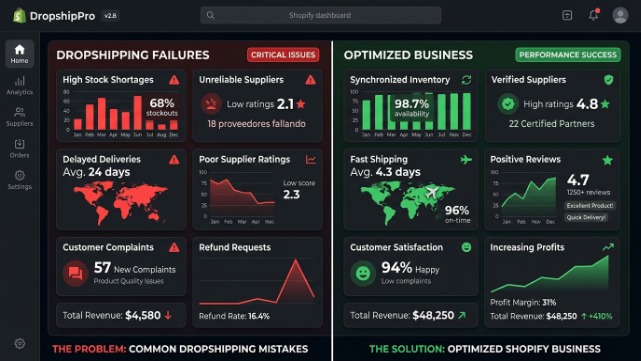
This is, hands down, the most common and most costly mistake in Shopify dropshipping. A new seller finds a product on AliExpress priced a dollar cheaper than a competing supplier and goes with the cheaper option without checking anything else no reviews, no sample order, no track record. Then three weeks later, shipping is delayed, the product arrives looking nothing like the photos, and the supplier goes silent when you try to reach them.
An unreliable supplier doesn’t just cost you one bad order. It generates chargebacks, tanks your store rating, and burns through the ad budget you spent acquiring that customer in the first place. Fix this by always ordering a sample before listing a product at scale, checking supplier ratings and review history, and confirming written return and refund terms upfront. Vetted platforms like Zendrop, Spocket, or CJ Dropshipping have already done a layer of supplier screening for you, which is exactly why sourcing through an established supplier network beats cold-picking a random AliExpress seller with zero track record.
It’s also worth having a backup supplier for your best-selling products. Relying on a single source for your top items means one stockout or one bad batch can take down your best revenue driver overnight.
Mistake #2: Ignoring the real math behind your margins
A lot of beginners price products on gut feeling “I’ll sell it for double what I pay” without accounting for everything else eating into that sale. Shipping costs, ad spend to acquire the customer, payment processing fees (typically around 2.9% plus a flat fee per transaction), your monthly Shopify subscription, and returns all chip away at that number before you see a dollar of real profit.
Run the actual formula: selling price minus product cost, minus shipping, minus ad spend, minus platform and processing fees, minus expected returns equals your real net profit. Once dropshippers actually do this math, a lot of “profitable” products turn out to be barely breaking even. A safe target is aiming for at least 30% gross margin after product and shipping costs, which leaves enough room to absorb ad spend, occasional refunds, and currency fluctuations if you’re sourcing internationally.
Mistake #3: Skipping product research and chasing gut feelings
Listing a product because it “looks cool” or because a competitor’s store seems to be doing well with it is a fast way to burn through ad budget with nothing to show for it. Winning products solve a specific problem, create genuine emotional appeal, and show real, sustained demand not just a one week spike.
Before committing to any product, check Google Trends for a steady upward interest curve, look at the Meta Ad Library and TikTok Creative Center to see whether the product is already heavily saturated with ads, and read reviews on similar listings to understand what customers actually want fixed. If dozens of stores are already running ads for the exact same product and the trend line is flat or dropping, that’s your signal to move on rather than jump in late.
Mistake #4: Overpromising on shipping times (or hiding them entirely)
Nothing destroys a new Shopify store’s reputation faster than a customer who ordered expecting a week and waited five. Customers in 2026 expect transparency and reasonable delivery windows, and when those expectations aren’t met, refunds, chargebacks, and one star reviews follow almost immediately. Beyond the reputational damage, hiding unreasonably long delivery times on your product pages can also run you into trouble with advertising platform policies and consumer protection regulations, which require honest disclosure of shipping expectations.
The fix is straightforward: state your actual shipping timeframes clearly on every product page, and lean toward suppliers with faster fulfillment platforms like Spocket or Zendrop that offer US or EU based warehousing can cut delivery times down to a matter of days rather than weeks. If a longer international shipping window is genuinely unavoidable for a particular product, say so upfront rather than letting the customer find out after they’ve already paid.
Mistake #5: Launching a store that looks unfinished
Many customers decide within seconds of landing on your store whether they trust it enough to buy. A messy layout, stock product photos ripped straight from the supplier page, broken navigation, or a missing returns policy will tank your conversion rate even if the product itself is genuinely good. Store design isn’t a cosmetic afterthought in dropshipping — it’s doing a huge share of the trust-building work that a physical retail store would otherwise handle through in person presence.
Keep your Shopify store clean, mobile friendly, and easy to navigate. Rewrite product descriptions in your own voice instead of copy-pasting straight from the supplier original, benefit focused copy converts noticeably better and also protects you from thin, duplicate content SEO issues. Make sure your shipping policy, return policy, and contact information are easy to find, since their absence is one of the fastest ways to spike cart abandonment.
Mistake #6: Relying entirely on paid ads for traffic
A lot of new dropshippers treat Facebook or TikTok ads as their entire marketing strategy, pouring their whole budget into paid traffic with no organic presence backing it up. This works fine until ad costs climb or a campaign underperforms, and suddenly there’s no other channel bringing in customers. Relying solely on paid traffic also drives up your customer acquisition cost over time, since you’re competing purely on ad spend rather than building any compounding organic advantage.
Diversify early. Build out SEO optimized product and blog content that captures organic search traffic, build a presence on the social platforms where your audience already spends time, and consider email and SMS marketing to squeeze more value out of the customers you’ve already acquired rather than treating every sale as a one-time transaction.
Mistake #7: No system for tracking orders and inventory
Once your order volume picks up past a handful a day, manually checking out every order and manually tracking stock levels becomes unmanageable, and mistakes creep in fast orders placed twice, orders missed entirely, products sold that are actually out of stock at the supplier. Supplier unreliability and stock issues remain one of the leading causes of dropshipping failure, and a huge chunk of that is actually a lack of automated tracking rather than the supplier itself being bad.
This is where dropshipping automation earns its keep. Tools like DSers, AutoDS, or Zendrop sync inventory in real time, route orders automatically to your supplier, and update tracking information without manual intervention, which removes the exact category of human error that sinks so many growing stores.
Mistake #8: Installing too many paid apps
It’s tempting to install every Shopify app that promises to boost conversions, automate a task, or add a slick feature. But each app comes with its own monthly cost, and a bloated app stack quietly eats into your margin every single month whether or not those apps are actually driving meaningful revenue. Worse, too many apps running simultaneously can slow down your store’s load speed, which directly hurts both conversion rates and SEO rankings.
Audit your installed apps every few months and ask honestly whether each one is earning its subscription cost. Keep only what’s genuinely moving the needle — usually a lean stack of a fulfillment/automation app, an email marketing tool, and maybe one conversion focused app like reviews or upsells is enough for most growing stores.
Mistake #9: Treating dropshipping as passive income
Maybe the most damaging mistake of all isn’t operational it’s a mindset problem. A lot of beginners go in expecting a hands-off, “set it and forget it” income stream, inspired by YouTube videos promising quick riches. When the first month brings five sales instead of five hundred, discouragement sets in fast, and many people quit right before the momentum they were building would have paid off.
Dropshipping is a real business. It requires active management of suppliers, marketing, customer service, and continuous testing realistically ten to twenty hours a week even with strong automation in place, more if you’re doing everything manually. Budgeting your time and capital realistically from day one, rather than expecting overnight results, is what separates sellers who stick around long enough to succeed from the ones who quit in month two.
Mistake #10: No plan for customer service and returns
New sellers often underestimate how much of their week gets eaten by customer service once orders start coming in “where’s my order,” refund requests, sizing questions, address changes. Without a clear process, response times slip, customers get frustrated, and negative reviews start piling up faster than positive ones.
Set up an order-tracking page so customers can self serve basic status checks, prepare canned responses for your most frequent questions, and write a clear, visible returns policy before you ever need to enforce one. Even a simple structure here dramatically reduces the day to day support burden as your order volume grows.
Avoiding these mistakes as a Pakistani Shopify seller
If you’re running your store from Pakistan, a couple of these mistakes show up with a local twist worth flagging separately. Overpromising on shipping is especially risky if you’re combining an international supplier with local delivery customers expecting a domestic-feel experience need honest expectations set upfront, particularly with customs clearance delays factored in.
Cash on Delivery, still the dominant payment method for a large share of Pakistani online shoppers, introduces its own version of the “no tracking system” mistake without a confirmation step before dispatch, COD refusal rates at the doorstep can quietly eat your margins even on products that are technically selling well. Confirming orders via WhatsApp before forwarding them to your supplier is a simple, low-cost fix that a lot of successful local sellers already build into their process. And when choosing couriers for the local leg of fulfillment, treat reliability the same way you’d vet an international supplier Leopards, TCS, and M&P all have different strengths depending on the city and product type, and picking based on price alone repeats mistake #1 in a different form.
The bottom line
Nearly every dropshipping failure traces back to a small, repeatable set of mistakes bad supplier vetting, ignoring real margin math, weak product research, an unfinished looking store, and treating the business as more passive than it actually is. None of these require some secret insider trick to fix. They require structure, honesty with yourself about the numbers, and a willingness to build systems instead of relying on hustle alone.