How to Build a Successful Shopify Dropshipping Business
There’s a particular kind of excitement that comes with the idea of starting a dropshipping business. No inventory to buy upfront, no warehouse to manage, no boxes piling up in your spare room. You pick products, you market them, and a supplier handles the rest. It sounds almost too easy, and for a while, it kind of was. But if you’ve spent any time looking into dropshipping recently, you’ve probably noticed the conversation has changed. The old playbook of importing random AliExpress products and throwing some Facebook ads at them doesn’t work the way it used to, and honestly, that’s a good thing.
Let’s talk about what actually building a successful Shopify dropshipping business looks like today, what’s changed, what still works, and how to set yourself up properly from day one instead of learning everything the hard way.
Why the old dropshipping playbook stopped working
A few years ago, the barrier to entry for dropshipping was almost nonexistent. You could spin up a store, import a few trending products, and start running ads within an afternoon. That low barrier is exactly what made the space so crowded, and it’s also what made customers increasingly skeptical of stores that felt thrown together.
Customers now expect fast shipping, professional packaging, and reliable customer service, none of which were considered table stakes just a few years back. That shift matters enormously, because a store that can’t deliver on those expectations loses trust almost instantly, and in dropshipping specifically, trust is everything. You don’t have a physical location customers can walk into, you don’t have years of brand history backing you up, so every signal on your store either builds confidence or quietly chips away at it.
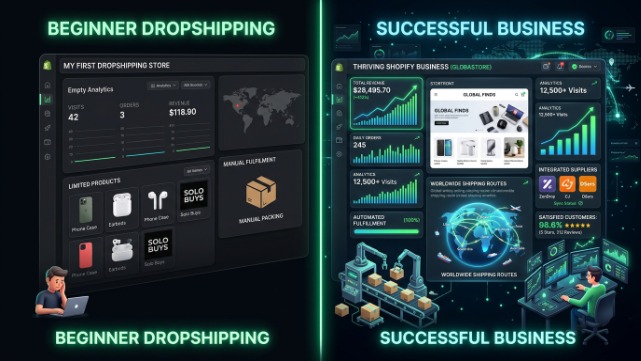
The sellers actually succeeding these days are the ones treating dropshipping as a real, structured business rather than a quick side hustle, with proper automation, vetted suppliers, and a genuine brand identity behind the store. That doesn’t mean dropshipping has gotten harder in some unfair way. It means the bar has risen to match what customers now expect from any online store, dropshipped or not, and merchants who meet that bar are still building genuinely profitable businesses.
Step one: pick a niche you can actually defend
Before touching suppliers or apps, the foundation of everything is choosing what you’re actually going to sell. This is the step most beginners rush through, and it’s the one that determines almost everything downstream, your marketing angle, your customer trust, and your margins.
A good niche has a few things going for it. First, it solves a real problem or taps into a real interest rather than just being a random trending gadget with no lasting appeal. Trending products can generate a quick spike in sales, but they rarely build a sustainable business, because once the trend fades, so does your traffic and your reason for existing. Second, it should have enough product depth that you can build out a full catalog and eventually cross sell and upsell, rather than being a one product store with nowhere to go. Third, it needs healthy margins after accounting for product cost, shipping, and advertising, which usually rules out ultra cheap, ultra competitive categories where you’re fighting a hundred other stores selling the exact same item at the exact same price.
Popular categories that continue to perform well include cosmetic kits, fitness equipment, home decor goods, and consumer electronics, though popularity alone isn’t a reason to pick a niche. The stores that actually last tend to combine a genuine interest or expertise from the founder with a market that has room for a distinct brand angle, rather than just copying whatever’s currently trending on someone else’s TikTok feed.
Step two: choose suppliers you can actually trust
This is where dropshipping success or failure often gets decided quietly, long before a single ad ever runs. Your supplier relationship determines your shipping times, your product quality, and ultimately how much of your customer service headache is even in your control.
For beginners just getting their footing, DSers and CJ Dropshipping remain two of the most accessible starting points, both offering meaningful functionality without a subscription, and both built with a shallow learning curve. DSers, as the official AliExpress partner, helps import products, manage orders across multiple stores, and find reliable suppliers with tools like a Supplier Optimizer that compares options on pricing and performance history.
As you grow, shipping speed becomes a much bigger priority than it was when you were just validating an idea. Customers expect five to seven day delivery at minimum, and suppliers shipping purely from overseas often can’t deliver that consistently, which is where suppliers offering domestic or regional fulfillment become worth the extra cost. Zendrop, for example, has built a reputation specifically around US based fulfillment enabling one to five day shipping on eligible products, alongside branded packaging and automated order processing, which matters a lot if you’re targeting US or EU customers who are used to fast delivery from major retailers. Spocket is similarly known for fast US and EU shipping paired with generally higher product quality, while Syncee operates as a large global marketplace connecting stores to millions of products from verified suppliers across many countries, useful if you’re building a niche that doesn’t fit neatly into a single region’s supplier network.
If you’re leaning toward custom branded products rather than generic items, print on demand platforms like Printful and Printify let you create unique designs on everything from apparel to home goods, manufactured and shipped only when an order comes in, which combines the no-inventory benefit of dropshipping with a genuinely differentiated product line rather than reselling the exact same item as dozens of other stores.
Whatever supplier you choose, it’s worth building relationships with more than one from early on. Poor supply chain management can lead to stockouts that push customers straight to competitors, and the supply chain world is genuinely volatile, with shifting tariffs, shipping delays, and labor shortages all capable of disrupting a single-supplier setup with little warning. Having a backup supplier lined up, even informally, protects you from a disruption that could otherwise stall your entire store.
Step three: automate the operational grind early
One of the biggest mistakes new dropshippers make is treating order fulfillment as something they’ll manually manage forever. That works fine at ten orders a week. It becomes a full-time data-entry job at a hundred, and it becomes genuinely unmanageable well before you hit real scale.
Modern dropshipping apps can automate product imports, inventory updates, order forwarding to suppliers, and tracking number syncing, and the more of this you automate early, the more time you free up for the parts of the business that actually require your judgment, like marketing, brand building, and customer relationships. Basic automation, like auto-forwarding orders to your supplier the moment they come in, is available in most apps at little to no cost. More advanced automation, like multi-supplier routing rules and real-time inventory sync across several supplier feeds at once, tends to require more robust tools once you’re operating at real volume.
A useful way to think about this is matching your tooling to your actual order volume rather than over-investing too early. If you’re doing under fifty orders a month, your priority should be finding products and validating demand, not building an elaborate automation stack, so a free tool like DSers or CJ Dropshipping is genuinely enough. Once you’re in the fifty-to-five-hundred-orders-a-month range, shipping complaints tend to become your biggest headache, which is usually the point where investing in a supplier offering faster regional fulfillment starts paying for itself. Beyond a thousand orders a month, especially across multiple channels, you’re effectively running a real logistics operation and need tools built for that level, with API-grade supplier integrations and proper exception handling for failed orders.
Step four: build a store that actually looks like a brand
This is the part that separates stores that scale from stores that quietly fizzle out after a few months. A poorly designed, generic-feeling store kills customer trust almost instantly, and rebuilding that trust after a bad first impression is far harder than getting it right from the start.
Invest in product photography and descriptions that don’t look copy-pasted straight from a supplier listing. Even small touches, custom product photos, a clear and specific brand voice in your copy, thoughtfully organized collections, signal to a first-time visitor that they’re buying from a real, considered business rather than a dropshipping store thrown together over a weekend. AI powered store builder tools have made this dramatically more accessible than it used to be, generating layouts, product copy, and even bundled upsells without needing design or coding skills, which levels the playing field considerably for solo founders who don’t have a design background.
Make sure your policies are visible and clearly written. Shipping timelines, return policies, and contact information should be easy to find, not buried three clicks deep, since uncertainty around these details is one of the fastest ways to lose a hesitant buyer at checkout. And take compliance seriously as you scale into running ads across different regions, since privacy regulations and consent requirements vary by market and getting caught out by them can quietly threaten a store that’s otherwise doing everything right.
Step five: get your unit economics right before you scale
It’s easy to get swept up in traffic and order volume and forget to actually check whether you’re making money. Dropshipping margins can look healthy on paper and evaporate the moment you factor in advertising costs, payment processing fees, and returns.
Track your true net profit at the store, product, and even ad level rather than just watching top line revenue, since vanity metrics like total sales can mask a business that’s actually losing money once real costs are accounted for. This is especially important in the early testing phase, when you’re likely running paid ads on unproven products and need to know quickly whether a product is genuinely profitable or just generating traffic that costs more than it returns.
Print-on-demand and niche branded products, when done well, tend to allow considerably healthier margins than generic mass-market items, sometimes in the range of 20 to 80 percent depending on the category, precisely because you’re not competing purely on price against a dozen identical listings. Building your catalog with margin in mind from the start, rather than chasing whatever’s cheapest to import, makes a meaningful difference to how sustainable your business actually is once ad costs are factored in.
Step six: treat customer service as part of your product
Since you don’t control the physical fulfillment process directly, customer service becomes one of the only places where your brand can genuinely differentiate itself from every other store sourcing similar products. A customer who gets a fast, helpful response when something goes wrong is far more likely to become a repeat buyer than one who gets ignored, even if the original issue was a supplier’s fault rather than yours.
This is where automation tools built for customer service genuinely pay off in dropshipping specifically, handling order tracking questions and basic inquiries instantly so customers aren’t left wondering where a package shipped from overseas actually is. Pairing this with proactive post purchase communication, letting customers know their order is on its way and roughly when to expect it, goes a long way toward reducing the anxious “where’s my order” messages that otherwise flood a dropshipper’s inbox.
A note for Pakistani entrepreneurs building dropshipping stores
Dropshipping from Pakistan comes with a genuinely different set of considerations than dropshipping from the US or UK, mostly because the model itself works best when targeting international customers rather than the local Pakistani market. Cash on Delivery, which dominates domestic Pakistani ecommerce, doesn’t pair naturally with dropshipping’s typical fulfillment timelines and supplier relationships, so most successful Pakistani dropshippers build their stores to sell into the US, UK, EU, Canada, or Australia rather than selling locally.
Payment gateway access is one of the first practical hurdles to sort out. Since Shopify Payments isn’t directly available in Pakistan, most Pakistani dropshippers rely on third-party payment processors that support Pakistani business registration, and it’s worth researching and setting this up properly before investing heavily in ads, since payment friction at this stage can derail an otherwise solid store.
Supplier communication and time zone management matter more than they might for a merchant based closer to their target market. If you’re sourcing from suppliers in China while selling to customers in the US, you’re managing a three-way time difference between yourself, your supplier, and your customer base, which makes clear, documented communication and realistic customer-facing shipping expectations especially important to get right from day one.
Currency and pricing strategy deserve early attention too. Pricing your store correctly in USD, GBP, or EUR while managing costs in PKR requires factoring in currency fluctuation as a real business variable, not an afterthought, particularly since ad spend on platforms like Meta or Google is typically billed in the currency of your target market.
And building credibility as a Pakistan-based store selling internationally is worth being intentional about. A professional-looking store, responsive customer service, and clear, honest shipping timelines all matter even more when you’re an unfamiliar brand to an international customer who has no other context for trusting you. Getting these fundamentals genuinely right is often the biggest differentiator between Pakistani dropshipping stores that scale into real businesses and ones that struggle to gain traction.
Bringing it all together
Dropshipping in 2026 isn’t the low-effort side hustle it was sometimes made out to be a few years ago, and honestly, that’s what makes it a more legitimate path to real income for the people willing to treat it seriously. Pick a niche you can actually build a brand around, choose suppliers who won’t let your customers down, automate the operational grind early, and invest in making your store feel like a real business rather than a temporary experiment. Do that consistently, and dropshipping remains a genuinely viable way to build a profitable Shopify store from scratch.