How to Choose a Shopify Migration Expert
Migrating your store to Shopify is one of those decisions that sounds simple on paper and turns into a minefield the moment you actually start looking for someone to do it. You’ve probably already seen the ads, the Fiverr gigs promising “24 hour migration,” and the agencies quoting wildly different prices for what’s supposedly the same job. So how do you actually pick the right person or team to move your store without losing your SEO rankings, your product history, your customer data, or your sanity?
Let’s talk through it properly.
Why Shopify Migration Isn’t Just “Copy Paste”
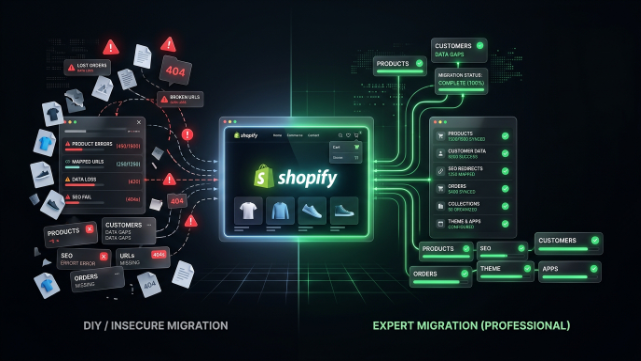
A lot of store owners assume migration is basically exporting a CSV file and importing it somewhere else. If only it were that easy. A real migration involves moving your products, collections, customer records, order history, reviews, blog content, URL structures, redirects, and often custom functionality that your old platform had baked in.
Get any one of these wrong and you’re looking at broken links, lost search rankings, angry customers who can’t find their order history, or a store that just looks and feels off compared to what you had before. This is exactly why the person or agency you hire matters so much. A good migration expert isn’t just moving data, they’re protecting everything you built before the move.
Start By Understanding What “Migration Expert” Actually Means
Here’s something people don’t talk about enough. Not everyone who says they do Shopify migrations actually specializes in migrations. Some are theme developers who occasionally handle a migration as a side task. Some are general Shopify agencies who treat migration like any other project. And some genuinely live and breathe platform transfers, whether that’s WooCommerce to Shopify, Magento to Shopify, BigCommerce to Shopify, or even older custom built sites.
The distinction matters because migrations have their own quirks. Someone who’s built fifty Shopify stores from scratch might still fumble a migration because they’ve never had to deal with preserving URL structures for SEO or mapping metafields from a completely different data schema. When you’re vetting candidates, ask directly: how many migrations have you done, and from which platforms specifically?
Check Their Track Record With Actual Proof
Talk is cheap in this industry, and unfortunately so are portfolios sometimes. Anyone can show you a live Shopify store and claim they migrated it. What you want is proof of the process, not just the end result.
Ask for before and after examples where they can walk you through what the old site looked like, what challenges came up, and how they solved them. A real expert will happily talk about the messy parts of a migration because that’s where the actual skill shows. If someone only wants to show you the pretty final product and gets vague when you ask about the transition process itself, that’s worth noticing.
It also helps to ask for references you can actually contact, not just testimonials sitting on their website. A five minute call with a past client can tell you more than an hour of sales pitch.
SEO Preservation Should Be Non Negotiable
This is probably the single biggest area where migrations go wrong, and it’s the one that costs store owners the most money long term. When you move platforms, your URL structure often changes completely. WooCommerce URLs look nothing like Shopify URLs. If those old URLs aren’t properly redirected with 301 redirects, you lose all the search engine equity you built up over months or years.
A good migration expert will map out every single URL redirect before touching anything live. They’ll also make sure your meta titles, meta descriptions, alt text, and structured data carry over instead of resetting to generic defaults. Ask specifically how they handle SEO during migration. If they don’t have a clear, detailed answer, that’s a red flag no matter how good their design portfolio looks.
Some agencies even do a full SEO audit before and after migration to confirm nothing dropped. That level of care is what separates someone who does migrations properly from someone who’s just moving files around.
Data Integrity Is Where Trust Gets Tested
Your customer data, order history, and product reviews are some of your most valuable business assets. When you’re choosing who handles your migration, ask exactly how they plan to migrate this information and what backup process they follow in case something goes wrong.
A professional will always take a full backup of your existing store before starting anything. They’ll also test the migration on a staging environment first rather than making changes directly on your live store. If someone tells you they’ll just migrate everything live without a staging test, walk away. That’s not confidence, that’s carelessness.
Reviews are particularly tricky because Shopify doesn’t have a native reviews system, so migrating reviews usually means using an app like Judge.me or Loox and importing historical review data into it. Ask how they plan to handle this specifically, because it’s often overlooked until the last minute.
Ask About Their Process, Not Just Their Price
Pricing varies wildly in this space, and honestly, the cheapest quote is rarely the best deal once you factor in what gets missed. Instead of asking “how much,” ask “what’s included.”
A proper migration process usually looks something like this: an initial audit of your existing store, a full data backup, a staging environment build, product and customer data transfer, redirect mapping, testing across devices, a pre launch review with you, and post-launch monitoring for a set period after going live. If a quote skips several of these steps or bundles everything into one vague line item, ask why.
Also clarify what happens if something breaks after launch. Do they offer a support window? Is that included in the price or billed separately? These details matter more than the sticker price itself.
Communication Style Matters More Than People Expect
You’re going to be working closely with whoever handles your migration, often over a period of days or weeks depending on your store’s complexity. If communication feels slow, vague, or overly technical without explanation, that’s going to be frustrating throughout the whole process.
Pay attention to how they communicate during the sales conversation itself. Do they explain things in a way you actually understand, or do they throw jargon at you to sound impressive? Do they respond promptly, or does it take days to hear back? These early signals usually predict how the entire working relationship will go.
Technical Skills You Should Look For
Beyond the general experience, there are specific technical capabilities worth confirming. Ask if they’re comfortable working with Shopify’s Liquid templating language, since custom theme adjustments often come up during migration. Ask about their experience with Shopify’s API, especially if you have a large catalog or complex integrations like ERP systems, custom pricing rules, or third party apps that need to carry over.
If your current store has custom functionality, like subscription models, wholesale pricing tiers, or multi currency setups, make sure whoever you’re hiring has actually handled similar complexity before. Migrating a simple 50 product store is a very different job than migrating a 5,000 SKU catalog with B2B pricing logic baked in.
Why Pakistan Based Businesses Have Extra Considerations
If you’re running a store based in Pakistan or serving the Pakistani market, there are a few extra things worth checking during migration. Make sure your migration expert understands how to properly set up local payment gateways like JazzCash, Easypaisa, or bank transfer options alongside international payment methods. These integrations don’t always transfer automatically and often need to be reconfigured from scratch on Shopify.
Cash on delivery is still a dominant payment method for a huge portion of Pakistani ecommerce, so confirm your migration expert knows how to properly configure COD as a checkout option, including any COD verification apps you might already be using or want to add.
Courier integrations matter too. If you’re using local couriers like Leopards, TCS, or M&P, make sure whoever handles your migration either has experience connecting these services to Shopify or is willing to research and test the integration properly rather than leaving you to figure it out post launch.
Currency and pricing display is another detail that gets missed. If your old store was showing PKR pricing with specific formatting or tax handling, confirm this carries over correctly rather than defaulting to USD or an awkward currency format that confuses local customers.
Red Flags To Watch Out For
A few warning signs should make you pause before hiring anyone for your migration. Be cautious if someone promises an unrealistically fast timeline for a complex store, since rushed migrations are where the most damage happens. Be wary if they can’t clearly explain their SEO redirect strategy when asked directly. Watch out for vague answers about backups and staging environments. And be careful of anyone who wants full upfront payment before any work begins, especially if you have no way to verify their previous work.
On the flip side, trust builds when someone walks you through their process unprompted, asks detailed questions about your specific store setup, and is upfront about challenges your migration might face rather than promising a flawless experience with zero effort.
Questions Worth Asking Before You Hire Anyone
Before signing off on any migration project, here are the conversations worth having directly. Ask how many similar migrations they’ve completed and request to speak with at least one past client. Ask specifically how they handle SEO redirects and metadata preservation. Ask what their backup and staging process looks like. Ask what happens if something breaks after launch and whether that’s covered. And ask how they’ll handle any custom functionality specific to your store, like subscriptions, wholesale pricing, or local payment integrations if you’re serving the Pakistani market.
The answers to these questions will tell you far more about whether someone is the right fit than any portfolio or price quote ever could.
Timeline Expectations You Should Have
A straightforward store with a few hundred products and no complex custom functionality typically takes anywhere from one to two weeks for a proper migration, including testing. Larger catalogs with thousands of products, custom integrations, or multi currency setups can take three to six weeks or longer depending on complexity.
Be suspicious of anyone promising a same day or 48 hour turnaround for anything beyond the simplest store. Migrations done that fast usually skip critical steps like proper testing, redirect mapping, or data verification, and you often don’t find out what got missed until weeks later when something breaks or your traffic drops unexpectedly.
What Happens After The Migration Goes Live
The work shouldn’t stop the moment your new Shopify store goes live. A good migration expert will monitor your store closely for at least a week or two after launch, checking for broken links, missing redirects, checkout issues, or any data that didn’t transfer correctly. They should also be checking your search console and analytics to confirm your SEO rankings are holding steady rather than dropping off after the switch.
Ask upfront whether this post launch monitoring period is included in your quote, because it genuinely makes a difference in catching small issues before they become bigger problems.
Making Your Final Decision
At the end of the day, choosing a Shopify migration expert comes down to trust built through specifics. Anyone can say they’re experienced, but the ones worth hiring will show you their process, answer detailed questions without hesitation, and treat your data with the seriousness it deserves. Don’t rush this decision just because you’re eager to get off your current platform. A rushed migration that breaks your SEO or loses customer data will cost you far more time and money than taking an extra week to find the right person for the job.
If you’re currently weighing your options and want a team that’s handled Shopify migrations for stores of all sizes, including those with Pakistan specific payment gateways, courier integrations, and COD workflows, TheScriptFlow has been doing exactly this kind of work for clients locally and internationally. Reach out and we’ll walk you through exactly how we’d approach your specific migration, no vague promises, just a clear plan built around what your store actually needs.