How to Drive Traffic to a New Shopify Store
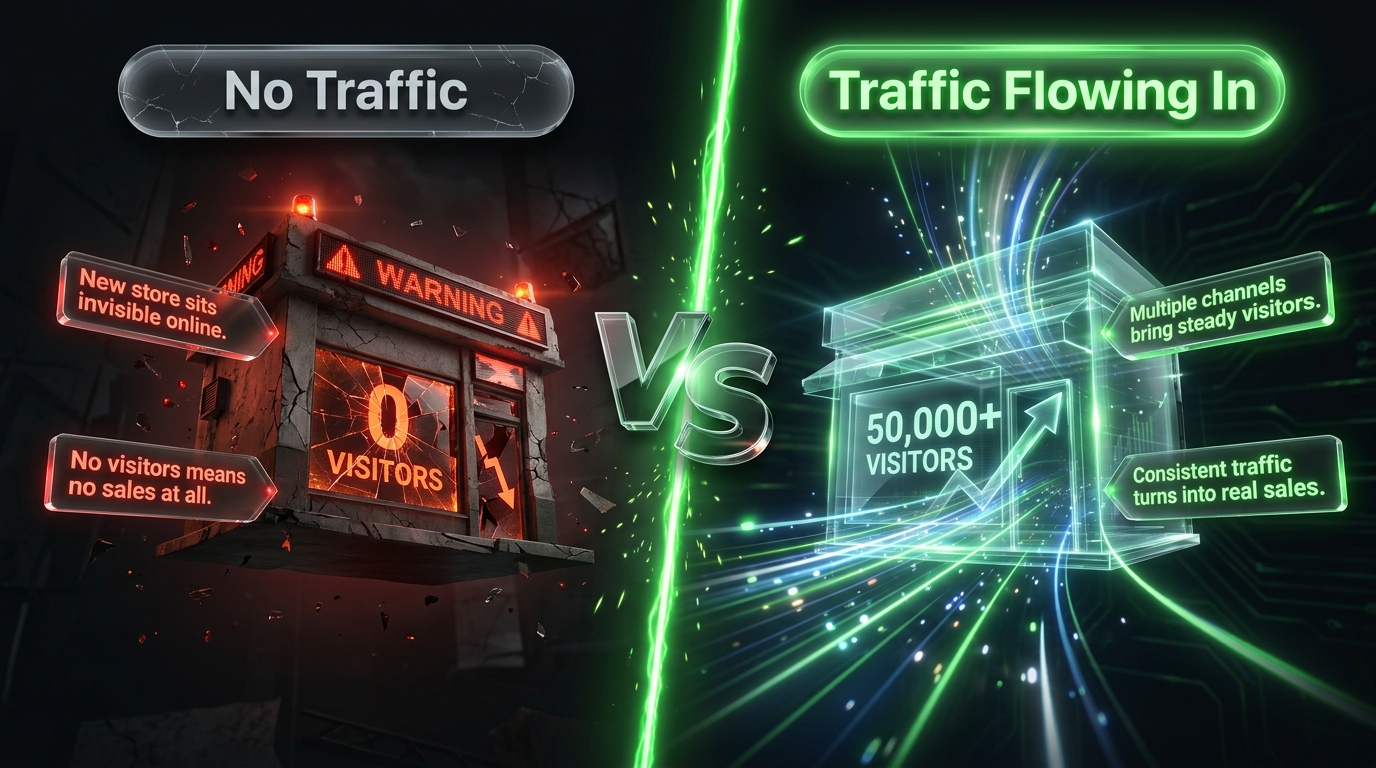
You’ve built your store, your products are live, and your checkout is working perfectly. And then… nothing happens. No visitors, no orders, just an empty analytics dashboard staring back at you. This is one of the most common and most discouraging moments in the entire Shopify journey, and it happens because building a store and driving traffic to it are two completely separate skills. In this guide, I’m going to walk you through every realistic way to get real, targeted visitors to your new store, starting with the free methods and moving into paid strategies once you have a bit of budget to work with.
Why Traffic Is Harder Than People Expect
New store owners often assume that once their store is live, customers will naturally find it. Unfortunately, the internet doesn’t work that way. Google needs time to index and rank a brand new site, social media algorithms favor established accounts with engagement history, and paid ads require budget and testing before they become efficient. This means your first few weeks of traffic almost always require deliberate, manual effort rather than passive discovery. Understanding this upfront saves you from the discouragement that causes so many new store owners to give up right when momentum was about to build.
Start with Organic Social Media
Social media is the single most accessible traffic source for a brand-new store with no existing audience, because it costs nothing but time and consistency. TikTok and Instagram Reels are especially powerful if your product has any visual appeal, since short form video content gets distributed to new audiences based on engagement rather than your existing follower count. Post consistently, ideally daily in the early weeks, showing your product in real use, behind the scenes content of your process, or trending formats adapted to your niche. Don’t aim for polish here, aim for authenticity, since slightly rough, relatable content routinely outperforms overly produced ads in these early discovery phases. Use relevant hashtags and participate in trending audio or formats where it makes sense, since these genuinely do help new accounts get initial visibility.
Tap Into Communities Where Your Customers Already Are
Rather than trying to build an audience from scratch, go find audiences that already exist. Facebook groups built around your niche, whether that’s parenting, fitness, home decor, or whatever your product category is, are full of people actively discussing and recommending products. Join these groups and genuinely participate for a while before ever mentioning your store, answering questions and being helpful, so that when you do share what you’re building, it doesn’t read as spam. Reddit works similarly, with niche subreddits often having highly engaged, purchase ready audiences, though you’ll want to read each community’s rules carefully since many are strict about self-promotion. The goal here isn’t to blast links everywhere, it’s to become a recognized, trusted presence in spaces your customers already frequent.
Leverage Micro-Influencers Instead of Big Names
You don’t need a celebrity endorsement to drive meaningful traffic. Micro influencers, those with anywhere from a few thousand to a hundred thousand engaged followers, often have far higher trust with their audience than larger accounts, and many are open to product collaborations in exchange for free product rather than cash, especially early in their own growth. Search your niche’s hashtags to find accounts whose audience matches your target customer, and reach out with a genuine, personalized message rather than a generic template. Even a handful of these collaborations can send a meaningful, targeted wave of traffic your way, and the content they create can often be repurposed on your own social channels afterward.
Write SEO Content That Compounds Over Time
Unlike social media traffic, which requires constant fresh content to maintain, SEO traffic compounds over time and keeps working long after you’ve published it. Start a blog on your Shopify store covering topics your target customers are actually searching for, whether that’s buying guides, how to content, or comparisons relevant to your niche. Optimize your product and collection pages with proper titles, meta descriptions, and natural keyword usage, since these pages can rank in search results independently of your blog content. This strategy takes longer to show results than social media or ads, often several months before you see meaningful organic traffic, but it’s one of the few traffic sources that doesn’t require ongoing spend or constant content creation to sustain.
Build Your Email List from Day One
Email might not feel like a traffic source in the traditional sense, but it becomes one of your most valuable channels over time, and it costs nothing to start. Set up a popup offering a small discount in exchange for an email address, and make sure it’s not overly aggressive or it’ll hurt your user experience. Every subscriber you capture, even before you have a large list, is someone you can bring back to your store through welcome sequences, promotions, and new product announcements without spending a rupee on ads. The list you build in these early weeks becomes a genuine traffic asset that grows more valuable every month.
Start Small with Paid Social Ads
Once you’ve validated that your product converts with organic traffic, even at a small scale, it’s time to consider paid ads carefully. Meta ads and TikTok ads are the most accessible starting points for most niches, letting you test with a modest daily budget rather than requiring a large upfront commitment. Test two or three different creative angles rather than betting everything on a single ad, since you often can’t predict in advance which angle will resonate. Keep a close eye on your cost per click and, more importantly, your cost per purchase, since a cheap click that never converts isn’t actually cheap traffic at all. Retargeting ads, shown to people who’ve already visited your store but didn’t buy, typically convert at a much higher rate than cold traffic, making them one of the most efficient early uses of a small ad budget.
Consider Google Ads for High Intent Traffic
While social ads are great for discovery, Google Ads can capture customers who are already actively searching for what you sell, which often means higher purchase intent. Search ads targeting specific product keywords can be highly effective, though they typically require a slightly higher budget to gather enough data for optimization. Google Shopping ads, which display your product image and price directly in search results, are particularly effective for ecommerce since they let customers compare options visually before ever clicking through to your store. Start small, monitor performance closely, and scale only the campaigns that show a clear, positive return.
Use Pinterest If Your Products Are Visual
Pinterest is genuinely underrated as a traffic source for certain niches, particularly home decor, fashion, beauty, food, and DIY products. Unlike other social platforms, Pinterest content has a long shelf life, with pins continuing to drive traffic months after posting, since it functions more like a visual search engine than a traditional social feed. Create pins for your products and blog content, use keyword rich descriptions, and pin consistently to build momentum over time. If your niche fits, this can become a surprisingly steady, low-effort traffic source once established.
Collaborate and Cross Promote
Look for other small brands or creators in complementary, non competing niches and explore cross-promotion opportunities, whether that’s a joint giveaway, a shoutout exchange, or a bundled promotion. This tactic costs nothing beyond outreach effort and can expose your store to an entirely new audience that already trusts the recommendation because it’s coming from a brand or creator they already follow, rather than a cold ad.
Track Where Your Traffic Actually Comes From
None of these tactics matter if you’re not measuring which ones are actually working. Set up Google Analytics 4 alongside Shopify’s built in analytics so you can see exactly which channels are driving visitors, and more importantly, which channels are driving buyers rather than just browsers. A traffic source that brings a lot of visitors but very few sales is far less valuable than a smaller source that consistently converts. Review this data weekly in your first months, since patterns become visible quickly once you’re actively looking, and let that data guide where you invest your next round of time and budget.
Driving Traffic to a Store Based in Pakistan
If you’re running your store from Pakistan, a few local factors should shape your traffic strategy. Facebook and Instagram remain the dominant social platforms for reaching Pakistani consumers, so prioritizing content and community engagement there tends to deliver stronger early results than platforms with smaller local user bases. WhatsApp is worth building into your traffic and conversion strategy too, since sharing your store link in relevant WhatsApp groups or using WhatsApp catalogs alongside your Shopify store can drive genuinely engaged, purchase ready traffic. When running paid ads, factor in that Cash on Delivery remains the dominant payment preference locally, so your ad messaging and landing pages should clearly highlight COD availability alongside JazzCash and Easypaisa, since traffic that arrives but doesn’t see a familiar payment method often bounces without converting. And when working with local couriers like Leopards, TCS, or M&P, mentioning realistic delivery timelines in your marketing builds the kind of trust that turns curious traffic into confident buyers.
Common Traffic Mistakes New Store Owners Make
Don’t jump straight into paid ads before validating that your product and store actually convert with organic traffic, since you’ll just be paying to discover problems you could have found for free. Don’t spread yourself across too many channels at once in the early weeks, since consistent effort on two or three platforms beats scattered, inconsistent effort across six. Don’t ignore email capture until later, since every early visitor who leaves without subscribing is a lost opportunity to bring them back for free. And don’t judge a traffic channel too quickly, since some sources, particularly SEO and Pinterest, take months to show their full potential and abandoning them too early means missing out on their long-term compounding value.
Final Thoughts
Driving traffic to a new Shopify store is rarely about finding one magic channel that solves everything. It’s about layering organic social content, community engagement, influencer collaborations, SEO, email capture, and eventually paid ads into a system where each channel reinforces the others. The stores that grow fastest aren’t necessarily the ones with the biggest budgets, they’re the ones that show up consistently, track what’s actually working, and double down on the channels that prove themselves with real data rather than guesswork.