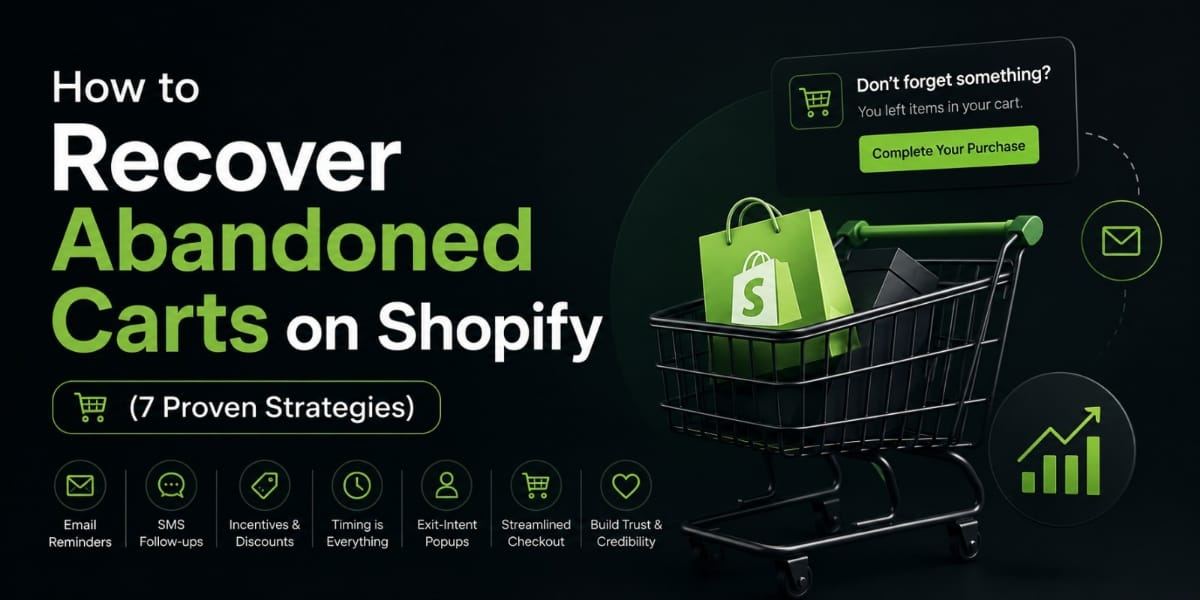
How to Recover Abandoned Carts on Shopify (7 Proven Strategies)
Let me paint a picture that might feel uncomfortably familiar.
Someone finds your Shopify store. Maybe through an Instagram ad, maybe through a Google search, maybe through a friend’s recommendation. They land on your product page. They read the description. They look at the photos. They check the reviews.
They like what they see.
So they add the item to their cart. Maybe two items. Maybe three. They click through to checkout. They start filling in their details.
And then they stop.
They close the tab. They put their phone down. They get distracted by something else. And just like that, a sale that was seconds away from happening disappears.
That scenario plays out thousands of times every single day across Shopify stores all over the world. And the numbers behind it are genuinely staggering.
Research consistently shows that somewhere between sixty and eighty percent of all online shopping carts are abandoned before the purchase is completed. On average, that means for every ten people who add something to their cart on your store, seven of them leave without buying.
Seven out of ten.
Think about what that means in real terms for your business. Think about the ad spend, the SEO effort, the content creation, and the time you have invested in driving traffic to your store. All of that effort brings people to the point where they are actively adding your products to their cart. And then the majority of them walk away before the transaction completes.
That is not just a conversion problem. It is a revenue leak. And it is happening right now, quietly, on your store, every single day.
But here is the other side of that story.
Most of those people did not abandon because they decided they did not want the product. They abandoned for a much more recoverable set of reasons. An unexpected shipping cost. A moment of hesitation. A distraction. A question they could not find the answer to. A payment method they prefer that was not available. A moment of indecision that needed nothing more than a gentle nudge to resolve.
These are not lost causes. These are warm leads who got close and needed a little more help getting over the line.
And with the right recovery strategies in place, a significant portion of those abandoned carts can be converted into completed purchases. Some stores recover ten percent of abandoned carts. Some recover twenty or even thirty percent with a well built, well executed recovery system.
That recovery revenue does not require any new traffic. It does not require a bigger ad budget. It just requires the right strategies applied to the customers you have already worked hard to attract.
This guide is going to walk you through seven proven strategies to recover abandoned carts on your Shopify store. Each one is explained in detail, with specific guidance on how to implement it and why it works.
Let us get into it.
First, Understand Why Shoppers Actually Abandon
Before we talk about how to recover abandoned carts, it is worth spending a moment understanding why they happen in the first place.
Because the recovery strategy that works best depends significantly on the reason behind the abandonment. And if you understand the real reasons, you can build a recovery system that addresses all of them rather than just the most obvious one.
Research into cart abandonment behavior consistently identifies the same core reasons across different industries and store types.
Unexpected costs at checkout are the number one cause of cart abandonment. Someone sees a product priced at thirty dollars. They go through the checkout process and suddenly discover that shipping is twelve dollars. That is a forty percent increase in the total cost they were expecting to pay. That surprise is jarring, and for many shoppers, it is enough to kill the sale completely.
Being forced to create an account is another major driver of abandonment. Someone wants to make a quick purchase. They do not want to set up a username and password and verify an email address just to buy one item. If your checkout requires account creation before purchase, you are losing a significant number of sales.
A complicated or lengthy checkout process frustrates shoppers who are used to the frictionless experience of major platforms. Too many steps, too many form fields, too many pages to navigate through, and the patience of even a motivated buyer starts to wear thin.
Payment security concerns cause some shoppers to hesitate, particularly on stores they have not purchased from before. If your checkout does not look trustworthy, if there are no security badges, no recognizable payment logos, no clear indicators that their information is safe, some shoppers will simply decide the risk is not worth it.
Browsing or comparison shopping accounts for a meaningful chunk of abandoned carts. Some people add items to carts as a way of saving them or keeping track while they compare options across multiple stores. These are not necessarily lost sales, but they need a different recovery approach than someone who genuinely forgot or got distracted.
Payment method limitations cause abandonment when shoppers prefer a payment method you do not offer. If they want to pay with a specific digital wallet or buy now pay later service and it is not available at your checkout, they may leave.
Distractions and interruptions are responsible for a large portion of cart abandonment that has nothing to do with your store at all. A phone call comes in. A child needs attention. The bus arrives. The shopper fully intended to complete the purchase and simply never got back to it.
Understanding this range of reasons is important because it tells you that cart recovery is not just about sending a reminder email. It is about addressing multiple different barriers to purchase through multiple different channels and strategies working together.
That is exactly what this guide is going to show you how to do.
Strategy 1: Build a Three Part Abandoned Cart Email Sequence
Email is the foundation of any cart recovery strategy. It is the channel with the highest reach, the most flexibility, and consistently one of the best returns on investment in e-commerce.
But a single reminder email is not a cart recovery strategy. It is a starting point. The difference between a basic recovery attempt and a genuinely effective one is the structure and sophistication of the email sequence you send.
A three-part abandoned cart email sequence is the standard that consistently delivers the best results for Shopify stores. Each email serves a specific purpose, reaches a different type of abandoner, and addresses a different layer of hesitation.
Email one: The friendly reminder.
This email goes out within one to three hours of the cart being abandoned. Timing is everything with the first email. The sooner it arrives after the abandonment, the higher the chance of recovery, because the purchase intent is still fresh and the shopper is likely still in a buying mindset.
The tone of this email should be light, helpful, and friendly. Not aggressive. Not desperate. Just a warm, natural reminder that feels like a helpful nudge rather than a sales push.
Show them exactly what they left behind. Include product images, names, prices, and a single prominent button that takes them directly back to their cart with one click. The fewer steps between the email and the completed purchase, the better.
Do not include a discount in this first email. There are two good reasons for this. First, many abandoners will convert without one, and giving away margin unnecessarily reduces your profitability. Second, training your customers to abandon carts in order to receive a discount in the follow up email is a pattern you do not want to create.
Keep the subject line of this first email direct and clear. Something like “You left something behind” or “Your cart is waiting for you” communicates the purpose without being pushy.
Email two: The trust builder.
This email goes out twenty four hours after the first if the cart is still not converted.
By this point, if the shopper has not returned, there is likely a reason beyond simple forgetfulness. They may have a question they could not find the answer to. They may be uncertain about the quality or the fit of the product. They may have a concern about your return policy or your shipping times.
Email two is designed to address those potential hesitations directly.
Include four or five strong customer reviews specifically for the products in their cart. Genuine, specific reviews that speak to quality, fit, durability, or whatever aspect of the product matters most to your customers. Reviews from real people are far more persuasive than anything you could write yourself.
Add a brief, clear section about your return policy and shipping times. Remove the friction of uncertainty by making it crystal clear that buying from you is risk-free. If you offer free returns or a satisfaction guarantee, say it prominently.
If you have any trust badges, security certifications, or recognizable payment logos, include them in this email as well.
End with a clear call to action back to their cart. No discount yet, but a warmer, more information-rich message that removes the barriers that might be holding them back.
Email three: The incentive.
This email goes out forty eight hours after the abandonment if the cart is still not converted.
By now you have reminded them twice. You have addressed potential hesitations. If they are still on the fence, a modest but genuine incentive is often the final nudge that converts a hesitant abandoner into a buyer.
Offer something meaningful. A ten or fifteen percent discount code. Free shipping. A small free gift with their order. Whatever makes most sense for your margins and your product.
Create genuine urgency around the offer. Make the code valid for twenty four or forty eight hours. Tell them the offer expires and mean it. Artificial urgency that gets reset every time someone visits destroys trust. Real urgency that reflects an actual deadline motivates action.
Keep this email short and focused. The offer is the message. Make the code prominent, make the button clear, and make it as easy as possible to complete the purchase before the offer expires.
Strategy 2: Send Abandoned Cart SMS Messages
Email is essential. But it is not the only recovery channel available to you.
SMS has some properties that make it uniquely powerful for cart recovery. Open rates for text messages are dramatically higher than email. Most text messages are read within minutes of being received. And unlike email, which sits in an inbox competing with dozens of other messages, a text message arrives on the most personal device your customer owns and demands immediate attention.
For cart recovery specifically, the combination of speed and visibility makes SMS a genuinely effective complement to your email sequence.
The key to SMS cart recovery is brevity and clarity. You have very limited space and you are landing in a personal space. The message needs to be short, direct, and respectful of that intimacy.
A good abandoned cart SMS message does three things. It reminds the shopper what they left behind, ideally naming the specific product. It makes it trivially easy to return to the cart with a direct link. And if it includes an incentive, it makes that offer absolutely clear.
Something like: “Still thinking about your
A follow-up SMS, if you send one, should be sent at least twenty-four hours after the first and should include the incentive if they still have not converted. Keep the same brevity. Get in, deliver the value, and get out.
You need explicit opt-in for SMS marketing, which means you can only use this channel for subscribers who have agreed to receive text messages. But for those who have, SMS recovery can add meaningful incremental revenue on top of your email sequence.
Tools like Klaviyo and Omnisend both support combined email and SMS cart abandonment flows that let you manage both channels from a single automation without needing separate tools.
Strategy 3: Use Exit Intent Pop Ups on Your Checkout Page
Some cart abandonment happens before you even have the opportunity to follow up via email. The visitor never got far enough into the checkout process to provide their email address. They added items to their cart, started heading toward checkout, and then changed their mind before entering any contact information.
For these visitors, email and SMS recovery are not options because you do not have their contact details. But you can still intervene in real time before they leave.
Exit-intent technology detects when a visitor is about to navigate away from your page, typically by tracking cursor movement toward the browser navigation bar or the back button, and triggers a pop-up at that exact moment.
An exit-intent pop-up on your cart or checkout page gives you one last chance to address whatever is causing the abandonment before the visitor disappears entirely.
The message in this pop-up should directly address the most common reasons for abandonment at that stage. If unexpected shipping costs are a major issue for your store, a pop-up that appears as someone is leaving the checkout and offers free shipping on their order can stop a significant number of abandoners in their tracks.
Something like “Wait, before you go. Complete your order in the next twenty minutes and we will cover your shipping costs” is direct, relevant, and removes a real barrier in real time.
You can also use the exit-intent pop-up to collect an email address from visitors who were about to leave without providing one. Offer a small incentive in exchange for their email and the promise to hold their cart. Even if they do not complete the purchase immediately, you now have a way to follow up.
Keep the design of your exit-intent pop-up clean and on-brand. The message should be concise and the call to action should be unmistakably clear. One offer. One button. No clutter.
Apps like Privy, OptiMonk, and Justuno all work well with Shopify and offer exit intent pop up functionality with good customization options.
Strategy 4: Optimize Your Checkout Process to Reduce Abandonment
Every strategy discussed so far is about recovering carts after they have been abandoned. But the most effective cart recovery strategy of all is reducing abandonment in the first place by removing the friction that causes it.
Your checkout process is where the sale is either won or lost. And for many Shopify stores, the checkout is full of small friction points that collectively add up to a significant number of lost sales.
Here is a systematic way to think about checkout optimization.
Enable guest checkout.
If your store currently requires shoppers to create an account before completing a purchase, change this immediately. Guest checkout is one of the single most impactful changes you can make to reduce cart abandonment.
Shopify makes enabling guest checkout straightforward in your settings. Give shoppers the option to check out as a guest, and offer them the opportunity to create an account after the purchase is complete, when they are already invested in the transaction, rather than before.
Show all costs as early as possible.
Unexpected costs at checkout are the leading cause of cart abandonment. The solution is to eliminate the surprise entirely by showing shoppers the full cost of their order as early in the process as possible.
Add a shipping cost estimator to your cart page that lets shoppers enter their location and see the estimated shipping cost before they even begin the formal checkout process. If you offer free shipping above a certain order value, display that threshold prominently throughout the shopping experience, not just at checkout.
When there are no surprise costs waiting at the end of the checkout process, a major reason for abandonment disappears.
Reduce the number of checkout steps.
Every additional step in your checkout process is an opportunity for a shopper to change their mind. Shopify’s native checkout is already fairly streamlined, but if you have added apps or customizations that have introduced extra steps or form fields, audit those additions critically.
Ask only for the information you genuinely need. Remove any optional fields that add length without adding value. Make autofill work correctly so shoppers can breeze through the form without typing every detail manually.
Offer multiple payment options.
Payment method limitations cause more abandonment than most store owners realize. Make sure you accept all the payment methods your customers prefer.
Shopify Payments covers the basics, but also consider enabling Shop Pay, PayPal, Apple Pay, Google Pay, and buy now pay later options like Afterpay or Klarna. Each additional payment option you add removes a barrier for a different segment of your customer base.
Buy-now-pay-later options in particular have become increasingly important for higher-priced products. Offering the ability to split a payment into four interest-free installments can meaningfully increase conversion rates on orders that a customer wants but hesitates to commit to all at once.
Make your checkout look trustworthy.
First-time customers who have never bought from your store before need visual reassurance that their payment information is safe. Include security badges and SSL indicators visibly in your checkout. Display recognizable payment logos. Include a brief, clear statement about how their information is protected.
These trust signals cost nothing to add and can make a meaningful difference in conversion rates, particularly for visitors who are new to your store.
The best cart recovery strategy is one that means fewer carts need recovering in the first place. Checkout optimization and abandonment recovery work together as a system, and investing in both is how you maximize the revenue from every visitor who adds something to their cart.
Strategy 5: Retarget Abandoners With Paid Ads
Email and SMS can only reach abandoners whose contact information you have. But what about the visitors who added items to their cart and left without providing any contact details at all?
Paid retargeting fills that gap.
Retargeting works by using pixel tracking technology to identify visitors who took specific actions on your store, in this case adding items to their cart and not completing the purchase, and then showing them targeted ads as they browse other websites and social media platforms.
A shopper who abandoned their cart on your Shopify store can see a Facebook or Instagram ad showing the exact products they left behind. They are browsing Instagram, they see the item they were looking at, and the reminder brings them back.
This is not intrusive or random advertising. It is a highly relevant reminder to someone who was already demonstrably interested in your products. The targeting is precise, the message is relevant, and the conversion rates for retargeted cart abandoners are consistently higher than for cold traffic.
How to set up cart abandonment retargeting for Shopify.
The foundation is the Meta Pixel, installed on your Shopify store, which tracks visitor behavior and sends that data back to Facebook and Instagram. Using custom audience capabilities, you can create a specific audience segment of people who added items to their cart but did not purchase within a defined time window.
You then create a retargeting campaign specifically for this audience. The creative should show the products they viewed or added to their cart, which is possible through dynamic product ads that automatically pull product images and details from your Shopify catalog.
The ad copy should be straightforward and direct. Something like “You left something behind” or “Still thinking about this?” acknowledges that they were on your site without being intrusive. Include a clear call to action and link directly back to the cart or the product page.
Google also offers retargeting capabilities through its display network and shopping campaigns, which can extend your reach to abandoners as they browse other websites and use Google search.
Retargeting and email work best as complementary channels rather than substitutes for each other. A shopper who receives your cart abandonment email and also sees your retargeting ad encounters two separate touchpoints that reinforce each other and keep your products top of mind.
The combined effect of email plus retargeting is consistently higher than either channel working alone.
Strategy 6: Add a Persistent Cart and Cross Device Sync
Here is a cart abandonment scenario that does not get talked about enough.
Someone is browsing your Shopify store on their phone during their lunch break. They add a few items to their cart. They get called back to work. They plan to finish the purchase later at home on their laptop.
They open your store on their laptop. Their cart is empty.
The items they added on their phone are not there. They would have to search for the products again, find the right variants, add everything back, and essentially start the process from scratch. Many people simply do not bother. They close the laptop and the purchase never happens.
This is cross-device abandonment, and it is a growing issue as more shoppers bounce between multiple devices throughout the day.
The solution is a persistent cart that is tied to a customer’s account or email address rather than just their browser session on a specific device. When a logged-in customer adds items to their cart on any device, those items should be waiting in their cart when they log in on any other device.
Shopify supports persistent cart functionality natively for logged in customers. The key is encouraging shoppers to log into their accounts, or to create an account, early in the shopping process so that their cart is saved to their profile rather than just to their browser.
You can make this feel natural and helpful rather than forced. A pop-up or banner that says “Sign in to save your cart across all your devices” frames account login as a benefit to the shopper rather than a requirement. That framing matters.
For shoppers who are not logged in, you can send a cart save email. When someone adds items to their cart and provides their email address at any point, send them a “You left items in your cart” email that includes a direct link back to their saved cart. This captures cross-device abandoners who had genuine intent but simply could not pick up where they left off.
Reducing the friction of returning to an abandoned cart, regardless of which device the shopper is using, can recover a meaningful percentage of abandonment that is driven by nothing more than inconvenience.
Strategy 7: Test and Optimize Everything Continuously
The six strategies above will significantly improve your cart recovery rate when implemented correctly. But the stores that achieve the best long-term results from cart recovery are not the ones that set up a system and leave it running unchanged forever.
They are the ones that treat cart recovery as an ongoing optimization project and continuously test and improve every element of their recovery funnel.
Here is what that looks like in practice.
Test your email subject lines.
Your cart abandonment email is worthless if it never gets opened. The subject line is the single most important factor in whether your email gets opened or ignored. Run A/B tests on your subject lines consistently.
Test curiosity-driven subject lines against direct ones. Test personalized subject lines that include the shopper’s name or the product they left against generic ones. Test urgency-based subject lines against friendly, conversational ones. Small improvements in open rate compound over time into significant revenue differences.
Test your email timing.
The conventional wisdom says to send your first cart abandonment email within one to three hours. But the optimal timing varies by store, by audience, and by product type. Some stores see better results with a thirty-minute delay. Others do better at two hours. Test different delays and measure the conversion rate for each.
Test your incentive structure.
Is a ten percent discount the most effective incentive, or would free shipping perform better for your specific customer base? Would a free sample or a small gift convert more abandoners than a percentage discount? Test different incentive types and values to find what resonates most with your shoppers.
Test your pop-up messaging.
If you are using exit intent pop ups on your cart or checkout page, test different messages, offers, and designs against each other. Small changes in headline copy, button color, or offer structure can produce noticeable differences in conversion rate.
Monitor your overall abandonment rate.
Track your cart abandonment rate as a key metric over time. If it is rising, investigate why. Look at your checkout analytics to identify which specific step in the checkout process is losing the most shoppers. That data will tell you exactly where to focus your optimization efforts.
Pay attention to your recovery rate by channel.
Track how much revenue each recovery channel is generating. How much is coming from your email sequence? How much from SMS? How much from retargeting ads? Understanding which channels are performing and which are underperforming helps you allocate your time and budget more effectively.
Cart recovery optimization is not a one time project. It is an ongoing discipline that rewards attention and iteration. Every percentage point improvement in your recovery rate translates directly into recovered revenue. Over the course of a year, those improvements add up to a number that is well worth the investment of time and effort to achieve.
Putting It All Together: Your Cart Recovery System
The seven strategies in this guide work best not in isolation but as a coordinated system.
Your checkout optimization reduces the number of carts that get abandoned in the first place. Your exit-intent pop-ups catch abandoners in real time before they leave. Your three part email sequence follows up with every abandoner whose email you have, addressing different layers of hesitation across three carefully timed emails. Your SMS messages add a high visibility additional touchpoint for subscribers who have opted into text messages. Your retargeting ads reach abandoners across social media and the web regardless of whether they are on your email list. Your persistent cart functionality removes the cross device friction that loses shoppers who intended to return but found it too difficult. And your continuous testing and optimization makes the whole system better over time.
When all seven of these strategies are working together, the percentage of abandoned carts that you recover improves dramatically. And every cart you recover is pure additional revenue from traffic you have already paid to acquire.
Final Thoughts
Cart abandonment is not a problem you can solve completely. Some percentage of shoppers will always leave before completing their purchase. That is the nature of online retail.
But the stores that treat cart recovery seriously, that build proper systems, that address real barriers to purchase, and that follow up thoughtfully across multiple channels are the ones that keep that percentage as low as possible and recover as much of the remainder as they possibly can.
The revenue is there. It is sitting in carts that were almost filled. It belongs to customers who were close to buying and just needed a little more from you to get there.
Go get it.
Start with your email sequence today. Add the other strategies one by one as you build out your recovery system. Test, measure, and optimize as you go.
Because every abandoned cart that gets recovered is not just a sale you almost lost. It is a customer relationship that almost never happened. And customer relationships, built one recovered cart at a time, are the foundation of a Shopify store that grows year after year.