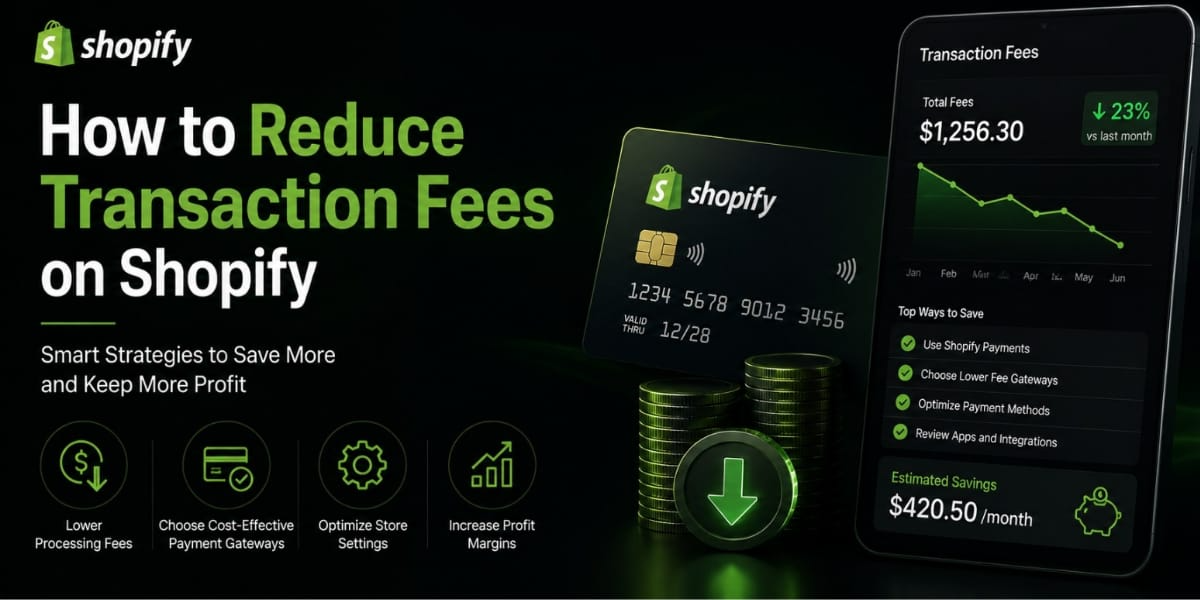
How to Reduce Transaction Fees on Shopify
Let me ask you something that most Shopify guides never bring up.
Do you actually know how much you’re paying in fees every single month?
Most store owners don’t. They see a sale come in, feel good about it, and never stop to calculate how much of that sale quietly disappeared into transaction fees before the money hit their bank account.
And that’s a problem.
Because those fees add up faster than you think. A 2% fee here. A 30 cent charge there. Multiply that across hundreds of orders every month and you’re looking at a significant chunk of your revenue just vanishing.
The good news? You can reduce them. Significantly. And that’s exactly what we’re going to talk about today.
This is your complete guide to understanding and reducing transaction fees on your Shopify store. No fluff. No complicated finance talk. Just real, practical steps you can take starting today.
Let’s get into it.
First, Let’s Understand What You’re Actually Being Charged
Before you can reduce your fees, you need to understand where they’re coming from.
There are two types of fees that Shopify store owners deal with. Most people confuse them or lump them together. They’re actually very different things.
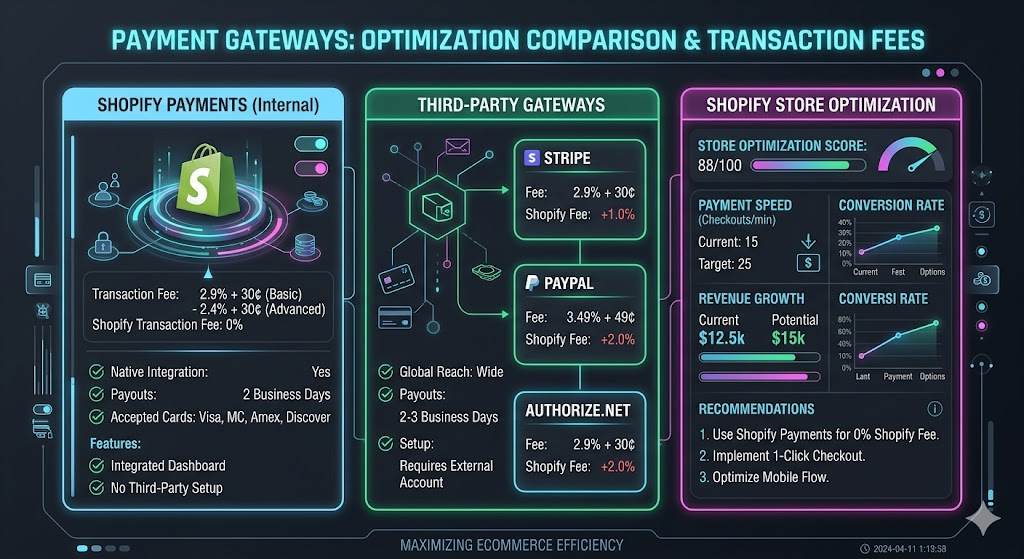
The first is credit card processing fees. This is what your payment gateway charges for processing each transaction. Every payment processor in the world charges this — Shopify Payments, Stripe, PayPal, all of them. It’s unavoidable. You can minimize it but you can’t eliminate it entirely.
The second is Shopify transaction fees. This is an additional fee that Shopify charges on top of the processing fee when you use a third-party payment gateway instead of Shopify Payments. On the Basic plan, this is 2% per transaction. On the Shopify plan it’s 1%. On the Advanced plan it’s 0.5%.
That second fee is the one that really hurts. Because it means you’re paying twice on every sale once to your payment gateway and once to Shopify.
Understanding this difference is the foundation of everything else we’re going to talk about.
The Single Biggest Thing You Can Do Switch to Shopify Payments
Let’s get the most impactful tip out of the way first.
If you are using a third party payment gateway and Shopify Payments is available in your country, switch to Shopify Payments immediately.
This one change eliminates the Shopify transaction fee entirely. Gone. Zero. That’s a saving of 0.5% to 2% on every single order depending on your current plan.
Think about what that means in real numbers. If your store does $10,000 in sales per month and you’re on the Basic plan paying 2% in Shopify transaction fees, you’re losing $200 every month to fees that you simply don’t have to pay. That’s $2,400 per year. For nothing.
Switch to Shopify Payments and that $2,400 stays in your pocket.
Shopify Payments is currently available in the US, UK, Canada, Australia, Ireland, New Zealand, Singapore, Hong Kong, Japan, and several European countries. If your business is registered in any of these places, there’s almost no good reason not to use it as your primary gateway.
If you’re in Pakistan or another unsupported country, you can’t use Shopify Payments directly. We’ll cover what to do in that situation later in this guide.
Upgrade Your Shopify Plan Sometimes It Actually Saves You Money
This one sounds counterintuitive. Spend more to save more?
But hear me out because the math genuinely works in many cases.
Here’s how the Shopify transaction fees break down by plan when using third party gateways. Basic plan charges 2%. Standard Shopify plan charges 1%. Advanced plan charges 0.5%.
And here’s how credit card rates through Shopify Payments break down. Basic plan is around 2% plus 30 cents per online transaction. Standard plan drops to around 1.7% plus 30 cents. Advanced plan goes down to around 1.5% plus 30 cents.
So the higher your plan, the lower your fees per transaction.
Now do the math for your store. If you’re on the Basic plan at $39 per month and doing $20,000 in monthly sales through a third-party gateway, you’re paying $400 in Shopify transaction fees alone. Upgrading to the standard Shopify plan at $105 per month cuts that to $200. You spend $66 more on your plan but save $200 in transaction fees. That’s a net saving of $134 every month.
The breakeven point is different for every store. But if your monthly sales volume is high enough, upgrading your plan is one of the smartest financial moves you can make.
Sit down, do the actual math for your store’s numbers, and see whether upgrading makes sense. You might be surprised.
Negotiate Your Rates for High Volume Stores
Most beginner store owners don’t know this is even possible.
Payment gateways publish their standard rates. But those standard rates aren’t always fixed. If your store is processing a significant volume of transactions every month, you may be able to negotiate better rates directly with your payment processor.
This typically kicks in at around $50,000 to $100,000 in monthly processing volume or more. If you’re at that level, contact your gateway’s merchant support team and ask about custom pricing or volume discounts.
Shopify itself also has an enterprise program Shopify Plus which comes with significantly reduced transaction and processing fees. Shopify Plus starts at $2,300 per month, so it’s clearly not for small stores. But for large operations doing millions in annual revenue, the fee savings can dwarf the subscription cost.
Even if you’re not at the negotiation stage yet, keep this in the back of your mind as your store grows. The moment your volume gets significant, pick up the phone and ask.
Choose the Right Payment Gateway for Your Market
Not all payment gateways charge the same fees. And sometimes the difference is meaningful.
If you’re using a third party gateway because Shopify Payments isn’t available in your country, take the time to compare your options properly. Look at the percentage fee, the fixed fee per transaction, and any monthly fees the gateway charges.
For example, if you’re processing a lot of small orders say $10 to $20 each a gateway with a lower fixed fee per transaction might serve you better than one with a lower percentage but higher fixed fee. The math changes depending on your average order value.
If your average order value is high say $150 or more a gateway with a lower percentage rate but higher fixed fee might save you more money overall.
Run the numbers for your specific store. Don’t just pick the gateway with the lowest headline percentage rate. Calculate the total fee on your actual average order value and compare gateways that way.
Encourage Customers to Use Lower Fee Payment Methods
Here’s something most store owners never think about.
Different payment methods carry different processing fees. Standard credit cards typically have lower processing fees than premium rewards cards or corporate cards. Digital wallets like Shop Pay often have competitive rates. Buy Now Pay Later services tend to charge higher merchant fees sometimes 4% to 6%.
You can’t control which card a customer uses. But you can think strategically about which payment methods you promote most prominently at checkout.
For example, if you’re offering both standard card payments and a BNPL option, you might consider only highlighting the BNPL option for products above a certain price threshold where the conversion benefit actually justifies the higher fee. For smaller purchases, guiding customers toward standard card checkout keeps your fees lower without sacrificing conversions.
This isn’t about removing options from customers. It’s about being thoughtful about how you present them.
Reduce Chargebacks to Avoid Chargeback Fees
Every chargeback costs you money beyond just the transaction amount.
When a customer disputes a payment and wins a chargeback, you lose the sale. You lose the product. And you get hit with a chargeback fee that typically ranges from $15 to $25 depending on your gateway.
If chargebacks happen frequently, your gateway may also flag your account as high risk. High risk accounts often face higher processing rates or even account suspension.
So reducing chargebacks isn’t just about avoiding those individual fees. It protects your overall fee structure.
How do you reduce chargebacks? A few key things make a big difference.
Use clear, accurate product descriptions so customers get exactly what they expect. Show realistic product photos. Be completely transparent about shipping times — if it takes three weeks, say it takes three weeks upfront. Have a clear refund policy and make it easy for customers to contact you. When customers can resolve issues directly with you, they’re less likely to go to their bank.
Use tracking numbers for every single shipment and share them with customers. If a customer files a chargeback claiming they never received their order, a tracking number showing delivery is your best defense.
And take fraud alerts seriously. If Shopify flags an order as high risk, review it carefully before fulfilling it. Shipping to a fraudulent order is how you end up losing both the product and the money.
Offer Incentives for Bank Transfers or Alternative Payment Methods
In some markets and business models, you can reduce processing fees by steering customers toward payment methods with lower costs.
Bank transfers, for example, typically have much lower fees than credit card processing. In some regions, direct bank payment options are widely trusted and used by consumers.
If your business model allows it, you could offer a small discount say 1% or 2% off for customers who pay via bank transfer. If your credit card processing fee is 2.9% and you offer a 1.5% discount for bank transfer, you’re still coming out ahead while giving the customer a reason to choose the lower-cost option.
This works better in B2B contexts or for higher value orders where the fee savings and discount math makes clear sense. For standard consumer retail, it’s less common. But it’s worth knowing the option exists.
Optimize Your Average Order Value
This one is a bit indirect but genuinely powerful.
Every transaction comes with a fixed fee component typically around 30 cents per transaction regardless of the order size. That fixed fee represents a much bigger percentage of a $10 order than a $100 order.
If someone buys a $10 product, your 30-cent fixed fee alone is 3% of the transaction before you even count the percentage fee. If they buy a $100 product, that same 30 cents is only 0.3%.
What this means is that strategies which increase your average order value product bundles, volume discounts, upsells, free shipping thresholds don’t just increase your revenue. They also reduce the effective fee percentage you’re paying per dollar of sales.
Add a free shipping threshold. Suggest complementary products at checkout. Offer a small bundle discount. Not only does this grow your revenue, it makes every dollar you earn more efficient from a fee perspective.
Keep Your Account in Good Standing
This one is about protecting what you already have.
Payment gateways reserve the right to increase fees, impose holds, or terminate accounts for stores that look risky. What makes a store look risky? High chargeback rates. Selling in high risk product categories. Sudden spikes in transaction volume. Customer complaints. Violations of the gateway’s terms of service.
Keeping your account in good standing means keeping your chargeback rate low, being transparent about what you sell, not violating any platform policies, and maintaining consistent and legitimate business practices.
A store in good standing keeps its standard fee rates. A store flagged as high risk can face significantly higher rates or lose access to affordable payment processing altogether.
Your behavior as a merchant directly affects your cost of processing. Keep your operation clean and professional.
Review Your Fee Reports Regularly
You cannot reduce what you don’t measure.
Shopify gives you detailed reports on your transactions, fees, and payouts right inside your dashboard. Make it a habit to review these at least once a month.
Look at how much you’re paying in total fees. Break it down by payment method. See if there are patterns maybe one payment type is costing you significantly more than others. Track how your fees change as your volume grows.
This regular review habit does two things. It keeps you aware of exactly what you’re spending on fees so nothing sneaks up on you. And it helps you spot opportunities moments where switching a gateway, adjusting a pricing strategy, or upgrading your plan could save you meaningful money.
Many store owners go months without ever looking at their fee reports. Don’t be one of them.
What About Pakistani Merchants Specifically?
If you’re running your Shopify store from Pakistan, your situation has some specific challenges worth addressing directly.
Shopify Payments isn’t available in Pakistan, which means you can’t eliminate Shopify’s transaction fee the same way merchants in supported countries can. You’re working with third-party gateways, and that extra fee is part of your reality for now.
Here’s how to minimize the damage.
First, upgrade your Shopify plan if your volume justifies it. Going from Basic to the standard plan cuts your Shopify transaction fee from 2% to 1%. On meaningful monthly volumes, that saving is real.
Second, choose your third-party gateway carefully. Compare total fees not just headline rates across the options available to you. Some international aggregators that work with Pakistani merchants have more competitive rates than others.
Third, focus heavily on average order value optimization. Since you’re paying a fixed fee per transaction on top of percentage fees, every strategy that increases what customers spend per order reduces your effective fee rate.
Fourth, keep your chargeback rate as low as possible. This protects you from higher risk categorization and the fees that come with it.
And keep an eye on Shopify’s expanding country support. Shopify Payments continues to launch in new markets. The day it becomes available in Pakistan, switching should be your immediate priority.
Let’s Pull It All Together
Reducing transaction fees on Shopify isn’t about finding one magic trick. It’s about making a series of smart decisions that each save you a little — and together save you a lot.
Switch to Shopify Payments if you can. That alone might be worth thousands of dollars a year depending on your volume.
Run the math on upgrading your plan. Higher monthly cost sometimes means dramatically lower fees overall.
Choose the right gateway for your market and your average order value. Don’t just pick the most famous name — pick the one that costs you least per dollar of sales.
Keep chargebacks low. Every dispute costs you fees, products, and potentially your account standing.
Increase your average order value. Bundles, upsells, and free shipping thresholds make your fee structure more efficient without you spending a single extra cent.
Review your reports monthly. What you measure, you can manage.
Every rupee or dollar you save in fees is pure profit. It doesn’t require a single extra customer, a single extra ad click, or a single extra sale.
It just requires you to pay attention and make smarter choices with the systems you already have.
Start with one thing from this list today. Then come back next month and do another. Small changes in your fee structure compound into serious savings over time.
Your store works hard to earn every sale. Make sure as much of that money as possible actually ends up with you.