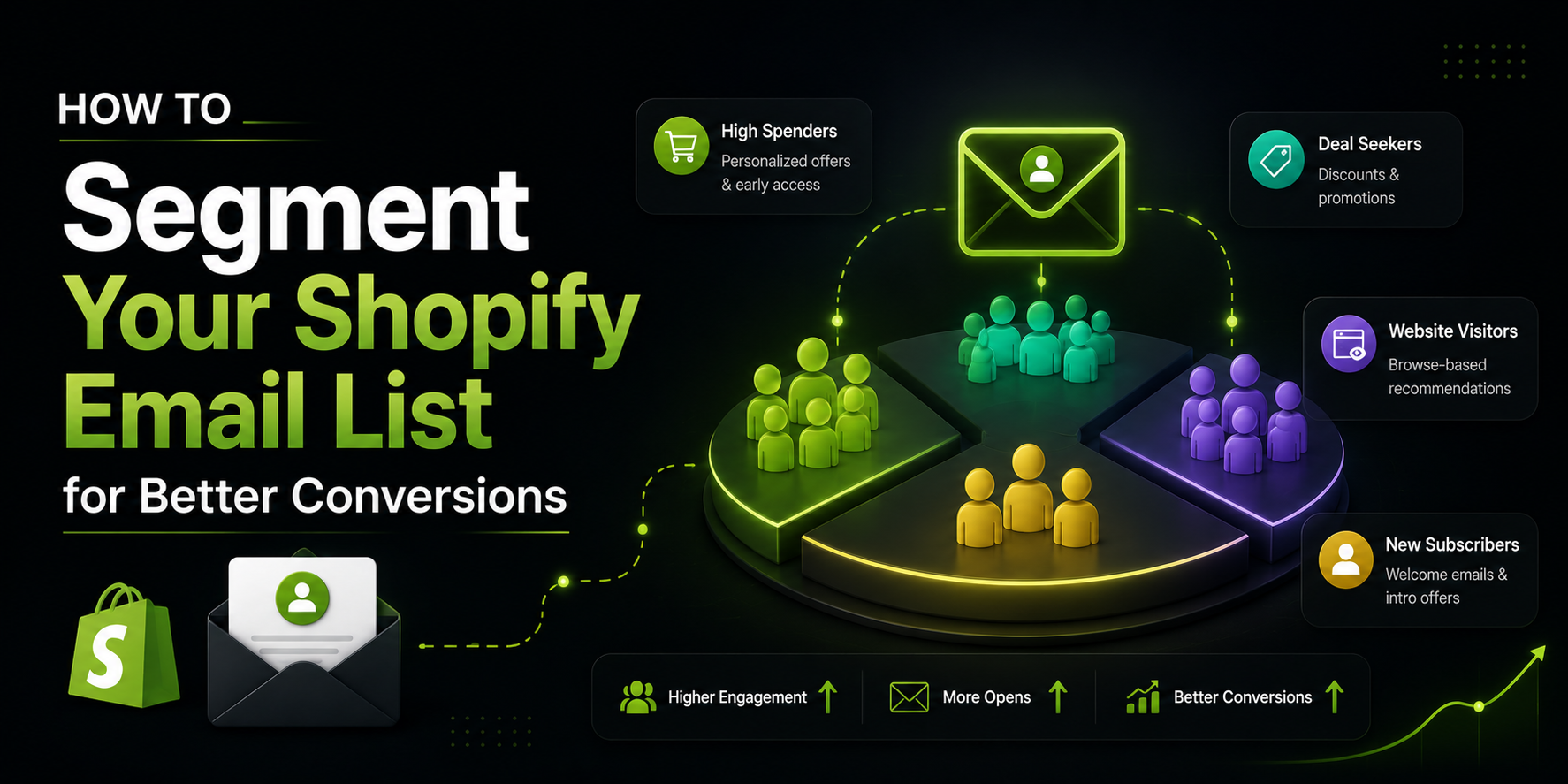
How to Segment Your Shopify Email List for Better Conversions
Let me ask you a simple question.
When was the last time you got an email from a brand that felt like it was written specifically for you?
Not a generic blast that went out to thousands of people. Not a promotional email that had nothing to do with anything you had ever bought or looked at. But an email that mentioned something you actually cared about, recommended something that genuinely made sense for you, or arrived at exactly the right moment with exactly the right offer.
It felt different, did it not?
You probably actually read it. You might have clicked. You might have bought something.
That is the power of segmentation. And it is the single biggest difference between email marketing that quietly generates revenue in the background and email marketing that gets ignored, unsubscribed from, or worse, marked as spam.
Most Shopify store owners send the same email to everyone on their list. New subscribers who have never bought anything get the same message as loyal customers who have purchased five times. People who bought yoga mats get the same email as people who bought protein powder. Someone who just placed an order yesterday gets the same promotional email as someone who has not visited the store in eight months.
That approach is not just ineffective. It is actively damaging to your brand and your deliverability.
When you send irrelevant emails, people stop opening them. When they stop opening them, your open rates drop. When your open rates drop, email providers like Gmail and Outlook start routing your emails to the promotions tab or the spam folder. And once that happens, even your most engaged subscribers stop seeing your messages.
Segmentation is how you fix all of that. It is how you make every email feel relevant, timely, and worth opening. It is how you increase conversions, protect your deliverability, and build the kind of relationship with your email list that turns subscribers into loyal, repeat customers.
This guide is going to walk you through everything you need to know about segmenting your Shopify email list. What segmentation is, why it matters so much, and the specific segments you should be building right now to start seeing better results from your email marketing.
Let us get into it.
What Is Email List Segmentation and Why Does It Matter?
Email list segmentation is the practice of dividing your email list into smaller, more specific groups based on shared characteristics or behaviors, and then sending each group messages that are relevant to their specific situation.
Instead of treating your entire email list as one audience, you treat it as many smaller audiences. Each segment gets content, offers, and messaging that speaks directly to where they are in their relationship with your brand.
The results speak for themselves. Segmented email campaigns consistently outperform non segmented campaigns across every metric that matters.
Open rates go up because people are receiving emails that are actually relevant to them. Click through rates improve because the content and offers inside the email match what that particular subscriber cares about. Conversion rates increase because the right offer is reaching the right person at the right time. Unsubscribe rates go down because people are not being bombarded with irrelevant content that makes them want to opt out.
Research from leading email marketing platforms consistently shows that segmented campaigns can generate significantly higher revenue per email sent compared to non-segmented broadcasts. Some stores see two, three, or even four times the revenue from segmented campaigns compared to sending the same message to everyone.
Beyond the direct revenue impact, segmentation also protects something that most store owners do not think about until it is already a problem: your sender reputation.
Your sender reputation is essentially a trust score that email providers assign to your sending domain. When lots of people open your emails, click on links, and engage positively, your reputation improves and your emails land in the inbox. When people ignore your emails, delete them without opening, or mark them as spam, your reputation suffers and your deliverability drops.
Sending irrelevant emails to uninterested subscribers is one of the fastest ways to damage your sender reputation. Segmentation keeps your emails relevant, keeps your engagement high, and keeps your reputation strong.
For a Shopify store that depends on email marketing to drive repeat purchases and recover abandoned carts, a strong sender reputation is not optional. It is fundamental.
The Foundation: What Data Do You Have to Work With?
Before you can build effective segments, you need to understand what data you have available.
Shopify collects a significant amount of useful customer data automatically. When you connect it to an email marketing platform like Klaviyo or Omnisend, that data becomes available for segmentation. Here is a breakdown of the main types of data you can use.
Purchase data is the most directly valuable for e commerce segmentation. This includes whether someone has purchased at all, how many times they have purchased, what specific products or categories they bought, how much they spent in total, when they last purchased, and how much time typically passes between their purchases.
Engagement data tells you how subscribers interact with your emails. Who opens your emails regularly. Who clicks on links. Who has not opened a single email in the last 90 days. This data lets you separate your engaged audience from your inactive one and treat each group appropriately.
Browse behavior data captures what subscribers look at on your store even when they do not buy. Which product pages they visit. Which collections they browse. Which items they view multiple times without adding to cart. This is behavioral intent data that can power highly targeted automations.
Demographic and location data includes information like where your customers are located, their language, their timezone, and any profile information they have provided. This is useful for localizing campaigns, running region specific promotions, and sending emails at the optimal time for each subscriber’s timezone.
Customer lifecycle data is about where someone is in their relationship with your brand. Are they a brand new subscriber who has never bought? A first-time buyer? A loyal repeat customer? Someone who used to buy regularly but has gone quiet? Each of those is a different stage with different needs and different messaging.
Acquisition source data tells you how someone got onto your list. Did they sign up through a pop up for a discount code? Did they join through a giveaway? Did they become a subscriber through the checkout process? Knowing how someone found you gives you context about their initial motivation and can inform how you communicate with them.
When you understand the data available to you, segmentation becomes much less abstract. You are simply grouping people who share relevant characteristics so you can communicate with them in a way that makes sense for where they are.
Segment 1: New Subscribers Who Have Never Purchased
Every email list has a group of people who signed up but have not yet made a purchase. Maybe they came in through a pop up that offered a discount code. Maybe they downloaded a lead magnet. Maybe they found your store through social media and signed up out of curiosity before they were ready to buy.
These people know your brand exists. They were interested enough to give you their email address. But they have not crossed the line into becoming a customer yet.
This segment needs a very specific type of communication. Your job with this group is to build trust, demonstrate value, and guide them toward that first purchase.
Do not treat new subscribers the same way you treat existing customers. Sending them a “Welcome back” email or a loyalty reward is tone deaf when they have never bought anything. Sending them a deep dive product comparison that assumes purchase history they do not have is equally off target.
What works for this segment is a well structured welcome series that introduces your brand, tells your story, shows your bestselling or most loved products, provides social proof like customer reviews and testimonials, and delivers on whatever promise brought them to your list in the first place.
If they signed up for a discount code, make sure that code is front and center in the first email and referenced again in follow up emails if they have not used it. Create a natural sense of gentle urgency around the offer without being pushy.
The welcome series for this segment should be your most polished, most thoughtfully crafted email sequence. It is first impressions. It sets the tone for the entire relationship. And it has a direct, measurable impact on whether a subscriber ever becomes a customer.
A good welcome series for new non-buyers typically consists of three to five emails sent over the first one to two weeks after sign up. The first email delivers the offer and introduces the brand warmly. The second highlights your bestsellers or most popular products. The third might tell your brand story or values. The fourth might address common hesitations with social proof and a FAQ. The fifth is a final nudge with a reminder that the welcome offer is expiring.
Each email has one clear call to action pointing back to your store. And the entire sequence is designed to move this subscriber from curious to converted.
Segment 2: First Time Buyers
Someone just made their first purchase from your store. That is a significant moment.
They crossed the line from subscriber to customer. They trusted you enough to hand over their payment information and wait for a product to arrive. That trust is valuable and fragile in equal measure.
The experience they have after that first purchase will largely determine whether they ever buy from you again. Research consistently shows that getting a customer to make a second purchase is the most important step in building long term loyalty. Customers who make two purchases are significantly more likely to make a third, a fourth, and beyond. But customers who buy once and have a mediocre post purchase experience often never come back.
Your first-time buyer segment needs a post-purchase sequence that makes them feel great about their decision.
Start with a genuine, warm thank you email. Not just an order confirmation, which is transactional and automated. A real email from your brand that expresses appreciation for their trust and their purchase. This email sets the emotional tone for the relationship.
Follow that up with useful content related to what they bought. If they purchased a skincare product, send tips on how to use it effectively, how to layer it with other products, what results to expect and when. If they bought fitness equipment, send a beginner workout plan or setup guide. If they bought clothing, send styling ideas or care instructions.
This kind of post purchase value content does something important. It reduces buyer’s remorse. It helps the customer get more out of their purchase. And it keeps your brand in their mind in a positive, helpful way during the critical days after the order arrives.
Then, after enough time has passed for them to have received and used their purchase, introduce them to complementary products or your broader range. This is not a hard sell. It is a natural extension of the conversation you have already been having.
Done well, a post-purchase sequence for first time buyers dramatically increases the percentage of one-time customers who become repeat customers. And repeat customers are the foundation of a profitable, sustainable e commerce business.
Segment 3: Loyal and High Value Customers
These are your best customers. The ones who buy regularly. The ones who spend the most. The ones who have the highest lifetime value and the strongest relationship with your brand.
They deserve to be treated differently from everyone else on your list. And most stores completely fail to do this.
Loyal, high value customers often receive the exact same promotional emails as brand new subscribers who have never bought anything. The same discount codes. The same sale announcements. The same content.
That is a missed opportunity on multiple levels.
First, it fails to acknowledge the relationship that already exists. A customer who has bought from you six times in the last year does not need to be convinced your products are good. They already know. Sending them a “Why You Should Try Us” email is tone deaf and signals that you do not know who they are.
Second, it gives away margin unnecessarily. Your most loyal customers are the ones most likely to buy at full price. Sending them the same 20 percent off code you are sending to everyone else is just reducing your revenue on purchases that would have happened anyway.
What your loyal and high value customers need is recognition and exclusivity.
Create a VIP or loyalty tier within your email strategy for this segment. Reach out to them first, before anyone else, when new products launch. Give them access to exclusive sales that are not available to your general list. Send them personalized recommendations based on their specific purchase history. Offer them early access to limited edition products or collections.
Make them feel like what they are: your most valued customers. Because they are.
A simple email that starts with “As one of our best customers, we wanted you to be the first to know…” already creates a fundamentally different experience than the standard promotional email that everyone else receives. That feeling of being recognized and valued is what builds the kind of loyalty that is genuinely hard for competitors to break.
You can also use this segment to gather feedback and generate user content. Your most loyal customers are the most likely to leave genuine reviews, refer friends, participate in surveys, and engage with your brand beyond just making purchases. Reach out to them specifically for these kinds of requests. They will respond at much higher rates than your general list.
Segment 4: At Risk and Lapsed Customers
This is one of the most valuable segments you can build, and it is one that most stores either ignore completely or handle poorly.
An at risk customer is someone who used to purchase from you regularly but whose buying behavior has slowed down or stopped. They have not quite hit the point of being fully lapsed yet, but the signals suggest they might be drifting away.
A lapsed customer is someone who purchased from you at some point but has not bought anything in a significant amount of time. Depending on your product type and typical purchase cycle, that might be 90 days, 180 days, or 12 months. The right threshold depends on how often a typical customer buys from you.
The reason this segment is so valuable is because re engaging a lapsed customer is almost always significantly cheaper than acquiring a brand new one. They already know your brand. They already bought from you once, which means they crossed that initial trust barrier. They are warm leads, not cold ones.
But they need a different kind of communication than your active customers.
A win-back campaign for this segment should start with acknowledgment. Not a hard sell. Not a generic discount blast. Something that opens with a genuine “We have noticed we have not seen you in a while” kind of message.
The tone matters here. It should feel personal and low-pressure. Something that communicates “We value you and we would love to have you back” rather than “Here is a coupon, please buy something.” People can feel the difference between genuine re-engagement and desperation.
From there, you can show them what is new since they last visited. New products. New collections. Improvements or updates to things they have bought before. Give them a reason to come back that is about genuine value, not just a discount.
If the initial re-engagement emails do not get a response, then a stronger incentive, a meaningful discount or a free gift with purchase, can be appropriate. You are making a calculated investment in recovering a customer relationship that has real long-term value.
If after a full win-back sequence the subscriber still shows no engagement, it is worth considering removing them from your active list entirely. Continuing to email truly unresponsive subscribers hurts your deliverability metrics and can damage your sender reputation over time. A smaller, engaged list is always more valuable than a large, unresponsive one.
Segment 5: Cart and Browse Abandoners
These are the people who were right on the edge of buying. They got close enough to add products to their cart or spend significant time on product pages. Then something pulled them away.
Maybe they got distracted. Maybe they wanted to think about it. Maybe they had a question they could not find the answer to. Maybe they found the shipping cost unexpectedly high. Maybe they just ran out of time.
Whatever the reason, they left without buying. And they are one of the warmest leads on your entire list.
Cart abandonment is one of the highest-priority segments to address with automation because the conversion potential is enormous. Industry data consistently shows that a significant percentage of people who abandon a cart will complete the purchase if they receive a well-timed reminder email. For many Shopify stores, cart abandonment emails are among the highest revenue-generating automations they have.
Your cart abandonment email should be sent relatively quickly after the abandonment, within one to three hours while the purchase intent is still fresh. It should show the specific products they left in their cart with images, names, and prices. It should make it extremely easy to come back and complete the purchase with a single clear link.
The first cart abandonment email should not lead with a discount. Many people abandon carts for reasons that have nothing to do with price. They got distracted, they needed more time, they had a question. A simple, friendly reminder is often all they need.
If the first email does not convert within 24 hours, a follow-up email that addresses potential hesitations can be effective. This might include customer reviews, a FAQ addressing common questions, or information about your return policy and shipping times. Remove friction and build confidence.
If the cart is still abandoned after 48 to 72 hours, a third email with a modest discount or incentive can tip the balance for price-sensitive abandoners.
Browse abandonment, which targets people who viewed specific products but did not add them to the cart, is a slightly earlier stage in the buying journey. The messaging should be softer. These are people who showed interest but were not quite at the decision point yet. A gentle “Still thinking about this?” email that highlights the product, shares relevant reviews, and provides an easy path back to that product page can be surprisingly effective.
Both of these segments require good behavioral data syncing between your Shopify store and your email platform. Klaviyo and Omnisend both handle this well with their native Shopify integrations.
Segment 6: Product and Category Buyers
One of the most powerful and underused segmentation strategies for Shopify stores is segmenting customers based on the specific products or product categories they have purchased.
The logic here is intuitive. If someone bought from your coffee collection, they are probably interested in other coffee-related products. If someone bought running shoes, they might be interested in running accessories, athletic socks, or workout apparel. If someone bought a beginner yoga mat, they might be ready for yoga blocks, a strap, or eventually a premium mat upgrade.
By segmenting your list based on purchase categories, you can send campaigns that are directly relevant to what each customer already cares about.
This is far more effective than sending your full product range to everyone. Not every customer is interested in everything you sell. Sending a customer who only ever buys from your men’s grooming section a campaign about women’s skincare products is irrelevant at best and annoying at worst.
Product-based segmentation lets you cross-sell and upsell in a way that feels natural and helpful rather than random and pushy.
It also allows you to time your campaigns intelligently based on repurchase cycles. If you sell a product that typically gets used up in about 30 days, you can automatically target buyers of that product with a replenishment email around day 25. If you sell a seasonal product that most customers buy annually, you can reach out to last year’s buyers right before that season comes around again.
These highly targeted, well-timed campaigns consistently outperform general promotional emails because they are relevant, anticipated, and timely. The customer who used up their coffee beans is expecting to need more soon. An email reminding them to reorder at exactly the right moment is not annoying. It is useful.
Segment 7: Subscribers by Engagement Level
Not everyone on your email list is equally engaged. Some people open almost every email you send. Some open occasionally. Some have not opened anything in months.
Treating all of these people the same way is a mistake. Your highly engaged subscribers should be your priority audience for important announcements, new product launches, and special campaigns. They are your most responsive audience and the most likely to convert.
Your less engaged or inactive subscribers, on the other hand, need to be handled carefully. Continuing to send frequent promotional emails to people who never open them is not just ineffective. It actively harms your sender reputation because high volumes of unopened emails signal to email providers that your content is not wanted.
Build an engagement-based segmentation structure for your list. At minimum, identify three groups.
Highly engaged subscribers are those who have opened or clicked at least one of your last five to ten emails. These are your most active audience. They should receive your full email cadence and be prioritized for important campaigns and launches.
Moderately engaged subscribers are those who open occasionally but not consistently. They respond to certain types of content or offers but not everything. Try to identify patterns in what gets them to engage. Seasonal promotions? New product launches? Educational content? Send them the type of content they respond to most.
Disengaged subscribers are those who have not opened an email in 90 days or more. Before you write them off, run a dedicated re-engagement campaign specifically for this group. Make the subject line compelling and different from your usual style. The goal is to find out if there is any spark left. Something like “Are we breaking up?” or “We miss you, here is something special” can get attention from people who have been tuning out your regular emails.
If the re-engagement campaign produces no response, remove those subscribers from your active list. Clean your list regularly. A lean, engaged list of active subscribers will always generate more revenue and better deliverability than a bloated list full of ghosts.
Segment 8: Geographic and Timezone Segments
If your Shopify store sells internationally or even across different regions of the same country, geographic segmentation can have a meaningful impact on your email performance.
The most practical application of geographic segmentation is send time optimization. An email sent at 9 AM in New York is arriving in the middle of the night for someone in Sydney. Email send times genuinely affect open rates. Sending each segment at the optimal time for their timezone means more people see your email at a moment when they are actually likely to read it.
Most email platforms including Klaviyo and Omnisend have send-time optimization features that can handle this automatically. But if you want more control, manually segmenting your list by major timezone groups and scheduling sends accordingly is straightforward.
Geographic segmentation also enables location-specific campaigns. If you have a sale that is only relevant to customers in a specific country, or a shipping promotion that only applies to certain regions, you can ensure only the relevant customers receive those emails. This keeps your campaigns relevant and prevents the frustration of a customer getting excited about an offer that does not actually apply to them.
For stores with international audiences, you can also use geographic data to localize your content, using regional language preferences, cultural references, and locally relevant promotions that make each subscriber feel like the email was created with them in mind.
How to Actually Build These Segments in Shopify
Understanding the theory of segmentation is one thing. Actually building and managing these segments is where the rubber meets the road.
The good news is that if you are using Klaviyo or Omnisend with Shopify, most of this is more straightforward than it sounds.
Both platforms sync customer data from Shopify in real time and give you a visual segment builder where you can define rules based on purchase history, engagement activity, product views, location, and dozens of other data points. You do not need to write code or export spreadsheets. You set the rules and the platform continuously updates the segment automatically as customers meet or no longer meet the criteria.
Here is a practical approach to getting started.
Start with your most high-impact segments first. Do not try to build every segment on this list in one sitting. Begin with the ones that will have the most immediate impact on your revenue.
Your cart abandonment automation and your welcome series for new subscribers are almost always the highest-priority starting points. Get those set up and running first. Then build out your first-time buyer post-purchase sequence. Then your loyal customer VIP segment. Then your lapsed customer win-back.
Work through the list gradually. Add automation and campaigns as you go. Measure the results. Refine based on what you learn.
Document your segments as you build them. Keep a simple reference that describes what each segment is, what the criteria are, and what emails or automations are associated with it. This makes it easier to maintain and optimize over time, especially as your list grows and your strategy becomes more sophisticated.
Test and iterate. Segmentation is not a set-it-and-forget-it exercise. The segments that work best for your store will depend on your specific products, your customer base, and your brand voice. Run A/B tests on subject lines, offers, and content for different segments. Pay attention to which segments respond best to what kinds of messages. Let the data guide your decisions.
Common Segmentation Mistakes to Avoid
Building segments is one thing. Using them effectively is another. Here are the most common mistakes Shopify store owners make with email segmentation and how to avoid them.
Segmenting once and never updating. Your customer base is constantly changing. New subscribers join. Buyers progress through their journey. Lapsed customers either re-engage or go cold. If your segments are static and never updated, they quickly become inaccurate. Use dynamic segments that update automatically based on current behavior rather than one-time snapshots.
Over-segmenting to the point of paralysis. More segments are not always better. If you create so many granular segments that you can never find the time to actually send relevant emails to each one, the segmentation effort is counterproductive. Start with fewer, broader segments and get more granular as your capacity and your email program mature.
Ignoring segment size. A segment that contains only 15 people is hard to draw meaningful conclusions from and difficult to test effectively. If a segment is very small, consider whether it can be combined with a related segment or whether it is worth creating a separate campaign for.
Using segmentation as an excuse to email more. Some marketers discover segmentation and then start sending more emails to more segments, thinking that more targeted communication always means better results. But email frequency still matters. Even relevant emails can become too frequent. Pay attention to how each segment responds to different sending frequencies and find the balance that maximizes engagement without causing fatigue.
Not aligning your messaging with your segment. This is the most fundamental mistake. You build a loyal customer segment and then send them the same generic promotional email as everyone else. The whole point of segmentation is to send messages that are specifically relevant to each group. If your messaging does not reflect the segment’s characteristics and needs, you have done the technical work of segmentation without capturing any of the benefit.
Final Thoughts
Email segmentation is not a complicated concept. At its core, it is just about sending the right message to the right person at the right time.
But that simple principle, when applied consistently and thoughtfully to your Shopify email marketing, has the power to transform your results. Higher open rates. Better conversions. More repeat purchases. Stronger customer relationships. Better deliverability. All of it flows from treating your subscribers as the individuals they are rather than one undifferentiated mass.
You do not need to build every segment at once. You do not need a huge list or a massive marketing budget. You need the right tool, a clear understanding of your customers, and a commitment to communicating with them in a way that is genuinely relevant.
Start with one segment today. Build your welcome series. Set up your cart abandonment flow. Create your loyal customer VIP group. Then keep going.
Every segment you build is a more precise, more personal conversation with a specific group of people who chose to be on your list. Respect that choice by making every email worth their time.
That is what segmentation is really about. And that is what separates the stores whose email marketing drives real, consistent revenue from the ones whose emails sit unopened in the promotions tab.
Start segmenting. Your conversions will thank you for it.