How to Use AI for Shopify Inventory Management
There’s a particular kind of stress that comes with running out of your best selling product during a sale, or realizing three months later that a slow moving item has been sitting in your warehouse eating up cash the whole time. If you’ve felt that before, you already understand why inventory management quietly becomes one of the hardest parts of running a Shopify store. It’s not glamorous like marketing or product design, but it’s the thing that decides whether your business actually makes money or slowly bleeds it out through stockouts and dead stock.
AI has changed what’s possible here in a real, practical way, not just as a buzzword tacked onto app descriptions. Let’s walk through what AI inventory management actually does, why it matters more than ever right now, which tools are worth your attention, and how to bring this into your store without turning it into another complicated system you have to babysit.
Why this topic is suddenly urgent for Shopify merchants
Before getting into the how, it’s worth understanding why this conversation is happening right now. For years, many Shopify merchants leaned on Stocky, Shopify’s own free purchase order and forecasting app, for basic inventory visibility. That’s changing fast. Shopify has been phasing Stocky out, with inventory transfers and forecasting features removed back in mid 2025, the app fully delisted from the App Store in early February 2026, and a complete shutdown scheduled for the end of August 2026. After that, Shopify has no built in equivalent for the kind of demand forecasting and purchase order automation Stocky used to offer.
That leaves a real gap for a lot of stores. Shopify’s native admin still covers the basics well, letting you track stock quantities across multiple locations, set up low stock alerts, and manage transfers between locations, all included in your regular subscription. But it doesn’t include demand forecasting, automated purchase orders, multi channel sync beyond Shopify’s own sales channels, or the kind of detailed analytics that help you understand what’s actually happening with your stock. Once you’re managing more than a handful of products, or selling across more than one channel, that gap starts costing you real money.
And the money at stake is not small. Poor inventory management costs retailers an estimated $1.6 trillion globally every year, covering everything from stockouts and overstocking to dead stock quietly gathering dust in storage. For a growing Shopify store, that same math plays out on a smaller scale but the pain is just as real: an oversold item makes a customer angry, and a few more mean your ad account is effectively bleeding cash on avoidable returns and refunds.
What AI actually brings to inventory management
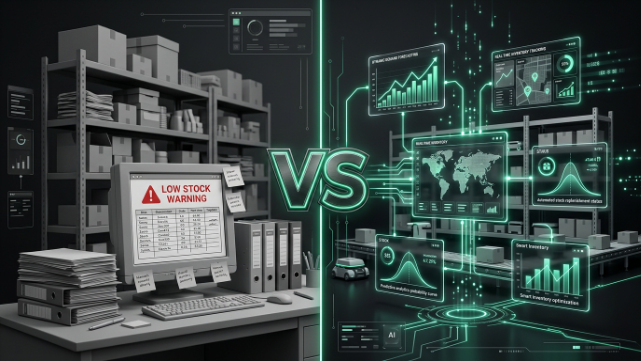
The old way of managing stock was mostly reactive. You’d check numbers manually, notice something was low, and scramble to reorder, often after it was already too late. AI flips this into something proactive, and it does that through a few core capabilities.
Demand forecasting is the big one. Rather than guessing how much of a product you’ll need next month based on gut feeling, AI driven forecasting tools analyze historical sales data, seasonal patterns, and trends to predict what you’ll actually need, often at the individual SKU level and months ahead of time. Some of these forecasting engines are trained on enormous datasets spanning millions of SKUs across many different stores, which gives them a depth of pattern recognition that a single store’s own sales history simply couldn’t provide on its own.
Automated purchase orders follow naturally from good forecasting. Instead of you manually calculating how much stock to reorder and from which supplier, the AI generates purchase orders based on sales velocity and supplier lead times, sometimes building out entire buying calendars that stretch twelve months ahead so you can plan for peak seasons well before they arrive.
Then there’s real-time stock synchronization, which matters enormously if you’re selling across more than just your Shopify storefront. If you’re also on Amazon, Etsy, a physical retail location, or wholesale, AI-powered inventory tools keep stock numbers accurate everywhere at once, updating the moment something sells so you’re never caught overselling an item that’s actually already gone.
Dead stock and slow-mover detection is another quietly powerful use case. AI can flag products that are sitting too long without moving, so you can put them on sale, bundle them with faster sellers, or stop reordering them altogether before they tie up more of your cash than they’re worth.
And for merchants making their own products rather than reselling finished goods, AI-backed bill-of-materials tracking connects raw material stock to your finished SKUs, automatically adjusting component level inventory as orders come in and flagging when a material is about to run short before it turns into a stockout on the finished product.
The tools worth looking at right now
Given the Stocky shutdown, a lot of Shopify merchants are actively searching for a replacement, and thankfully the market has responded with several strong options depending on what your store actually needs.
Prediko has become one of the most talked-about names in this space, and it’s easy to see why. Its AI forecasting engine is trained on over 25 million SKUs, giving it unusually deep demand prediction data for a Shopify-focused tool. It offers twelve month demand forecasting at the SKU level, automated purchase order generation, and revenue forecasting with seasonal trend analysis, and it recently added a three tab planning system with a full twelve month purchase order calendar to make planning ahead of peak seasons noticeably easier. It’s also one of the tools specifically positioned as a strong replacement for Stocky’s demand planning and inventory visibility features. Pricing varies depending on your store’s revenue, with entry plans built for smaller stores and enterprise pricing for stores above two million dollars in annual revenue.
Stockful is another option built specifically to be the closest direct replacement for Stocky, starting at a low monthly price and covering demand forecasting at every location, ABC analysis, dead stock detection, and a solid set of built in report types, aimed at merchants who want that lost visibility back without taking on the complexity of a full enterprise platform.
If you’re a merchant who actually manufactures your products rather than reselling finished goods, Katana is worth a serious look. It’s built around bill of materials, raw material stock tracking, and production scheduling that connects directly to your Shopify sales, so when an order comes in, your production queue knows about it, and when a material runs low, the system flags it before your finished product goes out of stock.
For multi-channel sellers whose real headache is keeping stock numbers consistent across platforms rather than forecasting demand, Stock Sync focuses narrowly on reconciling inventory data from supplier CSV feeds, ERP systems, and third party APIs, keeping everything accurate without you manually touching it. And if your store deals in raw materials, bundles, or made to order products, particularly common in fashion and D2C brands, tools like Invento are built specifically to link raw material stock to multiple finished SKUs so everything adjusts automatically as orders come in.
For larger operations juggling multiple warehouses, marketplaces, and complex fulfillment needs, platforms like SKULabs, Cin7 Core, and Linnworks step into more enterprise territory, offering barcode based fulfillment, full multi location warehouse management, and centralized inventory across many different marketplaces at once.
Whatever you choose, keep in mind pricing and features shift often in this category, so it’s worth confirming current plans directly on each vendor’s site rather than relying on numbers you saw months ago.
How to bring AI inventory management into your store the right way
Getting this right isn’t about picking the flashiest tool and flipping a switch. A few things make a real difference in how smoothly this goes.
Start by understanding your actual pain point. If your biggest struggle is knowing how much to reorder and when, forecasting focused tools like Prediko or Stockful are your priority. If your struggle is keeping numbers accurate across multiple sales channels, a sync-focused tool like Stock Sync matters more. If you manufacture your own goods, you need bill-of-materials tracking specifically, which narrows your list considerably. Don’t pay for forecasting depth you don’t need if your real problem is data consistency, or vice versa.
Feed it clean historical data. AI forecasting is only as good as what it’s learning from. If your sales history is short, messy, or full of anomalies from things like a one-off bulk order or a pricing error, take time to clean that up or flag those anomalies before letting the AI build its predictions on top of them.
Set sensible reorder thresholds and let the automation do its job, but check in regularly, especially in the first few months. Review the purchase order suggestions the AI is generating and make sure they line up with what you know about your supplier lead times, cash flow, and any upcoming promotions the AI wouldn’t necessarily know about on its own, like a big sale you’re planning or a product you’re intentionally winding down.
Plan your transition away from Stocky now rather than later. If you’re still relying on it, the shutdown timeline gives you a real deadline. Waiting until the last month before it goes offline means rushing a decision on a tool you’ll be depending on for months or years, so it’s worth testing alternatives now while you still have the old system as a fallback.
Don’t ignore multi-location and multi-channel needs even if you don’t have them today. If there’s any chance you’ll add a second warehouse, a retail location, or another sales channel within the next year, choose a tool that can grow with you rather than one you’ll need to replace again soon.
A note for Pakistani Shopify merchants
Running inventory for a Pakistan-based store comes with a few extra wrinkles that are worth planning around specifically. Cash on Delivery orders have a habit of skewing your effective demand numbers, since a meaningful share of COD orders end up returned or refused at the door, which means your true sell through rate is often lower than your raw order count would suggest. When you’re setting up AI forecasting, make sure it’s accounting for your actual fulfilled and delivered sales rather than gross orders placed, or you risk overstocking based on demand that never really existed.
Supplier lead times are another local factor that matters a lot here. If you’re importing stock or working with manufacturers in cities like Faisalabad, Karachi, or Sialkot, lead times can vary more than they would for a merchant sourcing domestically in a smaller, more predictable market. Make sure whatever AI tool you choose lets you set custom lead times per supplier rather than assuming a flat default, since that assumption alone can throw off your automated reorder points significantly.
Courier reliability is also worth factoring into your buffer stock calculations. If you’re shipping through Leopards, TCS, or M&P and dealing with the usual variability in delivery timelines across different cities in Pakistan, a slightly higher safety stock margin on your fastest moving items can prevent the kind of stockout that happens simply because a restock shipment got delayed in transit rather than because demand outpaced your forecast.
And if you’re selling through WhatsApp alongside your Shopify storefront, which a lot of Pakistani D2C brands do, make sure your inventory numbers stay synced between the two. A sale confirmed over WhatsApp that isn’t reflected in your Shopify stock count can quietly throw off your AI’s forecasting accuracy over time, since the system is working with an incomplete picture of what’s actually leaving your shelves.
Bringing it all together
Good inventory management used to mean hours buried in spreadsheets, guessing at reorder timing, and hoping you’d read the season right. AI has turned that into something far more precise and far less stressful, catching patterns in your sales data that would take a human weeks to notice, and doing it continuously in the background while you focus on actually growing your store. With Stocky on its way out, now is genuinely a good time to get this piece of your operations sorted properly rather than scrambling later.
If figuring out which tool fits your store, or getting it set up and properly configured with your real supplier data and sales history, sounds like more than you want to take on alone, that’s exactly the kind of work TheScriptFlow handles for Shopify merchants every day. Head over to thescriptflow.com and let’s get your inventory running the way it should