How to Use AI to Write Better Shopify Product Descriptions
If you’ve ever stared at a blank product page trying to describe the same hoodie for the fifth time that week, you already know why product descriptions are one of the most exhausting parts of running a Shopify store. They matter enormously for conversions and SEO, yet they’re repetitive enough to drain your creative energy fast. This is exactly where AI product description tools have changed the game for merchants, letting you generate compelling, SEO optimized copy in seconds instead of losing entire afternoons to writer’s block.
The goal of this blog isn’t to convince you that AI can replace a skilled copywriter’s judgment. It’s to show you exactly how to use AI product description generators the right way, so you end up with Shopify product descriptions that actually convert browsers into buyers and rank well in search, instead of generic filler text that sounds like every other store on the internet.
Why Product Descriptions Matter More Than Most Merchants Realize
It’s easy to treat product descriptions as an afterthought, something you rush through just to get the listing live. But descriptions do two jobs at once: they sell the product to a human, and they signal relevance to Google. Products with compelling, benefit focused descriptions convert noticeably better than bare bones listings, and unique, keyword-rich copy is what helps you actually rank on Google Shopping and in organic search results.
There’s also a trap a lot of merchants fall into without realizing it: copying manufacturer descriptions straight into their Shopify product pages. This might save time upfront, but it creates duplicate content across the web, and Google penalizes that. If your competitor is using the exact same description word for word, neither of you is winning any SEO battle. Writing unique Shopify product descriptions for every SKU isn’t optional if you actually care about organic traffic.
Where AI Actually Fits Into This Process
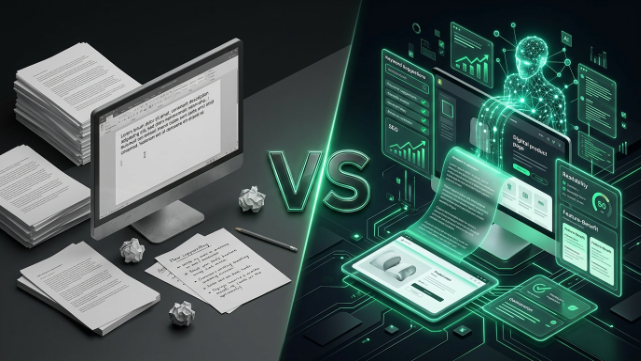
AI product description generators exist to remove the grunt work: the first draft, the repetitive structure, and the mental fatigue of describing similar products fifty different ways. What used to take thirty minutes of staring at a screen can now take under thirty seconds with the right prompt. But the smartest Shopify sellers treat AI output as roughly eighty percent of the work, not a finished, publish ready product. Your job is layering in the specific details, brand voice, and human judgment that make a description actually sound like it came from your store and not a template.
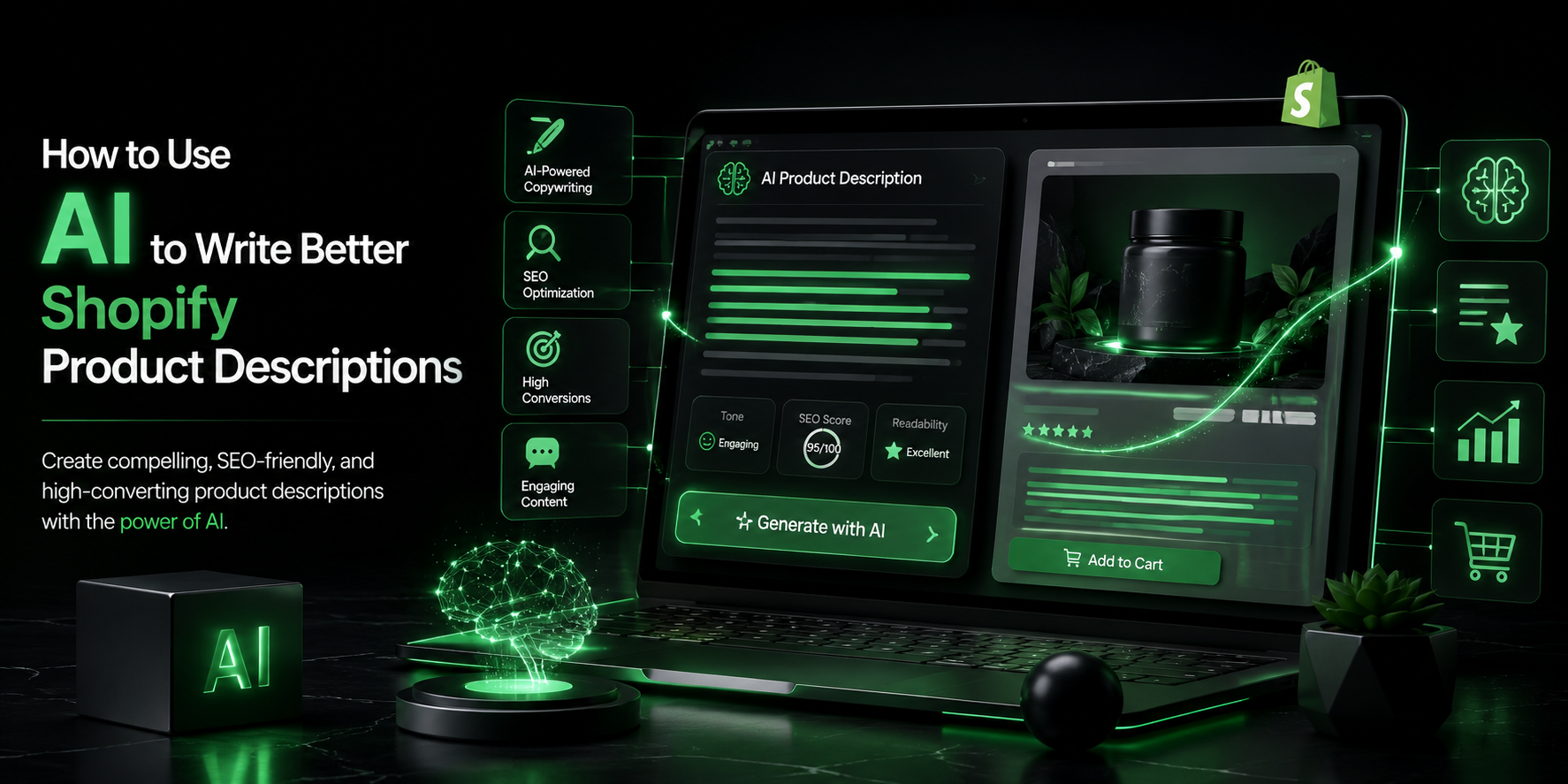
Shopify has made this easier than ever by baking AI directly into the platform. Shopify Magic, included free with your Shopify plan, generates description drafts based on the product details you enter, and it’s genuinely a solid starting point if you’re managing a smaller catalog and don’t want to add another subscription to your monthly costs. For merchants managing bigger catalogs, or those who want more control over SEO and tone, dedicated tools like Describely, Hypotenuse AI, Writesonic, and Copy.ai each bring something different to the table, from bulk CSV uploads for thousands of SKUs to built-in SEO scoring that checks your keyword density and readability before you even publish.
Give the AI Better Inputs to Get Better Output
Most weak AI generated product descriptions fail for one simple reason: the input was weak. If you type “write a description for a candle,” you’re going to get something generic, because the AI has nothing specific to work with. The better approach is feeding it structured details: the product name, product type, target buyer, main use case, materials, sizing or dimensions, common objections customers raise, and your brand’s tone of voice.
A useful prompt structure looks something like this: “Write a 100 word Shopify product description with a hook sentence, three bullet points highlighting the key benefits, and a soft call to action, in a warm and conversational tone.” Frameworks like AIDA, meaning Attention, Interest, Desire, Action, also work well when you explicitly ask the AI to structure the copy around them, because it forces the output to follow a persuasive flow instead of just listing features.
Here’s a trick that consistently produces better, more human sounding results: paste in one or two product descriptions you genuinely like, whether from your own older listings or from a competitor whose voice you admire, and ask the AI to match that rhythm, sentence length, and tone. This single step is often the difference between copy that sounds robotic and copy that actually sounds like a person wrote it.
Optimizing AI Written Descriptions for SEO
Getting a well written description is only half the job. If it’s not optimized for search, you’re leaving organic traffic on the table. Stores using AI thoughtfully for SEO optimized Shopify product descriptions have seen meaningful increases in organic search traffic within just a few months of updating their catalog, simply because the copy is finally targeting the actual language customers use to search.
Start by figuring out your primary keyword for each product, something specific like “organic cotton t-shirt” rather than just “t shirt.” That keyword should show up naturally in a few key places: the product title, the first paragraph of the description, one or two bullet points if you’re using them, and the meta description. AI tools can help you identify these keywords automatically now, but it’s worth cross referencing with actual keyword research tools or even just checking what language shows up repeatedly in customer reviews, since real buyers often use different phrasing than what you’d naturally write yourself.
Checking your competitors’ top ranking product pages before you write is also worth the extra five minutes. Look at what words show up again and again in their titles and descriptions, because that repetition usually signals what Google, and shoppers, associate with that product category. You can even feed a competitor’s top-ranking page into an AI tool and ask it to identify the keywords and structural patterns being rewarded in search, then use that insight to shape your own copy without copying their words directly.
One important caution here: longer isn’t automatically better for SEO. Google ranks based on quality and relevance, not word count. A tight 300 word description that actually answers the customer’s questions will consistently outperform a 600 word description padded with fluff just to hit a length target. Match your word count to what similarly ranking competitors are doing, then focus your energy on genuinely better, more specific information instead of filler.
Handling Product Variants Without Repeating Yourself
If you sell the same product in ten colors or five sizes, writing ten completely unique descriptions is overkill and honestly not necessary. The smarter approach, and one AI handles particularly well, is writing one strong master description focused on the product itself, its materials, its use cases, and its core benefits, then adding just one or two extra sentences per variant explaining who that specific color or size suits best, or what occasion it’s ideal for. This keeps your catalog from feeling repetitive to shoppers browsing multiple variants side by side, while still saving you the time of starting from scratch for every single SKU.
Building in Trust Signals and Answering Objections
A description that only lists features misses half of what actually convinces someone to buy. A large majority of shoppers trust reviews just as much as a personal recommendation from a friend, so when you have real social proof, whether it’s a strong review count or a specific number of five star ratings, weaving that naturally into your copy adds credibility that pure feature lists don’t. Something as simple as mentioning it’s been rated highly by hundreds of customers can shift a hesitant browser toward clicking add to cart.
It’s also worth remembering that a large share of shoppers abandon a purchase specifically because they couldn’t quickly find the answer to a question they had. Before you finalize any AI generated description, think through what a genuinely curious customer would ask before buying this exact product, whether that’s about sizing, care instructions, ingredients, or compatibility, and make sure that information is addressed either directly in the description or in a nearby FAQ section. AI can help you brainstorm these likely objections quickly if you simply ask it to list common customer questions for a product like yours.
Editing AI Output So It Doesn’t Sound Like AI
This is the step merchants skip most often, and it shows. AI generated descriptions have a recognizable rhythm when left untouched: overly enthusiastic adjectives, a certain sameness in sentence structure, and a tendency to state the obvious in a slightly stiff way. Running every AI generated description through a quick human edit before publishing catches this. Tighten vague claims, cut anything that sounds like it could apply to literally any product in that category, and read it out loud to check whether it actually sounds like your brand talking, not a template.
Grammarly and similar tools can help flag when your copy is reading as flat or “neutral” instead of the tone you were actually going for, whether that’s confident, playful, or warm. But the real fix usually comes down to a genuine human pass, adding one specific, slightly unexpected detail that no AI would have guessed, because that’s usually the sentence that makes a description feel authentically written by someone who knows the product.
A Practical Workflow for Different Catalog Sizes
If you’re just starting out with under fifty products, Shopify Magic combined with a general tool like ChatGPT for polishing and structure is genuinely enough, and it costs you little to nothing extra. As your catalog grows into the fifty to five hundred product range, dedicated tools like Copy.ai or Describely start to earn their subscription cost, since they’re built specifically around e commerce workflows and Shopify integration. Once you’re managing a catalog of five hundred products or more, especially with a lot of SKU turnover, bulk focused tools like Hypotenuse AI become worth it purely for the CSV upload feature, letting you generate hundreds of unique descriptions in one batch instead of one painstaking product at a time.
Whatever tool you land on, the same rule applies: pick one, start with a small batch of ten products, refine your prompts based on what you like and don’t like about the output, and only then scale up to your full catalog. Merchants who try to automate their entire catalog on day one, before they’ve dialed in a prompt that actually captures their brand voice, usually end up rewriting everything anyway.
What This Means for Shopify Merchants in Pakistan
For merchants running Shopify stores out of Pakistan, AI product description tools solve a very specific problem: writing convincing copy for both local and international buyers without doubling your workload. A lot of Pakistani stores sell into both markets, and the tone, trust signals, and even payment framing that convince a Karachi-based COD shopper can look different from what convinces an overseas buyer paying by card. AI tools that support multiple languages let you generate a base description in English, then quickly adapt a Roman Urdu or Urdu-friendly version for WhatsApp catalogs and local marketing, without hiring a separate copywriter for each market.
It’s also worth building COD specific reassurance directly into your product descriptions where relevant, since a huge share of Pakistani buyers still shop this way. Small additions like mentioning easy returns, verified quality checks, or delivery through trusted couriers like Leopards or TCS can quietly reduce the hesitation that leads to fake or abandoned COD orders. AI can help you draft these trust-building lines quickly, but the local context, what actually reassures a Pakistani buyer versus an international one, is something you or your team still needs to guide the AI toward, since generic AI training data leans heavily Western by default.
Bringing It All Together
AI has genuinely changed how fast Shopify merchants can produce quality product descriptions, but the tools work best as a drafting partner, not an autopilot. Feed them specific, structured details instead of vague prompts. Optimize deliberately for the keywords your actual customers are searching. Handle variants smartly instead of rewriting from scratch every time. And always, always run a human editing pass before anything goes live, because that final polish is usually what separates a description that ranks and converts from one that just sits there sounding like everyone else’s.
If building out this kind of AI-assisted, SEO-optimized product catalog feels like one more thing on an already overflowing to-do list, that’s precisely the kind of work TheScriptFlow handles for Shopify merchants day in and day out. From setting up the right AI writing workflow for your catalog size to making sure your descriptions actually speak to Pakistani and international buyers alike, TheScriptFlow builds product pages that sell and rank, without you having to become an SEO expert yourself. Visit thescriptflow.com to see how we can take your product descriptions from an afterthought to an actual growth channel.