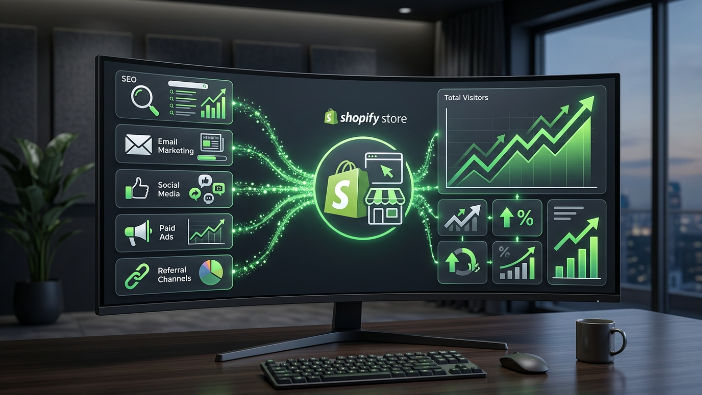
Shopify Marketing 101: Drive Traffic and Sales in 2026
INTRODUCTION
Running a Shopify store is one thing. Actually getting people to visit it and buy from you is a completely different challenge. A lot of store owners spend weeks setting up the perfect looking store, writing great product descriptions, and getting their checkout process right, and then they launch and hear nothing but silence. No visitors, no sales, no feedback. Just a beautiful store sitting on the internet with nobody in it.
The good news is that driving traffic and making sales is a learnable skill. It is not magic and it is not luck. It is a combination of strategies that, when applied consistently, compound over time and build a real business. This guide covers everything you need to know about Shopify marketing in 2026, from the free foundational stuff all the way to paid advertising and the newer trends that are working right
UNDERSTAND YOUR STORE BEFORE YOU SPEND A SINGLE PENNY
Before you run any ads or invest in any marketing channel, you need to make sure your store is actually ready to convert visitors into buyers. Sending traffic to a store that is not ready is like pouring water into a bucket with holes in it. You will spend money and get nothing back.
Your store needs a few things to be in good shape first. Your product pages need clear, high quality images. Not blurry phone photos, actual clean images that show the product well. Your descriptions need to explain what the product is, why someone should want it, and what problem it solves. Your prices need to be clearly displayed and your checkout process needs to be smooth and trustworthy.
You also need to have some form of social proof. Reviews, testimonials, user generated photos, anything that shows real people have bought from you and liked what they received. In 2026, people are more skeptical than ever about online stores, and social proof is what breaks down that skepticism.
Make sure your store loads fast on mobile. The majority of people who will visit your store will be on their phones. If your store takes more than three seconds to load, a huge percentage of them will leave before they even see your products. You can check your store speed in Shopify admin under Online Store and then the speed report.
Once these basics are in place, you are ready to start marketing.
SEO THE FREE TRAFFIC MACHINE
SEO is the most underrated marketing channel for Shopify stores, especially for beginners, because it is free and the results compound over time. Once you rank for a search term, you can get consistent traffic every single day without paying for it.
The way SEO works is straightforward. When someone types something into Google like affordable leather wallets for men or best skincare for dry skin, Google shows them a list of pages it thinks are most relevant and trustworthy. Your job is to make your store pages relevant and trustworthy enough to show up on that list.
Start with keyword research. You need to find out what words and phrases your potential customers are actually typing into search engines. A free tool called Google Keyword Planner can help with this. Ubersuggest and Ahrefs also have free versions that are useful. You are looking for keywords that have decent search volume but are not so competitive that giant brands dominate every result.
Once you have your keywords, you place them naturally in your product titles, product descriptions, collection page descriptions, and your page meta titles and meta descriptions. In Shopify, you can edit the meta title and meta description for every page by scrolling to the bottom of the product or page editor and clicking on Search Engine Listing.
Do not stuff keywords unnaturally. Write for humans first, search engines second. Google in 2026 is smart enough to understand context and it rewards content that genuinely helps people.
Blog content is also a powerful SEO tool for Shopify stores. Shopify has a built in blog feature. Writing helpful articles related to your products and niche brings in people who are in the research phase before they buy. For example, if you sell coffee equipment, writing a blog post titled How to Brew the Perfect Pour Over Coffee at Home will attract coffee enthusiasts who might then see your products and decide to buy.
Make sure all your product images have descriptive alt text. This helps Google understand what the images show, which contributes to your rankings. In Shopify, you can add alt text by clicking on a product image when editing a product.
EMAIL MARKETING YOUR MOST VALUABLE ASSET
If there is one marketing channel you should prioritize above everything else in 2026, it is email marketing. Your email list is something you own. Unlike social media followers or ad audiences, nobody can take your email list away from you. Algorithm changes, platform bans, rising ad costs, none of that affects your ability to send an email to your list.
The average return on investment for email marketing is extraordinarily high compared to other channels. For every dollar spent, email marketing typically returns many times over in revenue. For Shopify stores specifically, email is often the top revenue driver once the list is built.
To start building your email list, you need to give people a reason to sign up. A discount code for first time subscribers is the most common approach and it works very well. Something like Get 15 percent off your first order when you subscribe to our newsletter. You can set this up using Shopify Email or a third party tool like Klaviyo, which is the most popular email marketing platform for Shopify stores.
Klaviyo integrates directly with Shopify and it knows everything about your customers’ behaviour. It knows what products they viewed, what they added to their cart, what they bought, and how much they spent. You can use this data to send highly targeted emails that feel personal rather than generic.
There are a few email flows every Shopify store should have set up. The first is the welcome series. When someone signs up to your list, they should automatically receive a sequence of two or three emails that introduce your brand, tell your story, and guide them toward making their first purchase.
The second essential flow is the abandoned cart email. This goes out automatically when someone adds products to their cart but does not complete the purchase. Abandoned cart emails are some of the highest converting emails in ecommerce because the person was clearly interested enough to add items to their cart. A gentle reminder, sometimes with a small incentive, often brings them back to complete the purchase.
The third flow is the post purchase sequence. After someone buys, you should send them emails that thank them, tell them what to expect with their order, ask for a review once they have received it, and eventually suggest related products they might like.
Beyond automated flows, you should also send regular campaign emails to your whole list. Product launches, seasonal promotions, behind the scenes content, and helpful tips related to your niche all work well.
SOCIAL MEDIA MARKETING IN 2026
Social media has changed a lot and in 2026 the landscape looks quite different from even a few years ago. Organic reach on most platforms has declined significantly, meaning you can post great content and very few of your followers will see it unless you understand how each platform works.
That said, social media is still incredibly powerful for Shopify stores when used correctly. The key is to focus on one or two platforms rather than trying to be everywhere at once.
Instagram and TikTok
These two platforms are the most relevant for most ecommerce businesses in 2026. Both are heavily visual and both prioritize video content in their algorithms.
TikTok in particular has an extraordinary ability to show your content to people who do not follow you yet. A single good video can reach hundreds of thousands of people who have never heard of your brand. This is what makes it so valuable for new stores trying to build an audience from scratch.
The type of content that works on TikTok and Instagram Reels is not polished, corporate looking advertising. It is authentic, behind the scenes, story driven content. Show how your products are made. Show yourself packing orders. Share the story of why you started your business. Demonstrate your product being used in real life. Answer common questions about your products in short video form.
Consistency matters more than perfection on these platforms. Posting three to five times a week of decent content will outperform posting one piece of perfect content once a month.
Pinterest is an underrated platform for many ecommerce niches. It functions more like a search engine than a social network, and pins have a much longer shelf life than posts on other platforms. A pin you create today can still be driving traffic to your store two years from now.
Pinterest works especially well for niches like home decor, fashion, food, weddings, fitness, and DIY. If your products fit any of these categories, you should absolutely be on Pinterest.
INFLUENCER MARKETING AND UGC
Influencer marketing has matured a lot and in 2026 the most effective approach for most Shopify stores is not partnering with massive celebrities but rather with micro influencers. These are people with anywhere from five thousand to one hundred thousand followers in a specific niche.
Micro influencers have highly engaged, trusting audiences. Their followers see them as real people with genuine opinions rather than paid celebrities. When a micro influencer recommends a product they actually like, their audience listens.
To find relevant micro influencers, search hashtags related to your niche on Instagram or TikTok and look at the accounts posting consistently good content in that space. Reach out with a personalised message, offer them free products in exchange for an honest review, and see if there is a natural fit.
User generated content, which means photos and videos created by your actual customers, is equally valuable. When real customers post photos of themselves using your products, that content is more trustworthy than anything you create yourself. Encourage customers to tag you on social media and share their posts. You can even create a hashtag specific to your brand and invite customers to use it.
PAID ADVERTISING GOOGLE ADS
Once you have some organic traffic coming in and you understand which products are resonating with customers, paid advertising becomes a powerful way to scale up. Google Ads is one of the two main paid channels for Shopify stores.
Google Shopping ads are the product listing ads that appear at the top of Google search results with images, prices, and store names. These are incredibly effective for ecommerce because they show up when someone is actively searching for a product to buy. Someone searching for blue running shoes size 10 is very close to making a purchase, and if your ad appears right in front of them, you have a great chance of getting that sale.
To run Google Shopping ads, you need to connect your Shopify store to Google Merchant Center, which is a free tool that syncs your product catalogue with Google. Shopify has a Google channel app that makes this process straightforward.
Search ads are text based ads that appear when someone searches specific keywords. These work well for targeting people searching for solutions your products provide, even if they are not searching for your specific product yet.
Start with a small daily budget when you are learning Google Ads. Even five to ten dollars a day will give you useful data to work with. Pay attention to which keywords are driving clicks and which are driving actual purchases, and gradually shift your budget toward what is working.
PAID ADVERTISING – META ADS (FACEBOOK AND INSTAGRAM)
Meta ads, which run across Facebook and Instagram, work differently from Google ads. On Google, you are targeting people who are actively searching. On Meta, you are showing ads to people based on their interests, behaviours, and demographics, even when they are not searching for anything.
This makes Meta ads excellent for introducing your brand to people who do not know you exist yet. They are particularly powerful for visually appealing products that can stop someone mid scroll.
The most important element of a Meta ad is the creative, meaning the image or video you use. In 2026, video ads consistently outperform static image ads. Short videos of fifteen to thirty seconds that quickly show the product, demonstrate its value, and end with a clear call to action tend to perform best.
Meta has a feature called Advantage Plus Shopping Campaigns which uses artificial intelligence to automatically find the best audiences for your ads and optimise delivery toward purchases. This has become the recommended starting point for most ecommerce advertisers on Meta because it simplifies the campaign setup and often delivers strong results.
Retargeting is also an important part of your Meta ads strategy. You can show ads specifically to people who have already visited your store but did not buy. These people already know who you are, so the barrier to purchase is lower. Retargeting ads typically have much higher conversion rates than cold audience ads.
CONTENT MARKETING AND BLOGGING
We touched on blogging in the SEO section but it deserves its own discussion because content marketing is a long term strategy that builds trust, authority, and free organic traffic simultaneously.
The idea is simple. You create genuinely useful content related to your niche and publish it on your Shopify blog. Over time, people searching for information related to your niche find your content, learn from it, come to trust your brand, and eventually buy from you.
For example, if you sell fitness equipment, you might write articles about the best home workout routines, how to set up a home gym on a budget, nutrition tips for muscle building, and common mistakes beginners make when starting to exercise. People searching for these topics are your potential customers. By providing them with genuinely helpful information, you are building a relationship with them before they ever see your products.
The key to content marketing working is consistency and genuine quality. Writing one blog post and never writing another will not move the needle. Committing to publishing one or two genuinely useful articles per week over a period of six to twelve months will build real, compounding organic traffic.
LOYALTY PROGRAMS AND REFERRAL MARKETING
Getting a new customer is significantly more expensive than keeping an existing one. This is why loyalty programs and referral marketing are such smart investments for Shopify stores.
A loyalty program rewards customers for repeat purchases. Every time they buy, they earn points. Those points can be redeemed for discounts, free products, or other rewards. This gives customers a reason to come back to your store instead of buying from a competitor next time.
Shopify has several apps that make setting up loyalty programs easy. Smile.io is one of the most popular and it integrates seamlessly with Shopify. You can set up a points program, a referral program, and a VIP tier program all in one place.
Referral marketing turns your existing customers into your marketing team. When a happy customer refers a friend to your store and that friend makes a purchase, both the referrer and the new customer get a reward. This is powerful because people trust recommendations from friends far more than they trust any advertisement
SHOPIFY SPECIFIC MARKETING TOOLS
Shopify itself has several built in marketing features that are worth using.
Shopify Email lets you send email campaigns directly from your Shopify admin. It is simpler than Klaviyo but it is free for a certain number of emails per month, which makes it a good starting point for new stores.
Shopify Audiences is a feature available to Shopify Plus merchants that uses data from the broader Shopify ecosystem to help you find high intent buyers for your ads. It is a powerful tool if you are on the Plus plan.
Shopify Collabs is a platform that connects Shopify merchants with content creators for affiliate and influencer partnerships. You can find creators, manage partnerships, and track sales all within Shopify.
The Shopify App Store also has hundreds of marketing apps covering everything from SMS marketing to push notifications to affiliate programs. Be selective about which apps you install because too many apps can slow down your store.
SMS MARKETING THE RISING CHANNEL
SMS marketing has grown significantly and in 2026 it is one of the highest converting channels available to ecommerce stores. Text messages have open rates that email simply cannot match. Most people open a text message within minutes of receiving it.
The key to SMS marketing is getting explicit permission from customers before texting them, and then only texting them when you have something genuinely valuable to say. Nobody wants spam texts. But a well timed text about a flash sale, a back in stock notification for a product they wanted, or an order update is genuinely welcome.
Apps like Postscript and Attentive are popular SMS marketing tools that integrate with Shopify. You can set up automated SMS flows similar to email flows, including abandoned cart texts and welcome messages.
ANALYTICS KNOWING WHAT IS ACTUALLY WORKING
All of this marketing activity means nothing if you are not tracking what is working and what is not. You cannot improve what you do not measure.
Shopify has a built in analytics dashboard that shows you key metrics like total sales, number of orders, average order value, conversion rate, and where your traffic is coming from. Spend time in here regularly.
Google Analytics 4 gives you even deeper insight into how people are behaving on your store. You can see which pages people are visiting, how long they are staying, where they are dropping off in the purchase funnel, and much more.
Your conversion rate is one of the most important metrics to watch. This is the percentage of visitors who actually make a purchase. The average ecommerce conversion rate is around two to three percent. If yours is significantly below that, it means your marketing is bringing people in but something about the store itself is preventing them from buying.
Use your analytics to identify your best performing products, your most valuable traffic sources, and the pages where people are leaving your site. Then make decisions based on that data rather than gut feeling.
BUILDING A MARKETING CALENDAR
One of the most practical things you can do to stay consistent with your marketing is build a simple marketing calendar. This is just a plan of what you are going to do and when.
Map out the major holidays and shopping events relevant to your audience throughout the year. For ecommerce, the big ones are usually things like Black Friday and Cyber Monday, Valentine’s Day, Eid and other religious celebrations depending on your market, Mother’s Day, summer sales, and end of year holidays.
Plan your promotions, email campaigns, social media content, and ad campaigns around these dates well in advance. Last minute marketing is always less effective than planned, well prepared campaigns.
A marketing calendar also helps you stay consistent with content. If you know you need to publish two blog posts a week and post on social media four times a week, planning this out in advance means you are not scrambling at the last minute trying to figure out what to post
FINAL THOUGHTS
Marketing a Shopify store in 2026 is both more complex and more accessible than ever before. There are more tools, more channels, and more data available to you than any previous generation of store owners had. But that also means more noise and more competition.
The stores that win are not the ones with the biggest budgets. They are the ones that know their customers deeply, communicate with them genuinely, show up consistently, and keep improving based on what the data tells them.
Start with the basics. Get your SEO right, build your email list, and create authentic social media content. Then layer in paid advertising once you understand what is working organically. Build loyalty programs to keep your customers coming back. Track everything and keep adjusting.
Marketing is not a one time effort. It is an ongoing commitment to finding, attracting, and keeping the right customers. Do it well and your Shopify store will not just survive in 2026, it will genuinely thrive.