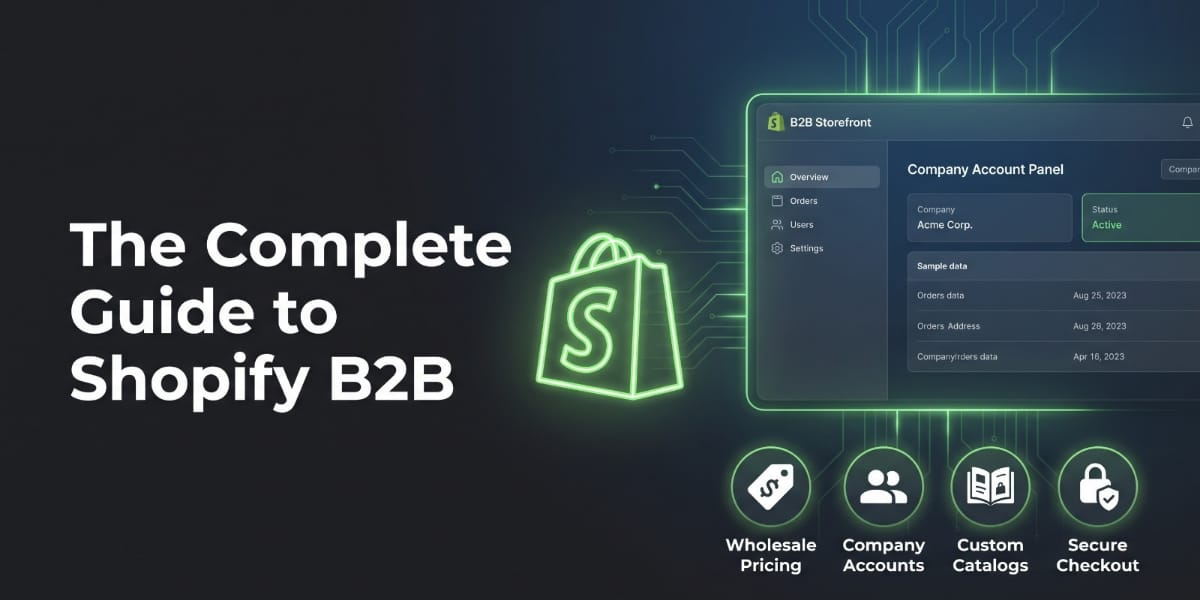
The Complete Guide to Shopify B2B
If you’ve been running your Shopify store for consumers only, you’re leaving money on the table. B2B ecommerce is exploding right now, and Shopify has quietly become one of the best platforms for selling to other businesses, not just individual shoppers. Let’s talk about what Shopify B2B actually is, how it works, and how you can use it to grow your store into something much bigger.
What Exactly Is Shopify B2B?
Shopify B2B is a built in feature that lets you sell wholesale directly through your existing Shopify store. Before this feature existed, merchants who wanted to sell both to regular customers and to wholesale buyers had to either use a separate platform, install a bunch of clunky apps, or run two completely different stores. That was messy, expensive, and hard to manage.
Now, with Shopify B2B, you can run your direct to consumer store and your wholesale business from the exact same admin panel. You get one inventory system, one order management dashboard, and one theme, but you can offer completely different pricing, payment terms, and catalogs depending on who’s buying.
Think of it like having a VIP back room in your store that only certain customers can access, with its own pricing and its own rules, while everyone else shops the regular way out front.
Why B2B Matters So Much Right Now
Business buyers now expect the same smooth, self service experience they get as consumers. They don’t want to email a sales rep and wait two days for a quote. They want to log in, see their special pricing, place an order, and get on with their day.
This shift matters a lot for merchants in Pakistan too. Local manufacturers, distributors, and wholesalers who sell to shops, boutiques, and resellers across the country have traditionally relied on WhatsApp orders, phone calls, and manual invoicing. That works, but it doesn’t scale. Shopify B2B gives Pakistani businesses a way to professionalize that wholesale relationship without losing the personal touch that local buyers appreciate.
Who Should Use Shopify B2B
This feature isn’t only for giant corporations. It makes sense for a wide range of sellers, including:
Manufacturers who sell to retailers and want an easier way to manage repeat wholesale orders.
Distributors who supply multiple smaller businesses and need different pricing tiers for different account sizes.
Brands that sell direct to consumers but also want to open a wholesale channel for boutiques or resellers.
Print on demand and apparel businesses looking to sell in bulk to corporate clients, schools, or event organizers.
Any Pakistani ecommerce brand that currently handles wholesale orders manually through WhatsApp, email, or spreadsheets and wants to bring that process online.
Core Features of Shopify B2B
Let’s go through what you actually get when you set up B2B on Shopify.
Company profiles. Instead of treating every buyer as an individual customer, Shopify B2B lets you create company accounts. A company can have multiple people attached to it, like a purchasing manager and an assistant, all buying under the same account with the same permissions and pricing.
Custom price lists. You can set different prices for different companies or customer segments. One wholesale buyer might get a flat 20 percent discount, another might get special pricing on specific products only, and your regular retail customers see the normal storefront pricing.
Quantity rules and minimums. You can set minimum order quantities, order increments, and maximum limits per product. This is huge if you only want to sell certain items in cases of 12 or cartons of 50, which is common for manufacturers and wholesalers.
Payment terms. B2B buyers often need net 30, net 60, or other payment terms instead of paying upfront by card. Shopify B2B supports these terms so you can invoice buyers and collect payment later, which matches how most wholesale relationships already work.
Self-service ordering. Buyers can log into their own account, see their negotiated pricing, browse their custom catalog, and place orders without ever needing to contact you directly. This alone saves an enormous amount of back and forth.
Custom checkout. You can hide certain payment methods for B2B buyers, show purchase order fields, and tailor the checkout experience so it feels built for business purchasing rather than a typical consumer checkout.
How Shopify B2B Works Behind the Scenes
At a technical level, B2B functionality on Shopify revolves around a few core building blocks: companies, locations, and catalogs.
A company represents the business you’re selling to. Under that company, you can add multiple locations, which is useful if a business has several branches or warehouses that each need their own shipping address and possibly their own pricing.
Catalogs are where the real customization happens. You create a catalog of products, assign specific pricing to that catalog, and then assign that catalog to one or more companies. This means two different wholesale clients could see two entirely different sets of products and prices, all from the same store, all managed from one place.
This setup is available on Shopify Plus, so if you’re planning to lean heavily into B2B, you’ll want to have that plan tier in mind as part of your growth strategy.
Setting Up Shopify B2B Step By Step
Here’s a simple breakdown of how the setup process generally goes.
First, you’ll enable B2B functionality within your Shopify admin settings. Once that’s turned on, you’ll start creating company profiles for your wholesale clients.
Next, you add contacts to each company. These are the actual people who will log in and place orders on behalf of that business.
After that, you build your price lists. You can either create a blanket discount for a company or go product by product for very specific pricing arrangements.
Then you set up your catalogs and assign them to the right companies, making sure each business sees only what you want them to see.
Finally, you configure your payment terms and checkout settings so buyers know exactly how and when they need to pay.
Once everything is set up, you’ll want to test the experience yourself by logging in as a test company account to make sure pricing, minimums, and checkout all behave the way you expect.
Shopify B2B for Pakistani Merchants
If you’re running a Pakistani ecommerce business, there are a few things worth thinking about specifically for our market.
Many local wholesale relationships are built on trust and long payment cycles, so the ability to offer net payment terms through Shopify B2B lines up naturally with how business is already done here. Instead of replacing that trust-based system, you’re just giving it a digital home.
Currency and pricing in PKR work fine within B2B catalogs, so you can set wholesale pricing in local currency without any complications.
If you’re currently relying on local payment gateway workarounds for your regular store, keep in mind that B2B buyers using net terms won’t need to go through an online payment gateway at checkout the same way retail customers do, since they’re often invoiced separately. This can actually simplify your payment gateway headaches for that part of your business.
For fulfillment, if you’re already working with local courier integrations for retail orders, you can apply those same shipping setups to B2B orders, or set different shipping rules entirely for wholesale shipments that tend to be bulkier and heavier.
Common Mistakes Merchants Make With B2B
Setting minimums too low. If your minimum order quantity doesn’t reflect your actual production or packing costs, you’ll end up processing wholesale orders that barely make you any profit.
Not training buyers on self service. Even though the system is self service, your wholesale clients are used to calling or messaging you directly. Spend time walking them through their new account so they actually use it instead of falling back on WhatsApp.
Ignoring catalog organization. If you dump your entire product range into every catalog without thinking it through, buyers get confused and your average order value can actually drop instead of rise.
Forgetting about tax and invoicing needs. B2B buyers often need proper invoices for their own bookkeeping, so make sure your invoicing setup, whether through Shopify or a connected app, meets that expectation.
B2B and B2C Living Together
One of the best parts of Shopify’s approach is that you don’t need a separate store for wholesale. Your regular customers keep shopping exactly the way they always have, completely unaware that a wholesale layer even exists. Meanwhile, your business buyers get their own tailored experience the moment they log in.
This matters a lot for brand consistency. You’re not managing two different websites with two different look and feels. It’s the same theme, the same product photography, the same brand voice, just with a different pricing and ordering layer underneath for approved business accounts.
Apps That Extend Shopify B2B
While the native B2B features cover a lot of ground, there are apps in the Shopify ecosystem that can extend things further, such as more advanced quoting tools, volume discount builders, and B2B specific analytics dashboards. If your wholesale operation grows complex enough, it’s worth exploring these to layer on extra functionality without rebuilding your entire setup.
Is Shopify B2B Worth It For Your Business
If you’re already fielding wholesale inquiries manually, even occasionally, this feature can save you hours every week and make your business look far more professional to bigger buyers. It also opens the door to bigger relationships, since larger businesses often prefer working with suppliers who have a proper self service ordering system rather than someone managing everything through a notebook and a phone.
For growing Pakistani ecommerce brands looking to expand beyond individual consumers and into supplying shops, boutiques, or corporate clients, Shopify B2B is genuinely one of the more exciting features to come out of the platform in recent years.
Final Thoughts
Shopify B2B takes something that used to require separate platforms, custom development, or a lot of manual effort, and folds it neatly into the same store you’re already running. Company accounts, custom pricing, payment terms, and self service ordering all work together to make wholesale selling feel as smooth as your regular storefront.
If you’re thinking about adding a B2B channel to your Shopify store and want help planning out your catalogs, pricing structure, or overall setup, that’s exactly the kind of project TheScriptFlow can help you build from the ground up.