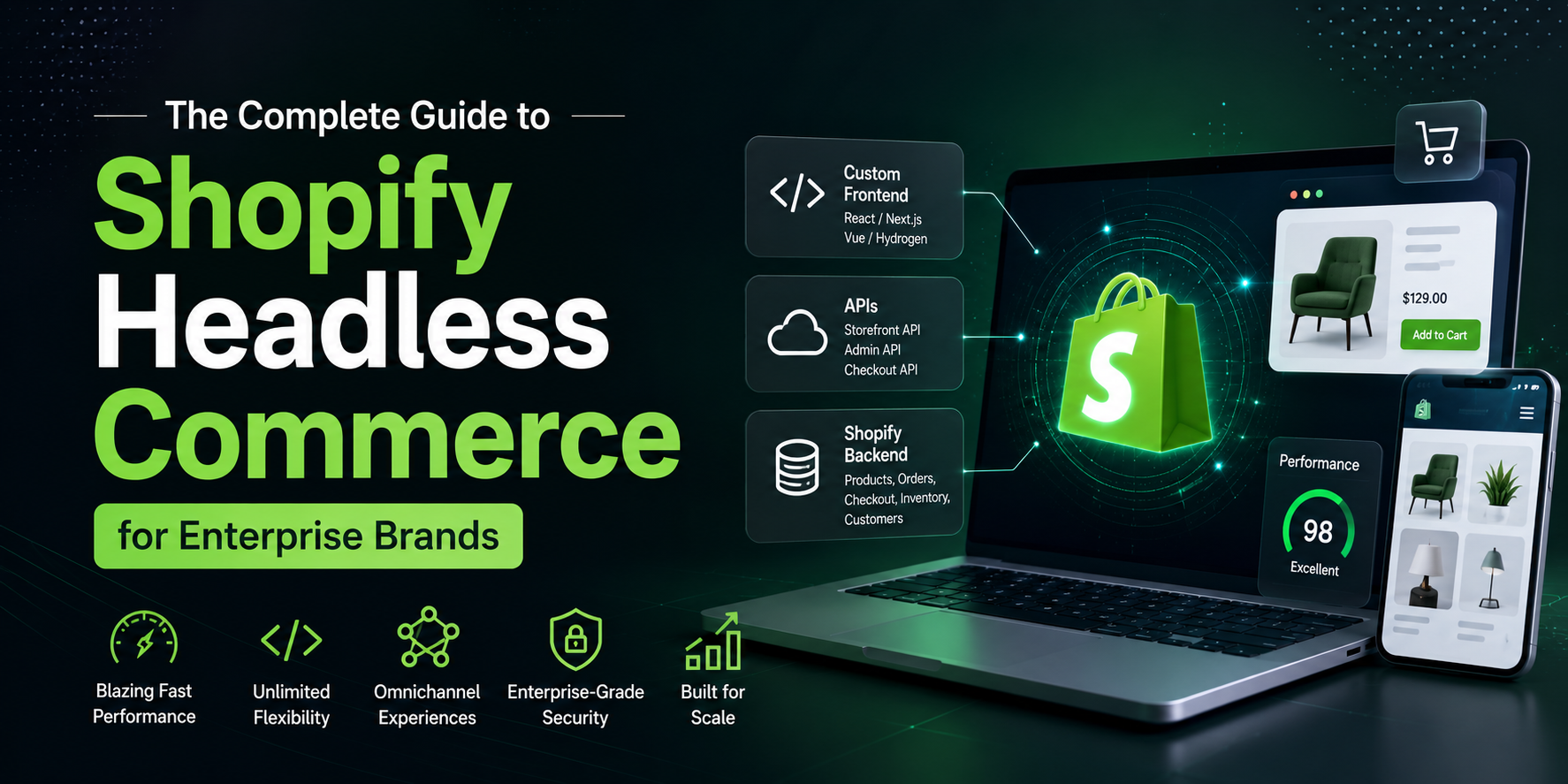
The Complete Guide to Shopify Headless Commerce for Enterprise Brands
Enterprise ecommerce is evolving faster than ever. Traditional online stores are no longer enough for brands that want lightning fast performance, personalized shopping experiences, omnichannel selling, and complete design flexibility. This is exactly why headless commerce has become one of the biggest ecommerce trends in recent years.
Shopify, already one of the most powerful ecommerce platforms in the world, has positioned itself as a major player in the headless commerce space. Enterprise brands are now using Shopify Headless Commerce to build faster, more scalable, and highly customized online shopping experiences.
But what exactly is Shopify headless commerce? Why are enterprise brands moving toward it? Is it worth the investment? And how can businesses implement it successfully?
In this complete guide, we will cover everything you need to know about Shopify headless commerce for enterprise brands in 2026.
What is Headless Commerce?
Headless commerce is an ecommerce architecture where the frontend (what customers see) is separated from the backend (where products, inventory, orders, and checkout are managed).
In a traditional ecommerce setup, the frontend and backend are tightly connected. This means the design, functionality, and customer experience are limited by the platform’s theme system.
In headless commerce, the frontend becomes completely independent. Developers can use modern technologies like React, Next.js, Vue, Hydrogen, or custom frameworks to create unique customer experiences while Shopify handles the backend ecommerce operations.
Simply put:
- Shopify manages products, inventory, checkout, payments, and orders.
- Developers build a completely custom storefront on top of Shopify APIs.
This separation gives enterprise brands significantly more flexibility and performance.
Why Enterprise Brands Are Choosing Shopify Headless Commerce
Large brands operate differently from small businesses. They require advanced customization, faster websites, integrations with enterprise systems, and omnichannel experiences.
Traditional ecommerce setups often struggle under these demands.
Shopify headless commerce solves many of these problems.
1. Faster Website Performance
Website speed directly impacts conversions.
Enterprise brands cannot afford slow-loading websites because even a one-second delay can reduce revenue significantly.
Headless architecture allows developers to use modern frontend frameworks that are optimized for performance.
Benefits include:
- Faster page loading
- Better Core Web Vitals
- Improved mobile experience
- Lower bounce rates
- Higher conversion rates
This is one of the biggest reasons why enterprise brands are moving toward headless solutions.
2. Unlimited Design Flexibility
Traditional Shopify themes still have limitations.
Headless commerce removes these restrictions completely.
Enterprise brands can create:
- Fully custom user experiences
- Interactive shopping journeys
- Dynamic content layouts
- Personalized product pages
- Advanced animations
- App-like interfaces
This flexibility allows brands to stand out in highly competitive markets.
3. Better Omnichannel Experiences
Modern customers shop across multiple channels:
- Websites
- Mobile apps
- Social commerce
- Smart devices
- POS systems
- Marketplaces
Headless commerce makes it easier to deliver consistent experiences across all channels because the backend data is centralized.
Shopify APIs allow brands to distribute ecommerce functionality anywhere.
4. Scalability for High Traffic
Enterprise brands experience large traffic spikes during events like:
- Black Friday
- Cyber Monday
- Product launches
- Flash sales
- Influencer campaigns
Headless commerce architectures can scale more efficiently than traditional setups.
Modern frontend frameworks and CDN systems help handle huge traffic loads without slowing down the website.
5. Easier Integration with Enterprise Systems
Large businesses often use multiple systems, including:
- ERP software
- CRM platforms
- Inventory management tools
- Marketing automation systems
- Analytics platforms
Headless commerce makes integrations easier because APIs connect everything together more efficiently.
This creates smoother workflows across departments.
How Shopify Headless Commerce Works
Shopify headless commerce relies heavily on APIs.
The backend remains Shopify, while the frontend is custom-built.
Here is the simplified architecture:
Backend (Managed by Shopify)
Shopify handles:
- Product management
- Checkout
- Inventory
- Payments
- Orders
- Customer accounts
- Store operations
Frontend (Custom Development)
Developers build custom storefronts using:
- React
- Next.js
- Vue.js
- Nuxt.js
- Hydrogen
- Remix
The frontend communicates with Shopify through APIs.
APIs
Shopify offers several APIs for headless commerce:
Storefront API
Used to display products, collections, carts, and customer data.
Admin API
Used for backend operations and advanced store management.
Customer API
Handles customer accounts and authentication.
Checkout API
Manages secure checkout experiences.
Shopify Hydrogen and Oxygen
Shopify introduced Hydrogen and Oxygen specifically for headless commerce.
These tools simplify development for enterprise brands.
What is Hydrogen?
Hydrogen is Shopify’s React-based framework for building custom storefronts.
It includes:
- Pre-built commerce components
- Fast rendering
- Shopify integrations
- Optimized performance
- SEO features
Hydrogen helps developers build headless stores much faster.
What is Oxygen?
Oxygen is Shopify’s hosting solution for Hydrogen storefronts.
It provides:
- Global CDN
- Fast hosting
- Security
- Scalability
- Simplified deployment
Together, Hydrogen and Oxygen create a complete headless ecosystem.
Advantages of Shopify Headless Commerce
Superior User Experience
Headless commerce allows enterprise brands to create premium experiences that feel modern and interactive.
This can significantly improve:
- Engagement
- Time on site
- Customer satisfaction
- Conversion rates
Improved SEO Performance
Fast websites rank better on search engines.
Headless storefronts built with frameworks like Next.js often deliver:
- Faster page speeds
- Better mobile performance
- Server-side rendering
- Optimized metadata
All of these contribute to better SEO.
Faster Innovation
Enterprise brands constantly test new ideas.
Headless commerce enables faster experimentation because frontend changes can happen independently from backend systems.
Teams can launch:
- New layouts
- Interactive campaigns
- Landing pages
- Personalized experiences
without rebuilding the entire store.
Enhanced Security
Separating frontend and backend reduces certain security risks.
Shopify also manages PCI compliance and payment security.
This is important for enterprise-level businesses handling large transaction volumes.
Better Global Performance
Headless storefronts often use modern CDN architecture that delivers content faster worldwide.
This improves the customer experience for international shoppers.
Challenges of Shopify Headless Commerce
While headless commerce offers major benefits, it also comes with challenges.
Enterprise brands must understand these before investing.
Higher Development Costs
Headless commerce requires experienced developers.
Custom frontend development is more expensive than using Shopify themes.
Costs may include:
- Frontend development
- API integrations
- Ongoing maintenance
- Hosting
- QA testing
This approach is usually best for larger brands with bigger budgets.
Increased Complexity
Traditional Shopify stores are easier to manage.
Headless systems involve:
- APIs
- Frontend frameworks
- Hosting infrastructure
- Deployment workflows
This adds technical complexity.
Longer Development Time
Custom storefronts take more time to build compared to standard Shopify themes.
Enterprise brands should plan accordingly.
Dependency on Developers
Most frontend updates require developer involvement.
Non-technical teams may have limited control over design changes unless a strong CMS setup is implemented.
When Should Enterprise Brands Go Headless?
Headless commerce is not necessary for every business.
However, enterprise brands should seriously consider it if they need:
- Advanced custom experiences
- High performance optimization
- Omnichannel selling
- Large-scale integrations
- Global scalability
- Highly personalized shopping journeys
Brands with simpler requirements may still perform well using traditional Shopify setups.
Shopify Headless Commerce vs Traditional Shopify
Traditional Shopify
Best for:
- Small businesses
- Startups
- Simple ecommerce stores
- Faster launch times
Advantages:
- Easier setup
- Lower cost
- Faster deployment
- Easier maintenance
Limitations:
- Less customization
- Theme restrictions
- Limited flexibility
Shopify Headless Commerce
Best for:
- Enterprise brands
- Large catalogs
- Custom experiences
- Omnichannel commerce
Advantages:
- Unlimited customization
- Better performance
- Enterprise integrations
- Modern frontend technologies
Limitations:
- Higher cost
- Technical complexity
- Longer development
Best Frontend Frameworks for Shopify Headless
Next.js
One of the most popular choices.
Benefits:
- Excellent SEO
- Fast performance
- Server-side rendering
- Large developer community
Hydrogen
Shopify’s official framework.
Benefits:
- Built specifically for Shopify
- Pre-built commerce tools
- Simplified development
Gatsby
Popular for static ecommerce experiences.
Benefits:
- Extremely fast loading
- Great SEO
Nuxt.js
Vue-based alternative for developers who prefer Vue.
Benefits:
- Strong performance
- Flexible architecture
Important Features Enterprise Brands Should Build
Personalized Experiences
Modern shoppers expect personalization.
Headless commerce allows:
- Dynamic recommendations
- Personalized homepages
- Custom offers
- User-based experiences
Advanced Search and Filtering
Enterprise stores often have huge product catalogs.
Custom search systems improve:
- Product discovery
- Navigation
- User experience
Progressive Web Apps (PWAs)
Many enterprise brands use headless commerce to create app-like web experiences.
Benefits include:
- Faster loading
- Offline capabilities
- Better mobile engagement
AI Powered Recommendations
AI can increase average order value through:
- Upsells
- Cross-sells
- Smart product suggestions
Headless systems make these integrations easier.
SEO Considerations for Shopify Headless Stores
SEO remains critical for ecommerce success.
Enterprise brands must optimize carefully.
Use Server Side Rendering
Frameworks like Next.js improve SEO by rendering pages on the server.
Optimize Core Web Vitals
Focus on:
- Largest Contentful Paint (LCP)
- Cumulative Layout Shift (CLS)
- Interaction to Next Paint (INP)
Maintain Clean URL Structures
Avoid unnecessary complexity in routing.
Optimize Images
Use:
- Modern image formats
- Lazy loading
- Responsive sizing
Structured Data
Implement schema markup for:
- Products
- Reviews
- FAQs
- Breadcrumbs
This improves search visibility.
Shopify Headless Commerce Architecture Example
A modern enterprise stack may include:
- Shopify Plus (backend)
- Hydrogen or Next.js frontend
- Contentful or Sanity CMS
- Algolia search
- Klaviyo email marketing
- Stripe payments
- Cloudflare CDN
- GA4 analytics
This creates a highly scalable ecosystem.
Real Benefits Enterprise Brands See
Brands using headless commerce often report:
- Faster load speeds
- Higher conversion rates
- Better SEO rankings
- Increased customer engagement
- Improved mobile experiences
- More flexible marketing campaigns
These improvements can directly impact revenue.
Is Shopify Plus Necessary for Headless Commerce?
Not always, but many enterprise brands choose Shopify Plus because it offers:
- Higher API limits
- Advanced automation
- Better scalability
- Dedicated support
- Enterprise features
For large businesses, Shopify Plus is usually the preferred option.
Common Mistakes to Avoid
Overengineering the Project
Not every feature needs to be custom-built.
Focus on business goals first.
Ignoring SEO
Some headless implementations accidentally hurt SEO.
Technical SEO must remain a priority.
Poor CMS Planning
Content teams need an easy way to update pages without developers.
A strong CMS strategy is essential.
Choosing the Wrong Tech Stack
Frontend frameworks should align with team expertise and business goals.
Underestimating Costs
Headless commerce requires ongoing investment.
Plan budgets carefully.
Future of Shopify Headless Commerce
Headless commerce is becoming increasingly mainstream.
Several trends are shaping the future:
AI Powered Commerce
AI driven personalization will become standard.
Voice Commerce
Headless systems will support smart device shopping experiences.
AR and 3D Shopping
Interactive product visualization will grow rapidly.
Faster Web Technologies
Frontend frameworks will continue improving performance.
Unified Commerce
Brands will connect online, offline, mobile, and social channels into one seamless ecosystem.
How Enterprise Brands Can Start with Shopify Headless
Step 1: Define Business Goals
Identify why you want to go headless.
Examples:
- Faster performance
- Better UX
- Omnichannel selling
- Scalability
Step 2: Choose Your Tech Stack
Select:
- Frontend framework
- CMS
- Hosting solution
- Search tools
- Analytics tools
Step 3: Work with Experienced Developers
Headless commerce requires specialized expertise.
Choose developers or agencies with proven experience.
Step 4: Prioritize Performance
Build with speed optimization from the beginning.
Step 5: Test Thoroughly
QA testing is essential for enterprise-level launches.
Final Thoughts
Shopify headless commerce is transforming how enterprise brands approach ecommerce.
It provides the flexibility, scalability, speed, and customization modern businesses need to compete in today’s digital landscape.
For enterprise brands looking to create world-class shopping experiences, headless commerce offers enormous potential.
However, it is not a simple plug-and-play solution. Success requires strategic planning, experienced development teams, strong SEO implementation, and long-term investment.
When executed properly, Shopify headless commerce can deliver:
- Faster websites
- Better conversions
- Improved customer experiences
- Stronger scalability
- Greater innovation
As ecommerce continues evolving in 2026 and beyond, headless architecture is likely to become a standard choice for ambitious enterprise brands seeking long-term growth and competitive advantage.