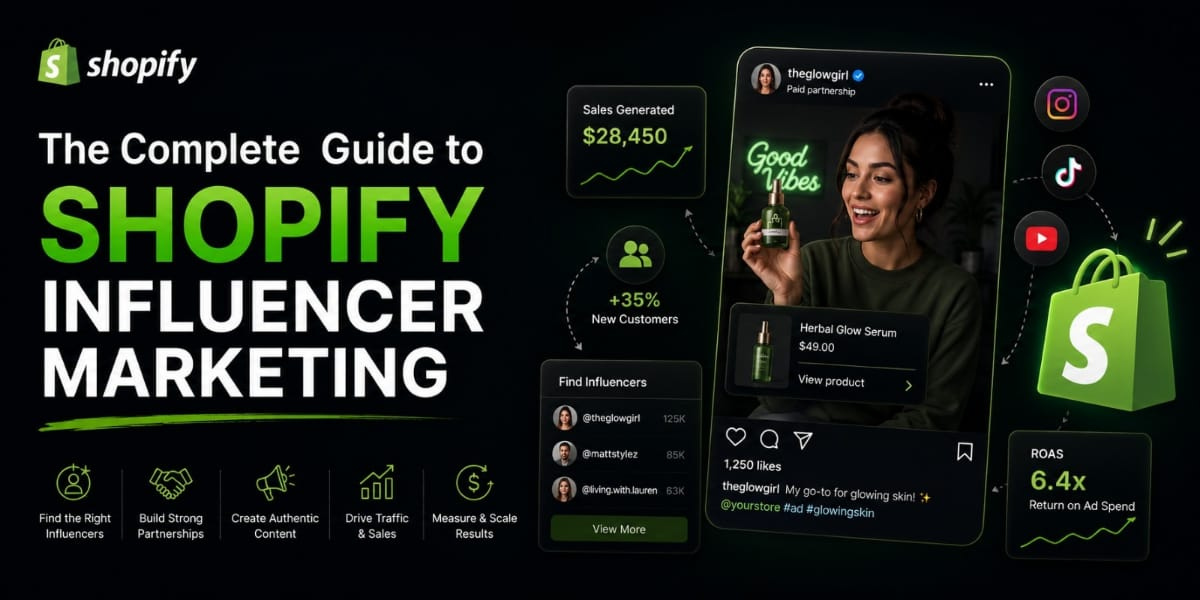
The Complete Guide to Shopify Influencer Marketing
There is a moment that every Shopify store owner dreams about.
A creator with a loyal, engaged audience picks up your product. They talk about it genuinely. Their followers trust them completely. And within hours your store is flooded with traffic, your notifications are going off, and orders are coming in faster than you expected.
That is influencer marketing working at its best.
And here is the thing. That moment is not reserved for big brands with massive budgets. It happens every single day for small and medium Shopify stores that have figured out how to find the right creators, build the right relationships, and set up campaigns that actually convert.
But it also goes wrong just as often. Store owners spend money on influencers who deliver zero sales. They partner with creators whose audiences have no interest in the product. They send free product with no clear agreement and get nothing back. They measure the wrong things and have no idea whether their influencer campaigns are working.
This guide is going to make sure you are in the first group and not the second.
We are going to cover everything what influencer marketing actually is in the context of Shopify, how to find the right influencers for your store, how to approach them, how to structure deals, how to brief them, how to track results, and how to build long term relationships that keep delivering value over time.
Let us get into it.
What Influencer Marketing Actually Means for Shopify Stores
Influencer marketing is when you partner with creators people who have built an audience on social media, YouTube, a podcast, or a blog to promote your products to their followers.
At its core, it is word-of-mouth marketing at scale.
When someone you trust recommends a product, you pay attention. You give it the benefit of the doubt. You are far more likely to click, explore, and buy than if you saw a traditional ad from a brand you have never heard of.
That trust is what influencers have built with their audiences. And when you partner with the right influencer one whose audience genuinely aligns with your ideal customer you are borrowing that trust for your brand.
For Shopify stores specifically, influencer marketing is particularly powerful because it works across every stage of the customer journey. An influencer can introduce your brand to someone who has never heard of you. They can provide the social proof that turns a hesitant browser into a buyer. They can remind past customers why they loved your product. And they can create content that you repurpose across your own channels long after the campaign ends.
Understanding the Different Types of Influencers
Not all influencers are the same. Understanding the different tiers and how they work is essential before you start reaching out to anyone.
Nano Influencers
Nano influencers have between 1,000 and 10,000 followers. Their audiences are small but extremely tight-knit. These are often people who built a following around a very specific interest or community a local foodie, a niche hobbyist, a passionate advocate for a particular lifestyle.
Engagement rates on nano influencer content are typically the highest of any tier. Their followers know them personally or feel like they do. Recommendations from nano influencers feel like advice from a friend.
For Shopify stores with limited budgets, nano influencers are often willing to work in exchange for free product alone. And because they are not yet flooded with brand requests, they tend to put genuine effort into the content they create.
Micro Influencers
Micro influencers have between 10,000 and 100,000 followers. This is the sweet spot for most Shopify stores and where the best ROI in influencer marketing consistently lives.
Micro influencers have large enough audiences to generate meaningful reach while maintaining the authenticity and engagement that comes from a more personal connection with followers. Their audiences are typically focused around a specific niche fitness, skincare, home décor, parenting, cooking, travel which makes targeting much more precise than working with larger influencers.
They are approachable, professional enough to deliver good content, and affordable enough that most Shopify stores can work with multiple of them simultaneously.
Macro Influencers
Macro influencers have between 100,000 and 1 million followers. At this level, influencers are operating as professional content creators. They have media kits, set rates, and often work with agents or management.
The reach is significant but engagement rates start to drop as audience size grows. Macro influencers cost substantially more typically in the range of several hundred to several thousand dollars per post and they receive so many brand partnership requests that competition for their attention and best creative effort is high.
For most Shopify stores, macro influencers make sense only when you have already validated your product and messaging with smaller creators and are ready to invest in broader awareness campaigns.
Mega Influencers and Celebrities
Mega influencers have over one million followers. At this level you are in celebrity territory YouTubers with massive channels, Instagram personalities with millions of followers, TikTok creators who are household names.
Campaign costs at this level start in the tens of thousands and go up from there. Engagement rates are typically the lowest of any tier. And unless your product genuinely fits their content and audience, the association can feel forced and perform poorly.
For the vast majority of Shopify stores, mega influencers are not the right investment. The ROI simply does not work at the scale most independent stores operate at.
Finding the Right Influencers for Your Shopify Store
Audience alignment is everything in influencer marketing. A creator with 500,000 followers whose audience has zero interest in what you sell is worth less than a creator with 8,000 followers whose audience is made up entirely of your ideal customers.
Here is how to find the right people.
Start on the Platform Where Your Customers Are
Go to the social platform where your target customer spends the most time. If you sell beauty products, Instagram and TikTok are the obvious starting points. If you sell home décor, Pinterest and Instagram. If you sell products for a professional audience, LinkedIn and YouTube.
Search hashtags related to your product category and your niche. If you sell organic pet food, search hashtags like #organicpetfood, #naturaldogfood, #healthypetlife. Look at who is creating content around those hashtags and getting genuine engagement.
Scroll through the content. Look for creators whose aesthetic, tone, and values align with your brand. Look for people who talk about topics your product naturally fits into — not creators who would clearly be promoting your product out of context.
Look at Who Your Competitors Are Working With
Search your competitors on Instagram, TikTok, and YouTube. Look through posts that have tagged them. Check the comments sections of their posts for creator mentions. See which influencers have reviewed or featured similar products to yours.
If a creator has successfully promoted a competitor’s product and driven engagement, they have already demonstrated that their audience is interested in your category. They are pre-qualified.
Use Influencer Discovery Tools
Manual searching works but it is time consuming. Influencer discovery platforms make the process significantly faster and give you data you cannot get from manual browsing.
Modash lets you search across Instagram, TikTok, and YouTube with detailed filtering niche, follower count, engagement rate, audience demographics, location. You can find hundreds of relevant creators in minutes.
Heepsy is another strong discovery tool with filters for audience quality, engagement authenticity, and niche relevance.
Upfluence integrates with Shopify directly and lets you find influencers, manage outreach, and track campaign performance all in one platform.
AspireIQ is a full influencer marketing platform that includes a discovery engine, campaign management tools, and analytics.
TikTok Creator Marketplace is TikTok’s own platform where creators opt in to be discovered by brands. Filtered search by category, follower count, and performance metrics makes finding relevant TikTok creators straightforward.
Pinterest Creator Hub offers similar discovery tools for Pinterest-focused creators.
Check Your Own Customer Base
This is one of the most overlooked influencer sourcing strategies available to Shopify store owners.
Some of your existing customers are creators. They already bought from you. They already love your product. If you can identify customers who have a meaningful social following in your niche, they are your ideal influencer partners they bring genuine authenticity that no paid partnership can replicate.
Look through your customer list for anyone who has tagged you on social media, left a particularly enthusiastic review, or mentioned your brand publicly online. Check their social profiles. If they have an engaged audience that aligns with your target customer, reach out.
Evaluating Influencer Quality Before You Reach Out
Not everyone with a large following is worth working with. Before you reach out to any creator, evaluate them against these criteria.
Engagement Rate
Follower count means very little without engagement. An account with 100,000 followers but only 200 likes and 5 comments per post has an engagement rate of 0.2% — essentially a dead audience.
As a general benchmark, engagement rates above 3% are considered good for larger accounts. Micro influencers should be in the 3 to 8% range. Nano influencers often have engagement rates of 5% or higher.
Calculate engagement rate by dividing the average number of likes plus comments by the follower count and multiplying by 100.
Audience Authenticity
Follower buying and engagement pod participation are real problems in the influencer industry. Some creators have inflated metrics that do not reflect genuine audience interest.
Tools like HypeAuditor and Modash have audience quality scores that flag suspicious activity sudden follower spikes, unusually high ratios of foreign followers, comment patterns that suggest inauthentic engagement.
A quick manual check is also useful. Scroll through the comments on a few recent posts. Do they look like real, thoughtful responses from real people? Or are they generic emoji chains and one-word comments that suggest bot activity?
Content Quality and Brand Alignment
Does the creator’s content style, aesthetic, and tone fit your brand? If you sell premium, minimalist skincare, a creator whose feed is chaotic and maximalist might not be the right fit even if their metrics are strong.
Look at the quality of their photography or video production. Look at how they write captions are they thoughtful and engaging or generic? Look at the brands they have worked with previously. Do those brands share your values and positioning?
Audience Demographics
The creator’s audience needs to match your target customer profile. If you sell women’s fitness apparel primarily to women aged 25 to 40, a creator whose audience is 70% male and predominantly under 20 is not the right fit regardless of how impressive their follower count is.
Most influencer discovery tools show audience demographic data age, gender, location, interests. Use this data to verify alignment before reaching out.
Recent Posting Frequency and Consistency
An influencer who posted regularly six months ago but has gone quiet recently might be losing audience engagement. Check their recent posting history. Consistent, recent activity is a good sign. Sporadic or declining activity is worth noting.
How to Approach Influencers the Right Way
The way you reach out to an influencer sets the tone for the entire relationship. A thoughtful, personalized outreach gets responses. A generic, copy-pasted pitch gets ignored.
Here are the principles of effective influencer outreach.
Personalize Every Message
Reference something specific about their content a recent post you genuinely found interesting, a topic they covered that relates to your product, something about their aesthetic or storytelling approach that resonates with your brand.
Generic messages that start with “Hi, I love your content” without any specifics are immediately recognizable as mass outreach. Creators receive dozens of these every week. They delete them.
A message that says “I watched your video on sustainable morning routines last week and it genuinely resonated especially the part about simplifying your skincare. I think our product might be a really natural fit for your audience” demonstrates that you actually paid attention. That stands out.
Keep It Short and Clear
Your initial outreach should be brief. Introduce yourself and your brand in one or two sentences. Explain why you think there is a fit between your product and their audience in one or two sentences. Tell them what you are proposing — a gifting collaboration, a paid partnership, an affiliate arrangement in one sentence. And invite them to respond with any questions.
Do not send a wall of text with your entire brand story, detailed campaign brief, and contract terms in the first message. That is overwhelming. Save the details for after they express interest.
Lead With What Is In It for Them
Influencers get approached by brands constantly. The ones that get responses are the ones where the value proposition to the creator is clear.
What are you offering? Free product? A commission on sales? A flat fee? Exposure? An ongoing partnership? Make it clear immediately.
Also think about their audience. Frame your product in terms of the value it provides to their followers not just the value of the partnership to the creator. A message that says “I think your audience would genuinely love this it solves a problem I see you talking about a lot” is more compelling than one that focuses purely on the terms of the deal.
Use the Right Channel
Most creators prefer to be contacted via the email address in their bio that signals a professional inquiry. DMs work for smaller nano and micro influencers who are more casual about their partnerships. For larger creators, going through their management email or booking contact is often required.
Structuring Your Influencer Deals
There is no single right way to structure an influencer deal. The right structure depends on the creator’s tier, your budget, and what you are trying to achieve.
Here are the main models.
Product Gifting
You send the creator your product for free in exchange for a review or feature if they love it.
This is the most accessible model for new Shopify stores and works particularly well with nano and smaller micro influencers. The key word here is “if they love it” gifting arrangements should never pressure creators to post positive content about something they do not genuinely like. Authenticity is what makes influencer marketing work. Forced positivity destroys it.
Be selective about who you gift to. Do the research first. Target creators whose audience genuinely aligns with your product. Sending product blindly to anyone who will take it wastes your product budget and generates low-quality content.
Affiliate Partnerships
You give the influencer a unique discount code or trackable referral link. They earn a commission typically 10 to 20% on every sale they generate.
This model aligns incentives perfectly. The influencer only earns when they actually drive sales, which means they are motivated to create compelling content. You only pay for results, which means there is no upfront cost risk.
Affiliate partnerships work especially well as a starting point with creators whose audience fit looks strong but whose ROI you have not yet proven. You can test the partnership with low financial risk and scale up investment for creators who demonstrate strong sales performance.
Flat Fee Paid Partnerships
You pay the creator a set fee for a specific deliverable one Instagram Reel, two TikTok videos, a YouTube review, a set of Stories. Payment is made regardless of how many sales are generated.
Flat fee partnerships are standard for macro influencers and increasingly common with established micro influencers. Rates vary enormously depending on platform, follower count, engagement rate, and content format.
A reasonable starting benchmark for micro influencers is between $100 and $500 per Instagram post and $150 to $600 per TikTok video, though rates vary significantly.
Hybrid Deals
A combination of a smaller flat fee plus an affiliate commission is increasingly popular and tends to work well for both parties. The flat fee compensates the creator for their time and effort. The commission gives them ongoing upside if the content performs well. And you benefit from their continued motivation to promote the content after the initial post.
Long-Term Ambassador Partnerships
Rather than one-off campaigns, ambassador relationships involve an ongoing partnership where the creator features your brand regularly over an extended period — monthly posts, quarterly campaigns, or an annual relationship.
Long-term partnerships deliver more authentic content because the creator genuinely integrates your brand into their life over time. Their audience sees repeated, consistent promotion rather than a one time mention that feels transactional. Brand ambassadors also tend to become genuinely knowledgeable about your products, which makes their content more credible and more useful.
Briefing Your Influencers Effectively
How you brief an influencer has a significant impact on the quality of content you get back.
Under-briefing leads to content that misses the mark wrong tone, wrong message, poor product presentation. Over-briefing stifles the creator’s natural voice and produces content that feels scripted and inauthentic.
The goal is a brief that gives the creator clear direction without removing their creative freedom.
A good influencer brief covers the following.
Brand Background a brief, engaging overview of who you are, what you sell, and what makes your brand different. Keep this to a short paragraph. You want the creator to understand your brand’s personality, not read a corporate fact sheet.
Campaign Objective what are you trying to achieve? Brand awareness? Direct sales? A specific product launch? New customer acquisition? Being clear about the objective helps the creator make content decisions that align with your goals.
Key Messages the two or three things you most want their audience to understand or feel about your product. Focus on benefits, not features. What does your product do for the customer? How does it make their life better?
Mandatory Inclusions anything that must appear in the content. A specific discount code. A product tag. A mention of a promotion. A link in bio. Be specific about these requirements but keep the list short. Every mandatory element you add reduces creative flexibility.
Content Guidelines general tone and style guidance that aligns with your brand. If your brand is warm and conversational, say so. If it is premium and minimal, communicate that. Share examples of content you love not to be copied, but to convey the aesthetic direction.
What Not to Do any specific things you want to avoid. Competitor mentions. Certain claims about the product. Content that conflicts with your brand values.
Approval Process whether you require content approval before posting. Many brands ask for content to be submitted for review 24 to 48 hours before the planned posting date. This is reasonable and most professional creators expect it.
Posting Timeline when you want the content to go live. Be specific and be reasonable. Give creators enough lead time to create quality content without rushing.
Tracking and Measuring Influencer Campaign Performance
You cannot improve what you do not measure. And influencer marketing is an area where many Shopify store owners fly blind.
Here is how to set up proper tracking and what to measure.
Unique Discount Codes
Give each influencer a unique discount code something like SARAHFIT15 for a fitness influencer named Sarah offering 15% off. Every time that code is used at checkout in your Shopify store, you know exactly which influencer drove that sale.
Unique codes are the simplest and most reliable way to track influencer-driven sales. They also give the referred customer an incentive to use the code, which can improve conversion rates.
UTM Parameters
UTM parameters are tracking tags you add to the URL in an influencer’s bio link or the link they share in content. When someone clicks that link and arrives on your store, Shopify and Google Analytics record exactly which influencer they came from.
Create a unique UTM link for each influencer partnership. Use a URL builder tool Google has a free one to generate these links. Include the influencer’s name and the campaign in the UTM parameters so your analytics data is easy to read.
Affiliate Dashboard Tracking
If you are running affiliate partnerships through an app like ReferralCandy, Refersion, or UpPromote, your affiliate dashboard tracks clicks, conversions, and commission earned for each influencer automatically.
Metrics to Evaluate
Beyond direct sales, there are several other metrics worth tracking to understand the full impact of an influencer campaign.
Reach and impressions tell you how many people saw the content. This is your awareness metric.
Engagement likes, comments, saves, shares tells you how the content resonated with the audience. High engagement indicates that the creator’s followers found the content genuinely interesting.
Profile visits and follower growth on your own social accounts during and after a campaign can indicate brand awareness impact beyond direct clicks.
Website traffic from the influencer’s content, tracked via UTM parameters or referral sources in your Shopify analytics.
Conversion rate of influencer-referred traffic. Are people who arrive from influencer content buying at a similar rate to your other traffic sources?
Cost per acquisition how much did you spend in total on the campaign divided by the number of new customers it generated? Compare this to your paid advertising cost per acquisition to understand relative efficiency.
Return on investment total revenue generated by the campaign divided by total cost of the campaign. This is your ultimate measure of whether the investment was worthwhile.
Repurposing Influencer Content
One of the most underrated benefits of influencer marketing is the content itself.
Good influencer content authentic videos and photos of real people using and loving your product is some of the most effective marketing material available. It outperforms brand-produced content in ads consistently because it feels real, not polished or artificial.
Always negotiate usage rights when structuring your influencer deals. Make sure your agreement explicitly gives you the right to repurpose the creator’s content in your own marketing on your website, in your email campaigns, in your social media posts, and in paid advertising.
Creator-generated content used as ad creative often called UGC ads consistently outperforms traditional ad creative on Meta and TikTok. The authenticity resonates with audiences who are increasingly skeptical of traditional advertising.
Save every piece of content your influencer partners create. Build a library of it. Use it across your marketing channels. The value of a single influencer partnership extends far beyond the initial post if you use the content strategically.
Building Long Term Influencer Relationships
The best influencer marketing is not transactional. It is relational.
When you invest in building genuine long term relationships with creators who love your brand, you create something far more powerful than any one-off campaign can deliver. You create authentic brand advocates who mention you organically, who genuinely recommend your products to their audiences, and whose followers see a consistent, credible association between that creator and your brand over time.
Here is how to build those relationships.
Pay fairly and on time. Nothing damages a creator relationship faster than late payment or underpayment. Be clear about payment terms upfront and honor them without being asked twice.
Give creators creative freedom. The best influencer content does not feel like an ad. It feels like genuine enthusiasm from someone whose taste and judgment their audience trusts. When you over script and over control the content, that authenticity disappears. Give direction, not a script.
Send new products before launch. Making your influencer partners feel like insiders giving them early access to new products, inviting them to virtual launch events, sharing behind-the-scenes brand updates deepens the relationship and keeps them genuinely engaged with your brand.
Recognize and appreciate their work. A personal thank you message after a campaign. A comment on their posts. Sharing their content on your brand account and giving them genuine credit. These small gestures matter and they are remembered.
Provide performance feedback. Share how their content performed with them. Let them know what resonated and what drove results. This helps them create better content for you in future campaigns and shows that you are invested in the partnership being genuinely successful for both parties.
Common Mistakes to Avoid
There are a few patterns that consistently derail influencer marketing campaigns for Shopify stores.
Prioritizing follower count over audience alignment. A creator with 500,000 followers whose audience has no interest in your product will generate less ROI than a creator with 15,000 followers whose audience is made up entirely of your ideal customers. Alignment always beats reach.
Not setting clear expectations upfront. Vague agreements lead to disappointing content and strained relationships. Be specific about deliverables, timelines, key messages, and usage rights before any product is sent or payment is made.
Working with too many influencers at once without proper tracking. If you cannot measure which creators are driving results, you cannot allocate your budget intelligently. Start with a manageable number, track everything, and scale what is working.
Expecting immediate results. Influencer marketing — especially with smaller creators — builds trust and awareness over time. Some campaigns drive immediate spikes in sales. Others build brand recognition that pays off over months. Both have value but require different measurement frameworks.
Ignoring the comment sections. The comment section of an influencer post about your brand is a real-time focus group. Pay attention to what their followers are saying. What questions are they asking? What objections are coming up? What aspects of your product are resonating? This feedback is invaluable.
Final Thoughts
Influencer marketing done right is one of the most powerful growth channels available to Shopify store owners.
It brings in new customers who are pre-warmed by someone they trust. It generates authentic content that you can use across your marketing channels. It builds brand credibility in ways that traditional advertising cannot replicate. And when you build genuine long term relationships with creators who love your brand, it becomes a compounding asset that keeps delivering value over time.
The stores that win at influencer marketing are not necessarily the ones with the biggest budgets. They are the ones that do the research to find the right creators, invest in building real relationships, give creators the freedom to be authentic, and measure everything so they can keep improving.
Start small. Find three to five micro influencers whose audiences genuinely align with your ideal customer. Reach out personally. Send your product. See what happens.
Build from there.
The right creator talking genuinely about your product to the right audience is worth more than any paid ad you could run. That is the power of influencer marketing — and it is available to every Shopify store willing to put in the work to do it right.