The Future of Ecommerce: AI Powered Shopify Stores
Something has quietly shifted in ecommerce over the past couple of years, and if you’re running a Shopify store, you’ve probably felt it even if you couldn’t name it exactly. Shopping doesn’t look the way it did five years ago. Customers expect stores to know what they want before they’ve fully figured it out themselves. Search boxes are starting to feel old-fashioned. And behind the scenes, the merchants pulling ahead aren’t necessarily the ones with the biggest ad budgets anymore, they’re the ones who’ve figured out how to let AI handle the parts of the business that used to eat up all their time and attention.
Let’s talk about where this is actually heading, what’s real versus what’s just marketing noise, and what an AI powered Shopify store genuinely looks like right now and over the next couple of years.
Why this isn’t hype anymore
It’s fair to be a little skeptical of “AI will change everything” claims. Plenty of technology trends get overhyped and then quietly fade. But the numbers behind AI in ecommerce are hard to wave away at this point. The AI powered ecommerce market was valued at $8.65 billion in 2025 and is projected to reach $22.6 billion by 2032, and AI adoption among ecommerce businesses has climbed to the point where 84 percent of ecommerce businesses now rank AI as their highest priority. That’s not a niche group of early adopters anymore, that’s the mainstream of the industry.
What’s genuinely interesting is how fast this is moving from “nice to have” to “basic infrastructure.” By 2028, about a third of online retailers are expected to be using advanced AI agents, up from less than 1 percent today, and looking further out, AI is expected to manage roughly 80 percent of customer interactions by 2030. Those aren’t small incremental shifts, they represent a fundamentally different shape for how stores operate.
At the same time, it’s worth being honest that not every AI feature actually moves the needle. Research on AI implementations in ecommerce has found that only 23 percent of them produce measurable ROI within the first year, which is a useful reality check. The future isn’t “add AI to everything,” it’s “add the right AI to the right parts of your business.” That distinction matters a lot, and we’ll come back to it.
The end of the search bar as we know it
One of the more striking shifts happening right now is in how customers actually find products. For decades, ecommerce has run on search boxes: you type “blue running shoes,” you scroll through a wall of results, you filter by size and color, you compare a few tabs, you buy. That model is starting to feel clunky next to what’s emerging.
Increasingly, customers are talking to AI shopping assistants instead of typing into search bars, and the difference isn’t just the input method, it’s that these assistants actually understand context in a way a search algorithm never could. An assistant that knows a customer has a marathon coming up in three weeks, that their feet tend to swell after long runs, and what their budget looks like, can make a genuinely useful recommendation rather than just returning everything tagged “running shoes.” This is sometimes called conversational commerce or generative commerce, and it’s changing what SEO and product discovery even mean. Content that doesn’t answer the natural, spoken language questions people actually ask is at risk of becoming invisible in a world where fewer people are typing exact keyword phrases.
This connects to something bigger happening across the industry: agentic commerce, where AI doesn’t just help someone find a product, it actually shops and transacts on their behalf. Among the biggest shifts happening in ecommerce right now are agentic commerce, meaning AI shopping on behalf of customers, alongside hyper personalization and AI powered customer service that can independently handle calls, chats, and emails. Picture a customer telling their AI assistant to reorder their usual coffee, and that single instruction triggering a whole chain of decisions: comparing prices, checking delivery speed, and completing a secure payment, all without the customer visiting a single storefront directly. That’s not a distant sci fi scenario, tools moving in this direction already exist, and the merchants who make their stores easy for AI agents to browse, understand, and transact with are going to have a real advantage as this becomes more common.
Personalization that actually feels personal
Personalization has technically existed in ecommerce for a long time, but what AI enables now is a different order of magnitude. The old model was crude: “customers who bought X also bought Y.” The new model looks at behavioral signals, micro interactions, and purchase history to predict what an individual customer wants before they’ve even searched for it, creating what the industry calls micro segmentation, where every visitor effectively gets a shopping experience tailored to their specific context. AI driven personalization is now responsible for a significant share of all online conversions, and it’s showing up in dynamic storefronts where images, descriptions, and even pricing shift in real time based on a shopper’s previous behavior and current signals.
The results back this up. Stores with strong personalization strategies are seeing notably higher conversion rates, and product recommendations alone are driving a substantial share of total site revenue. This isn’t cosmetic. Getting personalization right is turning into one of the clearest, most measurable ways AI pays for itself in a Shopify store.
That said, it’s worth being clear eyed here too. Not all AI driven personalization is created equal. There’s an important distinction between passive, reactive tools that wait for a customer to ask a question, and proactive systems that detect hesitation or exit intent through cursor movement, scroll patterns, and time on page, then step in before the customer leaves. A huge share of visitors who leave a Shopify store never interact with any element on the page at all, they browse, hesitate, and quietly exit. Proactive AI engagement that catches this moment, rather than sitting passively behind a chat bubble waiting to be clicked, is where some of the more meaningful conversion gains are actually happening.
Personalization’s twin: prediction
Alongside personalization sits predictive AI, which is quietly transforming how stores make decisions behind the scenes rather than on the storefront itself. Predictive AI analyzes historical and real time data to forecast trends, demand, and customer behavior, giving merchants a much clearer picture of what’s likely to happen next rather than relying purely on gut instinct or after the fact reporting.
This shows up concretely in areas like inventory, where AI driven predictive inventory management can save businesses meaningful money annually by avoiding both stockouts and overstock situations, and in fraud prevention, where AI models trained on huge volumes of transaction data catch sophisticated fraud patterns that rule based systems simply can’t see. It also shows up in dynamic pricing, where AI can adjust prices in near real time based on demand signals, competitor movement, and inventory levels, something that used to require a dedicated pricing analyst and now runs largely on its own.
What this looks like across a real Shopify store
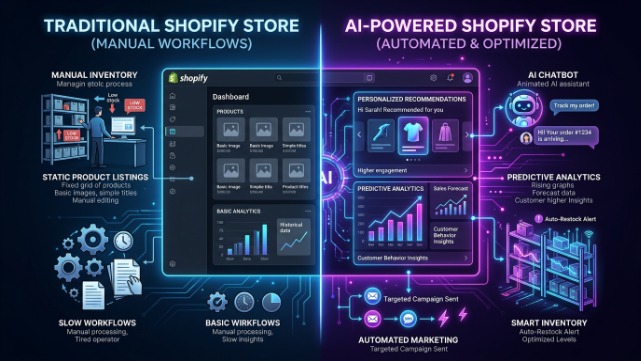
It helps to picture how all of this actually threads through a store’s day to day operations rather than treating it as one abstract trend. On the customer facing side, AI is handling a growing share of routine support inquiries, roughly 60 to 70 percent of things like order status questions, return requests, and basic product questions, freeing up human team members for the complex or emotionally sensitive conversations that genuinely need a person. Product recommendations are getting sharper and more individualized. Proactive engagement tools are catching hesitant visitors before they bounce. And increasingly, some of that discovery and even purchasing is happening through conversational AI assistants rather than a traditional storefront browse.
Behind the scenes, demand forecasting is replacing spreadsheet guesswork, automatically flagging what to reorder and when, well before a popular product actually runs out. Fraud detection is catching suspicious orders in real time using pattern recognition drawn from billions of transactions across entire merchant networks, not just a single store’s limited history. Content creation, things like product descriptions, blog posts, and email copy, is increasingly assisted by generative AI, dramatically cutting the time it takes to produce the volume of content a growing store needs. Access to tools like ChatGPT has been shown to cut time on professional writing tasks by 40 percent while actually raising output quality by 18 percent in controlled research, which says a lot about where content production is heading.
Shopify itself has leaned hard into this shift with native tools. Shopify Magic handles AI-assisted content creation, and Shopify Sidekick acts as an AI assistant for store management tasks like generating discount codes, updating product variants, and building reports. It’s worth noting, though, that native tools tend to be strongest on the operational, merchant facing side of things, while customer-facing conversion optimization is still often better served by dedicated third party apps built specifically for that purpose. Knowing which category a given AI tool actually belongs to, operational efficiency versus customer conversion, helps you set realistic expectations for what it’ll actually do for your store.
The parts of the future that go beyond just software
A few emerging trends are worth watching even if they’re not fully mainstream yet, because they hint at where things are heading over the next few years.
Digital twins, virtual replicas of products, supply chains, or even entire warehouses, are starting to let merchants simulate and optimize operations before making real world changes, and some brands are already using digital product replicas for virtual try ons that reduce returns. Augmented reality try on experiences are becoming genuinely useful rather than gimmicky, letting customers preview how glasses, furniture, or makeup shades will actually look in their own space before buying, which directly tackles one of ecommerce’s most persistent profit killers: returns.
Subscription and predictive replenishment models are also gaining ground, where AI predicts when a customer is likely to need a reorder, whether that’s based on typical usage patterns or, in more advanced cases, connected data like fitness tracker activity, and proactively suggests a refill before the customer even notices they’re running low. This shifts the relationship from one off transactions toward something more like an ongoing subscription mindset, which tends to create steadier, more predictable revenue for merchants willing to build it thoughtfully.
And underlying all of this is a growing expectation around trust and data privacy. As stores lean more heavily on personal behavioral data to power personalization and prediction, how transparently and responsibly that data gets handled is becoming a real differentiator, not just a compliance checkbox. A brand’s most valuable asset going forward isn’t just its inventory or its ad creative, it’s the trust customers place in how their data is used.
How to actually get started without overwhelming yourself
None of this means you need to rebuild your entire store overnight or throw money at every AI app in the Shopify App Store. The merchants who get real value out of AI tend to follow a similar, fairly simple pattern.
Start with whatever’s already built into your plan. Shopify Magic for content creation and Sidekick for store management are already included for most merchants, so there’s no reason not to be using them before reaching for a paid third party tool.
Pick one clear pain point and solve it well before adding more. Whether that’s customer support taking too much of your time, inventory forecasting being a constant guessing game, or fraud quietly eating into your margins, choose the single area causing you the most pain and implement a focused solution there first. Trying to overhaul customer service, personalization, inventory, and fraud detection all in the same month is a recipe for a messy rollout that’s hard to evaluate.
Measure what actually changes. Given that a meaningful share of AI implementations don’t produce measurable returns in their first year, it’s worth tracking real numbers, conversion rate, support ticket volume, chargeback rate, whatever metric ties to the tool you added, rather than assuming a new AI feature is working just because it looks impressive in a demo.
Favor tools that don’t require a developer. The AI tools genuinely worth using for most Shopify stores are the ones that work without needing technical expertise to set up and maintain. If a tool requires ongoing developer support just to function, it’s often not built with a typical merchant’s workflow in mind.
A note for Pakistani Shopify merchants
If you’re running a store from Pakistan, this shift toward AI powered ecommerce carries some specific opportunities worth thinking about early, since a lot of local merchants are still competing largely on price and manual hustle rather than smart automation.
Conversational and voice driven shopping is going to matter differently here than in Western markets, since WhatsApp is already the dominant channel for pre-purchase questions for a huge share of Pakistani shoppers. As AI shopping assistants become more common, integrating conversational AI directly into WhatsApp rather than only your Shopify storefront chat widget is likely to matter more for Pakistani stores than it does for merchants relying purely on web-based chat.
Trust-building through AI powered transparency is another area with real upside. Given how much Pakistani ecommerce still runs on Cash on Delivery specifically because of trust concerns around online payment, tools that use AI to reduce fraud, verify orders, and give customers real time, accurate tracking information can meaningfully shift behavior toward digital payments over time, which in turn reduces your COD related losses and return to origin costs.
Predictive inventory and demand forecasting carry outsized value for Pakistani merchants dealing with less predictable, often longer supplier lead times compared to markets with more mature domestic manufacturing. Getting ahead of demand with AI forecasting matters more when your restocking runway is longer and less forgiving of last minute surprises.
And personalization built around local context, language, currency display, regional pricing sensitivity, and culturally relevant product framing, still has a lot of untapped room in the Pakistani Shopify ecosystem. Most personalization tools are built and trained primarily on Western shopping behavior, so merchants who take the time to configure and tune these tools specifically for Pakistani customer patterns are likely to see a bigger relative advantage over competitors who install a generic personalization app and leave it on default settings.
Bringing it all together
The future of ecommerce isn’t some distant, abstract concept anymore, it’s showing up right now in how customers search, how stores forecast demand, how fraud gets caught, and how support tickets get resolved before a human ever sees them. The stores that come out ahead over the next few years won’t necessarily be the biggest ones, they’ll be the ones that picked the right AI tools for their actual pain points, implemented them thoughtfully, and kept the human touch where it genuinely matters most: the moments that need real judgment, real empathy, and real trust.
If you want help figuring out which parts of this future actually make sense for your store right now, rather than chasing every AI trend at once, that’s exactly the kind of strategic groundwork TheScriptFlow does with Shopify merchants every day. Head over to thescriptflow.com and let’s build your store’s AI roadmap together.