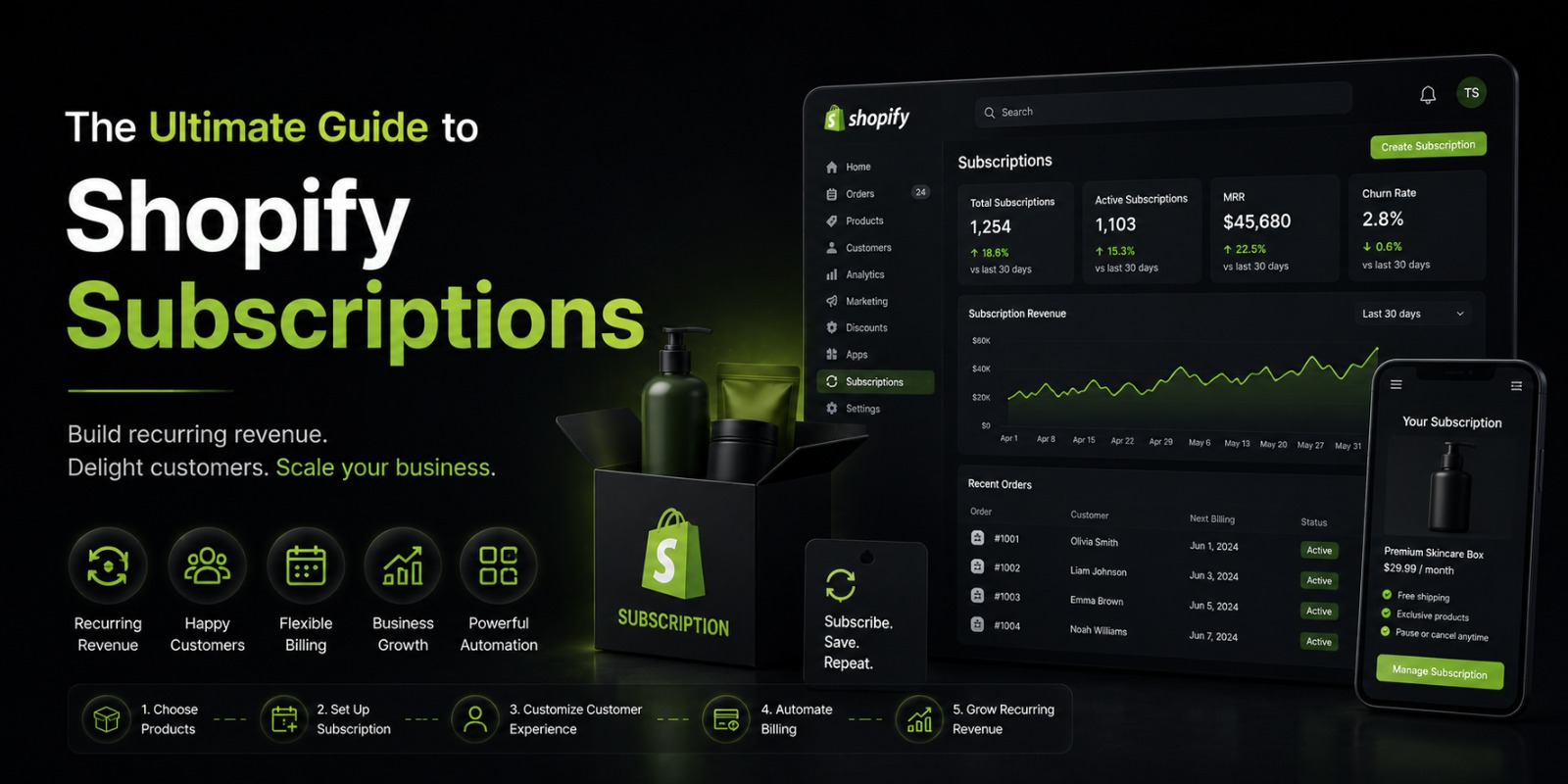
The Ultimate Guide to Shopify Subscriptions
If you’re running a Shopify store and still relying only on one time purchases, you’re leaving serious money on the table. Subscriptions are one of the most powerful business models in ecommerce right now, and Shopify has made it easier than ever to set them up, manage them, and scale them.
This guide covers everything from understanding what Shopify subscriptions actually are, to choosing the right app, setting up your first subscription product, reducing churn, and growing your recurring revenue month after month. Whether you’re just starting out or looking to level up an existing subscription offering, this is the only guide you need.
What Are Shopify Subscriptions?
A Shopify subscription is a billing arrangement where your customers agree to pay for your product or service on a recurring schedule weekly, monthly, quarterly, or whatever cadence works for your business. Instead of buying once and disappearing, subscribed customers are billed automatically and continue receiving your product without having to place a new order every time.
Think about brands like Dollar Shave Club, BarkBox, or even your favorite coffee company. Their entire business runs on subscriptions. Customers sign up once, and the revenue keeps coming in like clockwork. That’s the power you’re tapping into when you set up subscriptions on Shopify.
Subscriptions can work for physical products, digital products, memberships, and services. If you sell something that people use up and reorder, or something they want continuous access to, subscriptions make perfect sense.
Why Subscriptions Are a Game Changer for Your Shopify Store
Before we get into the how, let’s talk about the why. A lot of store owners think subscriptions are only for big brands or niche businesses. That’s not true at all. Here’s why subscriptions make sense for almost any Shopify merchant.
Predictable Revenue Every Month
One-time purchases create unpredictable revenue. Some months are great, some months are slow, and you’re always chasing the next sale. Subscriptions fix that. When you have 500 active subscribers paying PKR 3,000 or $30 a month, you know exactly how much is coming in before the month even starts. That predictability makes budgeting, inventory planning, and hiring so much easier.
Higher Customer Lifetime Value
A customer who subscribes to your store is worth far more than a customer who buys once. If someone buys your product once for PKR 2,500, that’s your revenue from them. But if they subscribe and stay for 12 months, that’s PKR 30,000 in lifetime value from the same customer. That completely changes how much you can afford to spend on acquiring new customers.
Lower Customer Acquisition Costs Over Time
When you retain customers through subscriptions, you’re spending less chasing new ones. Your existing subscribers keep paying, so you can allocate your marketing budget more efficiently. Over time, subscription businesses tend to grow more profitably than pure transactional businesses.
Stronger Customer Relationships
Subscription customers develop a habit around your product. They look forward to their monthly delivery, they become familiar with your brand, and they’re more likely to recommend you to others. The relationship goes deeper than a single transaction.
Better Inventory and Supply Chain Management
Because you know how many subscribers you have and what they’re receiving each cycle, you can plan your inventory with much more accuracy. No more guessing how much stock to order or scrambling when demand spikes unexpectedly.
Types of Subscriptions You Can Offer on Shopify
Not all subscriptions are the same. Depending on what you sell, one model might fit better than another.
Replenishment Subscriptions
These are the most straightforward. You sell a consumable product skincare, supplements, pet food, coffee, cleaning supplies and customers subscribe to get it delivered automatically before they run out. The value proposition is simple: convenience and often a small discount for subscribing.
This model works especially well for products with a predictable usage cycle. If your customers go through a bag of coffee in two weeks, a biweekly subscription makes perfect sense for them.
Curated Subscription Boxes
This is the model made famous by brands like Birchbox and FabFitFun. Every month, subscribers receive a curated selection of products, often with a discovery or surprise element. The value here is not just the products but the experience of receiving something new and thoughtfully selected.
Subscription boxes are a great way to introduce customers to multiple products across your catalog, and they tend to generate strong word-of-mouth because people love unboxing and sharing.
Membership Subscriptions
Instead of physical products, you sell access to exclusive content, to a private community, to special discounts, or to premium features. This works brilliantly for digital businesses, coaching brands, online courses, and stores that want to build a loyal inner circle.
A Shopify store selling fashion, for example, might offer a membership that gives subscribers early access to new arrivals, free shipping on all orders, and a monthly style consultation.
Hybrid Models
Some of the most successful subscription businesses combine models. They might sell physical products on a recurring basis but also layer in membership perks — exclusive content, member-only pricing, or early access. Don’t feel like you have to choose just one approach.
How Shopify Handles Subscriptions
Here’s something important to understand: Shopify’s core platform does not include built in subscription billing out of the box. To run subscriptions, you need a subscription app that integrates with Shopify’s Subscription API.
Shopify introduced its native Subscriptions API a few years ago, which allows third party apps to manage recurring billing directly through Shopify Payments. This was a major upgrade because it means the entire checkout experience stays within Shopify customers don’t get redirected to an external page, and managing subscriptions through your admin is much smoother.
The key requirement is that you need to be using Shopify Payments, or a payment provider that supports Shopify’s subscription billing. If you’re using a third party payment gateway that doesn’t support the API, you’ll have fewer options. For Pakistani merchants, this is worth paying attention to Shopify Payments is not currently available in Pakistan, so you’ll want to choose a subscription app that supports your payment gateway of choice.
Best Shopify Subscription Apps
Choosing the right app is one of the most important decisions you’ll make for your subscription business. Here are the leading options.
Recharge Subscriptions
Recharge is the most widely used subscription app on Shopify. It’s been around since the early days of Shopify subscriptions and has a massive feature set — flexible subscription rules, dunning management, customer portal, analytics, and integrations with nearly every major Shopify app. It’s a solid choice for established stores with significant subscription volume.
The pricing is usage-based, so costs scale as your subscription revenue grows. For high volume stores, this can get expensive, but the feature depth usually justifies it.
Seal Subscriptions
Seal Subscriptions is a popular alternative that’s especially attractive for smaller stores or merchants just getting started. It offers a generous free plan, clean interface, and solid core features. If you’re testing the waters with subscriptions and don’t want to commit to high monthly fees, Seal is worth a look.
Bold Subscriptions
Bold is another veteran in the Shopify subscriptions space. They’ve rebuilt their app from scratch over the past couple of years to fully utilize Shopify’s native subscription API. Bold offers strong customization options and a solid customer portal experience.
Native Shopify Subscriptions
Shopify has been rolling out its own built-in subscription features, particularly for merchants on higher plans. The native offering is improving steadily, though it’s still less feature-rich than dedicated third-party apps for most complex use cases.
Skio
Skio is a newer player that’s been gaining a lot of traction, particularly with direct to consumer brands doing serious volume. It focuses on reducing churn and improving the customer portal experience, with passwordless login being one of its standout features. If churn is your primary concern, Skio is worth evaluating.
Setting Up Subscriptions on Your Shopify Store
Let’s walk through the process of actually getting subscriptions live on your store.
Step One: Choose and Install Your Subscription App
Start by installing your chosen subscription app from the Shopify App Store. Most apps offer a free trial, so you can explore the interface before committing. Follow the installation process, which typically involves authorizing the app and connecting it to your payment provider.
Step Two: Create Your Subscription Plan
Inside your subscription app, you’ll create subscription plans that define the billing frequency, pricing, and products included. Common setups include monthly billing with a 10-15% discount compared to one time purchase prices, or offering multiple frequency options weekly, monthly, every two months and letting customers choose.
Think carefully about your pricing strategy here. The discount you offer for subscribing needs to be attractive enough to motivate sign ups but not so deep that it hurts your margins.
Step Three: Assign Products to Subscription Plans
Link specific products or collections to your subscription plans. You can make some products subscription only, subscription optional (customers can choose to subscribe or buy once), or offer both options side by side on the product page.
Step Four: Customize the Customer Portal
The customer portal is where your subscribers manage their subscriptions skip a delivery, pause, swap products, update payment info, or cancel. A well designed portal reduces customer service requests and, critically, reduces churn. Make sure the portal is branded to match your store and easy to navigate.
Most subscription apps let you customize the portal with your colors, logo, and language. Take the time to do this properly.
Step Five: Set Up Email Notifications
Your subscribers should receive clear, timely emails about their subscription upcoming billing reminders, order confirmations, shipping updates, and payment failure notices. Set up these automated emails within your subscription app and make sure they’re on brand and helpful.
Step Six: Test Everything Before Going Live
Before you launch, run through the entire subscription experience as a customer. Subscribe to a product, check the confirmation email, log into the customer portal, try skipping a delivery, and test the cancellation flow. You want to catch any friction points before your real customers experience them.
Pricing Strategies for Shopify Subscriptions
Getting your pricing right is critical. Here are the main approaches.
Discount Based Pricing
The most common model: offer a percentage discount (typically 10-20%) for subscribing versus buying once. This is simple to communicate and gives customers a clear financial incentive. The risk is that it trains customers to only want your product at a discount.
Subscribe and Save
Similar to the discount model but framed specifically around savings. Made famous by Amazon, this framing emphasizes the cumulative savings over time, which can be a strong motivator.
Exclusive Subscriber Pricing
Instead of discounting your regular price, you create a special subscriber price that isn’t available anywhere else. This frames subscription as access to something exclusive rather than simply a cheaper version of the same thing.
Tiered Subscription Plans
Offer multiple tiers basic, standard, premium each with different quantities, frequencies, or added perks. This lets customers self-select based on their needs and budget, and often encourages upsells to higher tiers over time.
Reducing Churn: Keeping Your Subscribers Longer
Churn is the number one enemy of subscription businesses. Every subscriber who cancels is recurring revenue you have to replace. Reducing churn by even a few percentage points can have a dramatic impact on your growth.
Dunning Management
Dunning refers to the process of handling failed payments. Payment failures are a major cause of involuntary churn — customers who would happily stay but whose subscription gets cancelled because a card expired or a payment didn’t process. Good subscription apps include automated dunning sequences that retry failed payments, send reminder emails, and give customers a chance to update their payment info before the subscription lapses.
Pause Instead of Cancel
Give customers the option to pause their subscription instead of cancelling outright. Many customers cancel because they have too much product on hand or because they’re going on holiday. If pausing is easy, they’ll choose it over cancelling. Most subscription apps support pause functionality in the customer portal.
Win-Back Offers
When a customer does try to cancel, trigger a retention offer a discount, a free gift with the next order, or a pause option. This “save” sequence can recover a meaningful percentage of cancellations.
Proactive Customer Engagement
Don’t wait for customers to disengage. Send regular emails that add value recipes using your products, tips, behind the scenes content, early access to new products. Subscribers who feel connected to your brand are less likely to cancel.
Easy Portal Experience
A complicated or frustrating customer portal drives cancellations. If it’s easier to cancel than to skip or pause, customers will cancel. Make sure your portal is intuitive and that skipping or pausing is just as easy as cancelling.
Marketing Your Shopify Subscriptions
Getting people to subscribe requires specific marketing approaches that are a bit different from marketing one-time purchases.
Highlight the Convenience
Subscription customers aren’t just buying a product they’re buying convenience. Emphasize that they’ll never run out, they don’t have to remember to reorder, and their favorite product shows up at their door automatically.
Show the Savings Clearly
Make the financial benefit obvious. On your product page, show both the one-time price and the subscription price side by side, with the savings highlighted. Don’t make customers do the math themselves.
Use Social Proof
Show reviews and testimonials specifically from subscribers. Prospective subscribers want to know that real people are happy with the experience not just the product but the subscription experience itself.
Offer a Low Risk First Order
Some customers hesitate to subscribe because they’re worried about being locked in. Offer an easy cancellation policy and highlight it prominently. The easier you make it to leave, the more confident customers feel signing up.
Run First Box Promotions
Offer a heavily discounted or even free first box to get customers into the subscription funnel. Once they’ve experienced your product, retention becomes much easier. This works especially well for subscription boxes and consumable products.
Email and SMS Marketing
Your existing customer list is your warmest audience for subscription sign-ups. Run targeted email and SMS campaigns to customers who have purchased your subscription-eligible products before. They already know and like your product — you just need to show them why subscribing makes sense.
Shopify Subscriptions for Pakistani Merchants
If you’re running a Shopify store based in Pakistan, there are some specific things to keep in mind.
Since Shopify Payments isn’t available in Pakistan, you’ll need a subscription app that integrates with your payment gateway. Apps like Recharge and Bold work with certain international gateways. It’s worth confirming compatibility with your chosen gateway before committing to any app.
For pricing, consider how PKR-denominated subscriptions sit in the market. Pakistani consumers are increasingly comfortable with recurring payments, particularly for products like supplements, skincare, baby products, and specialty food items. The key is building trust — make your cancellation policy clear and your customer portal easy to use.
Local courier partnerships are also worth thinking about for subscription fulfillment. If you’re shipping subscriptions monthly, you want a reliable courier partner with consistent delivery times so that your customers receive their orders on schedule every cycle.
Analyzing Your Subscription Performance
Once your subscriptions are live, tracking the right metrics will tell you whether your business is healthy and growing.
Monthly Recurring Revenue (MRR) is your most important top-line metric. It tells you how much predictable revenue your subscriptions generate each month.
Churn Rate measures what percentage of your subscribers cancel each month. A high churn rate signals problems with product-market fit, customer experience, or pricing.
Average Revenue Per User (ARPU) tells you how much each subscriber is worth on average per month. Increasing ARPU through upsells and upgrades is one of the most efficient ways to grow.
Customer Lifetime Value (LTV) for subscribers should be tracked separately from one-time customers. Knowing your subscriber LTV helps you understand how much you can invest in acquiring new subscribers.
Active Subscriber Count is a simple but important metric. Are you adding more subscribers than you’re losing each month? If yes, you’re growing. If not, churn is outpacing acquisition.
Most subscription apps include built-in analytics dashboards covering these metrics. Review them regularly at minimum weekly and use the data to make decisions about pricing, retention, and marketing.
Common Mistakes to Avoid with Shopify Subscriptions
A few pitfalls trip up a lot of store owners when they first launch subscriptions.
Not making the skip/pause option obvious enough is one of the biggest mistakes. When customers can’t easily find how to pause, they cancel instead. Make it prominent in the portal and in your emails.
Offering too steep a discount to attract subscribers can hurt you long-term. If your margins don’t support the discount, you’re growing an unprofitable subscriber base. Model out your unit economics before you set subscription pricing.
Ignoring failed payments is a revenue leak that adds up quickly. Set up automated dunning sequences from day one, not after you notice revenue dropping.
Sending too few emails to subscribers is a missed opportunity. Regular, value adding communication keeps subscribers engaged and reduces passive churn — the kind where customers forget they’re subscribed and cancel out of surprise when they see a charge.
Final Thoughts
Shopify subscriptions aren’t just a feature — they’re a business model shift. When you move from relying on one-time purchases to building predictable, recurring revenue, everything about your business becomes more stable, more profitable, and easier to scale.
The setup is straightforward once you choose the right app. The hard work is in retention creating a product and experience that people want to keep paying for month after month. Focus on that, and subscriptions can become the most valuable part of your Shopify business.
If you want help setting up subscriptions on your Shopify store, configuring the right app, or building a retention strategy that actually works, TheScriptFlow is here for it. We’ve helped dozens of merchants build subscription experiences that convert and retain. Reach out at thescriptflow.com.