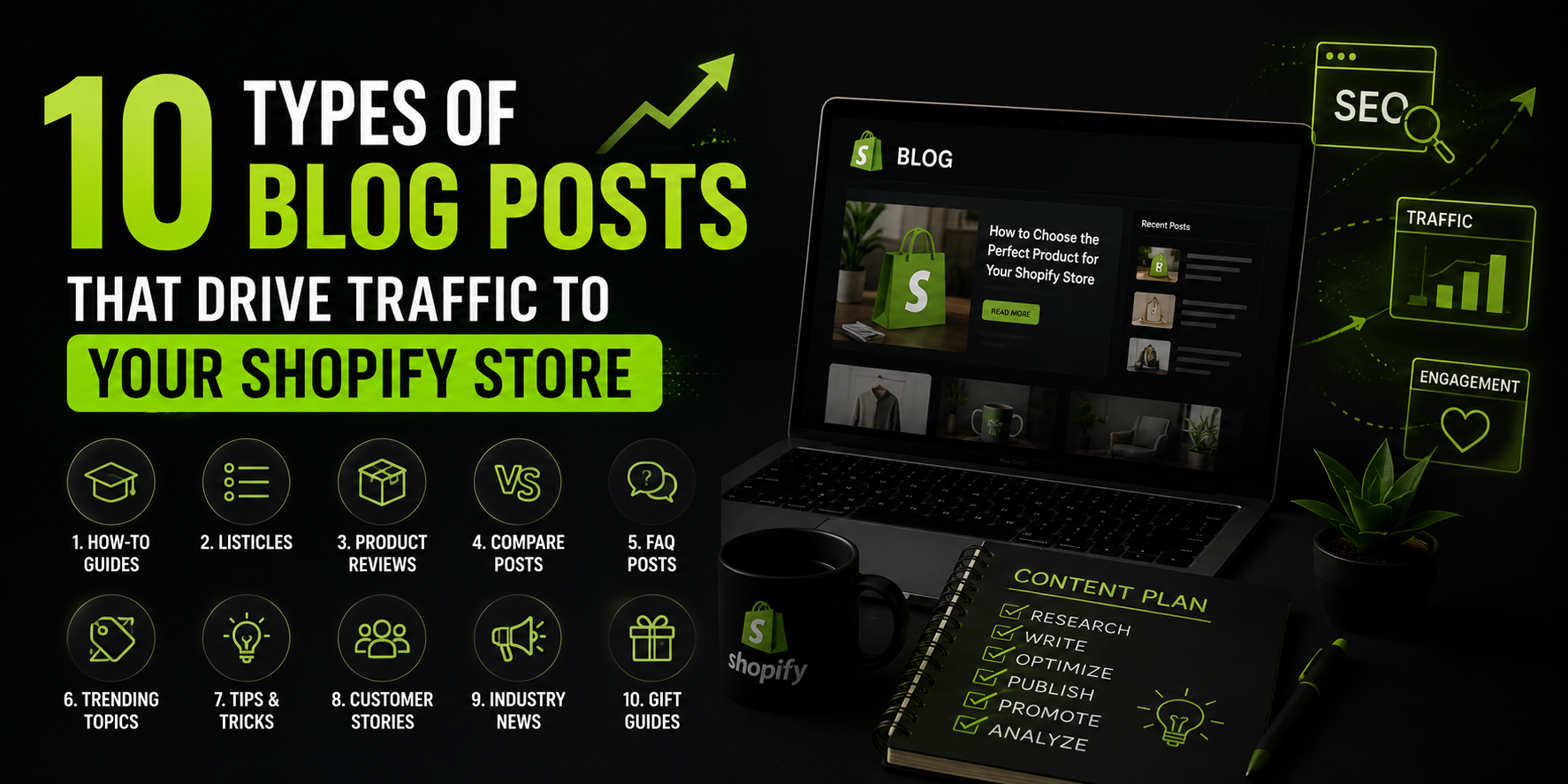
10 Types of Blog Posts That Drive Traffic to Your Shopify Store
Let me be straight with you.
Not all blog posts are created equal.
You can spend hours writing something that gets zero traffic, zero engagement, and zero sales. Or you can write something that ranks on Google within weeks, brings in consistent visitors for years, and converts a good chunk of them into paying customers.
The difference is rarely about writing quality alone.
It’s about the type of content you’re creating.
Certain types of blog posts are proven traffic drivers. They match what people are actively searching for on Google. They answer real questions. They solve real problems. They attract the exact kind of reader who is likely to buy what you’re selling.
Other types of blog posts no matter how beautifully written simply don’t generate traffic because nobody is searching for them.
So in this blog I’m going to walk you through the ten types of blog posts that actually work for Shopify stores. For each one I’ll explain what it is, why it works, and how to create one for your own store.
By the end you’ll have a clear content roadmap with ideas you can start writing this week.
Let’s get into it.
1. How To Posts
How-to posts are the backbone of any successful content strategy.
And the reason is simple.
When people have a problem or want to learn how to do something, the first thing most of them do is type “how to” into Google. How to make cold brew coffee. How to style a maxi dress. How to set up a home gym on a budget. How to remove acne scars naturally.
These searches happen millions of times every single day. And if your store sells products related to these topics, a well optimized how to post puts you directly in front of people who are actively looking for information in your niche.
The key to a great how-to post is to actually be helpful. Don’t skim the surface. Don’t give vague advice that could apply to anyone. Go deep. Walk the reader through the process step by step in a way that actually teaches them something useful.
And then at the end, naturally connect the content back to your products. If you’re a coffee store that just taught someone how to make perfect cold brew at home, mentioning your cold brew kit as the ideal tool for the job is not pushy it’s genuinely helpful.
How-to posts also tend to keep readers on your page longer because they’re reading through a process, not just skimming. That longer time on page sends a positive signal to Google that your content is valuable.
When you’re brainstorming how-to topics, think about every question your customers ask you before and after they buy. Every one of those questions is a potential how-to blog post.
2. Listicles
Yes, listicles still work. In fact they work extremely well.
A listicle is simply a blog post structured as a numbered or bulleted list. Things like “10 Best Yoga Poses for Beginners,” “7 Ways to Style a Leather Jacket,” “15 Home Gym Essentials Under 5000 Rupees,” or “5 Skincare Mistakes You’re Probably Making.”
People love listicles for a few reasons.
They’re scannable. Readers can quickly see what the post covers before committing to reading the whole thing. In a world where attention spans are short and screens are small, this matters a lot.
They set clear expectations. When you tell someone there are ten things on this list, they know exactly what they’re getting. That clarity reduces friction and increases the likelihood that someone will click on your result in Google.
They work well for a wide range of topics. Whether you’re covering product recommendations, tips, common mistakes, benefits, or ideas, a list format can make almost any topic more readable and more clickable.
For Shopify stores, listicles work especially well as product round ups and gift guides which I’ll talk about more in a moment. But they also work beautifully for educational content, tips, and curated recommendations.
When writing a listicle, make sure each item on the list actually delivers value. A listicle with ten items that are all thin and underdeveloped is far weaker than one with fewer items that each genuinely teach the reader something.
3. Product Comparison Posts
This one is one of the most powerful types of content for driving purchase-ready traffic.
Here’s why.
When someone searches for “Product A vs Product B” or “best
That’s the most valuable kind of visitor you can possibly get.
A product comparison post walks readers through the similarities, differences, strengths, and weaknesses of two or more products in an honest, balanced way. It helps people make informed decisions and builds enormous trust because you’re not just telling them your product is the best you’re helping them figure out what’s genuinely right for their situation.
You can compare your own products against each other “Which of our coffee grinders is right for you?” which helps customers self-select the right product and reduces post-purchase dissatisfaction. Or you can compare your products against competitors’ products, which works well if your product genuinely has meaningful advantages worth highlighting.
You can also compare products in your niche more broadly, even if not all of them are yours. A post like “French Press vs Pour Over vs Aeropress Which Brewing Method Is Right for You?” positions you as a knowledgeable authority in the coffee space, even if you’re only selling one or two of those products. Readers who find that post trust your expertise and are more likely to buy from you.
The most important thing with comparison posts is honesty. Don’t make every comparison turn out in your product’s favor in an obviously biased way. Readers can tell. Be genuinely fair and highlight real trade offs. That honesty is what makes these posts trustworthy and effective.
4. Buying Guides
Buying guides are the best friend of any customer who is new to your product category and doesn’t know where to start.
Think about the last time you went to buy something you didn’t know much about. A camera. A piece of fitness equipment. A skincare product. A kitchen appliance. You probably felt overwhelmed by all the options. You didn’t know what features mattered. You didn’t know what price range was reasonable. You didn’t know what questions to even ask.
A good buying guide solves all of that.
It explains what to look for when shopping in a category. It breaks down the different types or variations available. It explains who each type is best suited for. It gives practical advice on what to prioritize and what to ignore. And it helps the reader feel confident that they can make a smart decision.
For Shopify stores, buying guides are incredibly valuable because they target people at exactly the right moment in the buying process. Someone searching “how to choose a yoga mat” or “what to look for when buying a coffee grinder” is in research mode and getting close to a purchase. If your buying guide gives them the information they need and then naturally directs them to your products, you’ve done exactly what great content should do.
Buying guides also tend to rank well on Google because they comprehensively cover a topic that a lot of people are searching for. And they have a long lifespan a well written buying guide can bring in consistent traffic for years.
When writing a buying guide, think like a trusted friend who knows a lot about the product category. Not a salesperson. Not a marketer. A genuinely knowledgeable friend who wants to help someone make the right choice.
5. Gift Guides
Gift guides are seasonal content gold.
And yet so many Shopify store owners completely ignore them.
Here’s the thing about gift searches. They happen at very specific times of year around major holidays, birthdays, Valentine’s Day, Mother’s Day, Father’s Day, graduation season, and so on. And they represent some of the highest purchase-intent traffic Google sends anywhere.
Someone searching “gifts for coffee lovers” or “best gifts for home gym enthusiasts” or “gift ideas for skincare obsessed friends” is not browsing. They need to buy something. They just need help figuring out what.
A well crafted gift guide that shows up in those search results is essentially a direct line to a buyer who is ready to spend money right now.
The key to gift guide success is starting early. Google takes time to discover, crawl, and rank new content. If you publish a Christmas gift guide on December 20th, it’s not going to rank in time to do you any good this year. Publish it in October or early November and you have a real shot at capturing that holiday traffic.
The same applies to all seasonal gift content. Mother’s Day is in May publish your Mother’s Day gift guide in March or early April. Valentine’s Day is in February get your guide up in January.
And don’t just create new gift guides every year and let old ones disappear. Update your existing gift guides each season with fresh products and current information. A gift guide that already has some ranking history from last year will rank even faster this year if you refresh and republish it.
6. Problem Solving Posts
Every product in existence solves a problem.
And the people who need your products are often typing that problem directly into Google.
Problem-solving posts target these searches directly. Instead of writing about your product, you write about the problem your product solves. You acknowledge the pain. You explain the causes. You walk through the solutions. And naturally, one of those solutions involves your product.
The reason this works so well is intent alignment. When someone types “why does my skin break out after using moisturizer” or “why is my coffee always weak” or “how to stop back pain when working from home,” they are experiencing a real problem right now. They are actively seeking a solution. If your blog post answers their question and your product is part of the answer, you’ve connected with them at exactly the moment they need help.
Problem-solving posts also tend to rank well because they match the way real people search. People search for problems and symptoms much more than they search for products and solutions. They type what’s wrong before they know what the fix is.
So think about all the problems your products solve. Think about the symptoms, the frustrations, the pain points. Write posts that address those things directly and connect them back to your products naturally.
Not every problem-solving post needs to end with “buy our product.” Sometimes just building the association between your store and the solution is enough. Trust builds over multiple touchpoints, and someone who found your store through a helpful problem-solving post is much more likely to come back when they’re ready to buy.
7. Behind the Scenes and Brand Story Posts
Here’s a type of content that most people overlook entirely when they’re thinking about SEO.
And I get it behind the scenes posts don’t target high volume search keywords. They’re not going to generate thousands of visits from Google.
But they do something equally important.
They build deep trust and emotional connection with the people who do find them.
We’re living in a world where customers increasingly want to know who they’re buying from. They want to know the story behind the products. They want to see the real people and values behind the brand. They want to feel like they’re supporting something meaningful when they spend their money.
Behind the scenes posts give them exactly that.
You could write about how your products are made. Where your materials come from. The journey of starting your store. The values that guide every decision you make as a business. The challenges you’ve overcome. The people on your team and what they care about.
This kind of content doesn’t just live on your blog. It performs brilliantly on social media, it makes for compelling email content, and it’s the type of post that people actually share because it’s genuinely interesting.
And from an SEO perspective, brand story content builds something called entity authority Google’s understanding of who you are as a business, which contributes to how trustworthy it considers your entire website to be.
Write at least a few behind the scenes posts as part of your content strategy. They work differently from your keyword-targeted posts, but they work in ways that are just as valuable for your store’s long-term growth.
8. Tutorial and Educational Posts
Tutorial posts are similar to how to posts but tend to go deeper and cover more ground.
Where a how-to post might cover one specific task “how to make cold brew coffee” a tutorial post might cover a broader skill or topic “the complete beginner’s guide to home coffee brewing” or “everything you need to know about skincare ingredients.”
These comprehensive educational posts are incredibly powerful for SEO for one specific reason.
They rank for lots of keywords at once.
When you write a comprehensive guide that covers a topic in depth, you naturally end up using dozens of related terms, phrases, and questions throughout the content. Google sees this breadth of relevant language and understands that this page is a genuinely comprehensive resource on the topic. It tends to rank these pages for a wide range of related search queries, not just the main keyword you targeted.
This is what content marketers call a “pillar post” a comprehensive piece of content that anchors an entire topic area on your blog and supports more specific supporting posts that link back to it.
Tutorial posts also tend to attract backlinks. When you create a genuinely comprehensive resource on a topic, other bloggers and website owners who write about related topics often link to it as a reference for their own readers. Those backlinks are enormously valuable for your SEO.
Invest time in creating at least two or three truly comprehensive tutorial posts on the topics most central to your store’s niche. They take more effort than a standard blog post but deliver disproportionately larger results.
9. Review and Round Up Posts
Review posts and product round ups are among the highest converting types of content you can create.
And here’s the psychology behind why.
When someone is close to making a purchase, they often do one final round of research. They search for reviews. They look for round ups of the best options. They want someone they trust to have already done the evaluation work for them.
A well-written review post on a single product or a round up of the best products in a category meets that need perfectly.
Review posts work best when they’re genuinely thorough. Cover the product’s features, the experience of using it, who it’s best suited for, what its weaknesses are, and whether you’d recommend it. Don’t be afraid to mention downsides a review that’s honest about limitations is far more trustworthy than one that’s uniformly glowing.
Round-up posts like “The 7 Best Home Coffee Grinders in 2025” or “Best Yoga Mats for Every Budget” target people who are in buying mode and aren’t yet sure which specific product to choose. These posts rank extremely well for product category keywords and can drive significant purchase ready traffic.
One powerful variation of the round-up post is the “best of” post that includes products from your own store alongside products from other brands. This might feel counterintuitive why would you direct people to competitors? But it makes your post far more credible and useful, which means it ranks better and is more trusted by readers. And when your own products are genuinely good, they naturally shine in an honest comparison.
10. FAQ and Question Based Posts
This one is underused and underestimated by most store owners.
Here’s the thing about questions.
When people type questions into Google, Google knows exactly what they want. And if your blog post directly answers that question in a clear, comprehensive way, Google will often rank it very highly sometimes even showing a snippet of your answer right at the top of the results page in what’s called a “featured snippet” or “position zero.”
Getting a featured snippet is incredibly valuable. Your result appears above all the regular search results. It takes up much more space on the page. And it establishes you as the authoritative answer to that question.
FAQ posts and question based posts target these opportunities directly.
You can create a dedicated FAQ post on a broad topic “Everything You’ve Ever Wanted to Know About Skincare (Answered)” that covers twenty or thirty common questions in your niche. Each question becomes a subheading and each answer is a concise, genuinely helpful paragraph.
Or you can create individual posts for specific questions that your customers ask most often. “Is French Press Coffee Bad for You?” “How Long Does Cold Brew Last in the Fridge?” “What’s the Difference Between SPF 30 and SPF 50?”
Both approaches work well. The dedicated FAQ post is good for covering a lot of ground quickly and capturing featured snippets for multiple questions in one piece. The individual question posts go deeper on each topic and tend to rank better for more specific, competitive queries.
To find the best questions to target, look at the “People Also Ask” section that appears in Google search results. These are the questions Google has identified as most commonly asked about any topic. They’re essentially a roadmap of the content you should be creating.
How to Use These Post Types Together
Now here’s the part that takes everything above from good to great.
The most effective Shopify blogs don’t just randomly publish different types of posts. They use these post types strategically as part of a connected content ecosystem.
Here’s what that looks like in practice.
You start with a comprehensive tutorial post on a broad topic central to your niche. That’s your pillar. Then you create a cluster of supporting posts around it how to posts covering specific techniques, problem solving posts addressing common issues, FAQ posts answering related questions all linking back to the pillar post.
You create buying guides that help new customers navigate your product category and link to relevant product pages. You create comparison posts that help decision ready customers choose between options. You create gift guides around seasonal moments to capture high-purchase-intent holiday traffic.
You pepper in some behind the scenes and brand story content to build trust and humanize your store for the people who are getting to know you.
And then everything links together. Blog posts link to product pages. Related blog posts link to each other. Product pages link back to relevant blog content. Your email list gets your best blog content. Your social media drives traffic to the posts that are most likely to convert.
Every piece of content has a purpose. Every piece of content serves your customer and your store at the same time.
That’s a content strategy working the way it’s supposed to.
A Simple Plan for Getting Started
I know this is a lot of information and it can feel overwhelming when you’re starting from scratch.
So let me give you a simple, practical starting point.
In your first month of blogging, aim for four posts one of each of these types to begin with.
Start with one how to post targeting a specific question your customers ask before they buy. Then write one problem solving post that addresses the main pain point your products solve. Then create one buying guide that helps new customers understand what to look for in your product category. And finally write one listicle maybe a round up of your best products or a list of tips related to your niche.
That’s four posts. Four different types. Four different entry points for new customers to discover your store.
Then keep going. Add more post types as you find your rhythm. Build out your content clusters. Create your gift guides ahead of the holiday seasons. Invest in a few comprehensive tutorial posts as your blog matures.
Over time your blog becomes a library of valuable content that brings in the right customers every single day.
Final Thoughts
The question is never really “should I blog?”
For any Shopify store that wants to build sustainable, long-term traffic without being entirely dependent on paid advertising, the answer to that question is always yes.
The real question is “what should I blog about?”
And now you have a clear answer.
How-to posts. Listicles. Comparison posts. Buying guides. Gift guides. Problem-solving posts. Behind the scenes content. Tutorial posts. Review and round up posts. FAQ and question based posts.
Ten types of content that are proven to attract traffic, build trust, and drive sales for Shopify stores.
You don’t need all ten at once. Start with the types that feel most natural and most relevant to your products and your customers. Build momentum. Stay consistent.
The stores that are winning on Google are not winning because they got lucky.
They’re winning because they showed up, published consistently, and gave their customers genuinely helpful content week after week.
That’s it.
That’s the whole secret.
Now go write something.