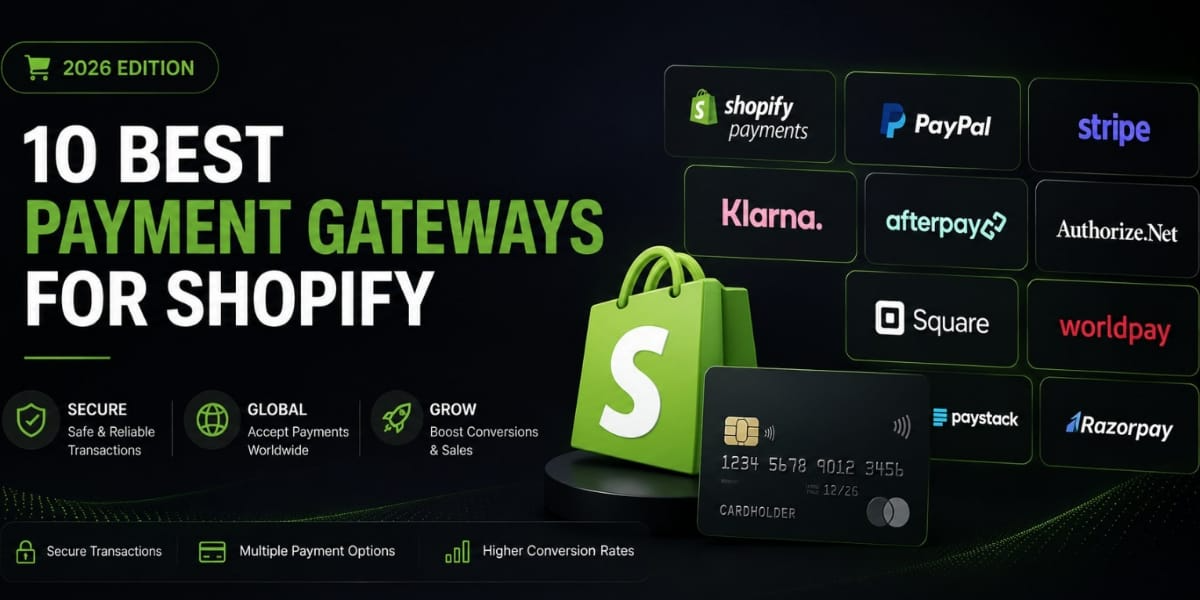
10 Best Payment Gateways for Shopify in 2026
Let’s be honest about something.
Your Shopify store can have the most beautiful design, the most irresistible products, and the most compelling copy in the world. But if your payment gateway is slow, unreliable, or simply not trusted by your customers they will leave.
No payment, no sale. It really is that simple.
So today we’re going to talk about the 10 best payment gateways you can use with your Shopify store in 2026. I’ll break down what each one offers, who it’s best for, and what you need to watch out for. By the end, you’ll know exactly which one fits your store.
Let’s get into it.
But First What Even Is a Payment Gateway?
Before we jump into the list, let’s make sure we’re on the same page.
A payment gateway is the technology that processes your customer’s payment when they buy something from your store. When someone enters their card details at checkout, the gateway encrypts that information, sends it to the bank for approval, and then confirms whether the transaction went through.
Think of it as the digital version of a card machine at a physical shop. Without it, you simply cannot accept payments online.
Shopify supports dozens of payment gateways. Some are built right into Shopify. Others are third party services you connect to your store. Each one has different fees, features, supported countries, and customer trust levels.
Choosing the right one matters a lot.
What Should You Look For in a Payment Gateway?
Before I give you the list, here are the things you should be comparing.
Transaction fees are the percentage and fixed amount the gateway takes from each sale. These add up fast, so pay attention.
Supported countries matter because not every gateway works everywhere. Make sure the one you pick supports both where you are and where your customers are.
Supported currencies are important if you sell internationally. Can the gateway accept payments in multiple currencies?
Checkout experience is something customers notice even when they don’t realize it. A smooth, familiar checkout builds trust. A clunky one kills conversions.
Payout speed tells you how quickly your money actually reaches your bank account. Some gateways pay out daily. Others take a week.
Security features like fraud detection and chargeback protection protect your business from losses.
Now let’s look at the gateways.
1. Shopify Payments
We have to start here because for most store owners in supported countries, this is the obvious first choice.
Shopify Payments is built directly into your Shopify store. There’s no third-party account to set up, no separate dashboard to manage, and most importantly — no extra Shopify transaction fees. You only pay the standard credit card processing rate which starts at around 2% plus 30 cents on the Basic plan and goes lower as you upgrade.
It supports all major cards Visa, Mastercard, American Express, Discover. It also supports Shop Pay, Apple Pay, Google Pay, and Shop Pay Installments which is Shopify’s own Buy Now Pay Later solution.
Everything lives inside your Shopify dashboard. Your payouts, your fraud reports, your transaction history all in one place. That convenience alone is worth a lot when you’re managing a growing store.
The downside is availability. Shopify Payments only works in around 20 countries right now. If your business is registered outside those countries, you’ll need to look elsewhere on this list.
Best for Store owners in the US, UK, Canada, Australia, and other supported countries who want the simplest, most integrated setup.
2. PayPal
PayPal is the most recognized payment brand in the world. And that recognition is exactly why it belongs on this list.
When customers see the PayPal button at checkout, something relaxes in them. They’ve used it before. They trust it. They know their money is protected. That familiarity reduces checkout anxiety and leads to more completed purchases.
PayPal works with Shopify as a third-party gateway. You connect your PayPal business account to your store and it appears as a payment option at checkout alongside your other methods.
The fees are competitive around 3.49% plus a fixed fee for standard transactions, though rates vary by country and transaction type. PayPal also offers Pay Later options in some markets which lets customers split purchases into installments, similar to Shop Pay Installments.
One important thing to know. PayPal has its own buyer and seller protection policies. These can sometimes work against you as a merchant if a customer files a dispute. Make sure you understand their policies and keep solid records of every order.
PayPal is available in over 200 countries and supports more than 100 currencies. That global reach is hard to beat.
Best for Stores selling globally who want maximum customer trust and wide international coverage.
3. Stripe
Stripe is what you use when you want serious payment power with serious flexibility.
It’s one of the most developer friendly payment gateways on the planet. But don’t let that scare you off if you’re not technical. Stripe connects to Shopify smoothly and works well even without any custom development.
Stripe supports an enormous range of payment methods. Cards, digital wallets, bank transfers, and local payment methods that vary by region. If you’re selling to customers across multiple countries, Stripe’s ability to offer locally relevant payment options can meaningfully increase your conversion rate.
The standard fee is 2.9% plus 30 cents per transaction in the US. Rates vary in other countries but are generally competitive.
Stripe also has excellent fraud detection through their Radar system which uses machine learning to identify and block suspicious transactions. This is a major plus for stores that deal with high volumes or high-value orders.
One thing to note Stripe isn’t available in every country. Pakistan, for example, isn’t currently on the supported list for receiving payouts, though this continues to expand over time.
Best for Stores that want flexible, scalable payment infrastructure and sell across multiple international markets.
4. 2Checkout (now Verifone)
If you’re selling digital products or software, 2Checkout now rebranded as Verifone deserves serious attention.
It’s one of the few payment gateways specifically designed with digital goods in mind. It handles subscriptions, recurring billing, and digital product delivery in a way that most general-purpose gateways don’t.
2Checkout supports over 45 payment methods and accepts payments in more than 100 currencies. It’s also available in a much wider range of countries than Shopify Payments or Stripe, making it a viable option for merchants in markets that other gateways don’t serve.
The fees are slightly higher than some competitors around 3.5% plus 35 cents per transaction on their basic plan. But for the global reach and digital product support, many store owners find it worth it.
Best for Shopify stores selling digital products, software, or subscriptions who need wide global availability.
5. Klarna
Klarna has completely changed the way people think about online checkout.
It’s a Buy Now Pay Later gateway. Customers can split their purchase into four equal payments, pay in 30 days, or choose longer financing options depending on their country. And here’s the thing you as the merchant get paid in full right away. Klarna takes on the risk of collecting from the customer.
Why does this matter for your store? Because it dramatically increases the average order value. When a customer knows they can split a $200 purchase into four $50 payments, the hesitation goes away. They’re much more likely to add that extra item or choose the premium version of your product.
Klarna is available in over 45 countries and integrates with Shopify through an app. The merchant fees vary but are typically slightly higher than standard card processing — think around 3.29% to 3.79% plus a fixed fee depending on the product and region.
Best for Stores with higher priced products where Buy Now Pay Later options can meaningfully lift conversion rates and average order values.
6. Afterpay
Afterpay is another major Buy Now Pay Later player, and in some markets it’s even more popular than Klarna.
It’s especially dominant in Australia, New Zealand, the United States, Canada, and the UK. If your customer base is in any of these countries, Afterpay is a name they already know and trust.
The model is simple. Customers pay in four equal fortnightly installments. No interest. No hidden fees as long as they pay on time. You get the full amount immediately minus Afterpay’s merchant fee which is typically around 4% to 6% depending on your region and volume.
Yes, that fee is higher than a standard credit card rate. But the boost in conversions and average order value that Afterpay typically delivers tends to more than compensate for the higher cost.
Afterpay connects to Shopify through a direct integration and shows up as a payment option at checkout automatically once you’re set up.
Best for Stores targeting customers in Australia, New Zealand, USA, Canada, or the UK who want a trusted BNPL option with strong brand recognition.
7. Amazon Pay
Here’s one that often gets overlooked but shouldn’t.
Amazon Pay lets your customers check out using the payment information already saved in their Amazon account. No entering card details. No creating a new account on your store. Just a familiar button and a couple of clicks.
The trust factor here is massive. Amazon is one of the most trusted brands in ecommerce. When customers see the Amazon Pay button, they instantly feel safe. And because their payment details are already stored, the friction of checkout drops significantly.
This is especially powerful for first time visitors to your store who don’t know you yet. They might be hesitant to enter their card details somewhere new. But paying through Amazon feels safe because they trust Amazon even if they’ve never heard of your brand.
Amazon Pay’s fees are around 2.9% plus 30 cents per transaction in the US, similar to other major gateways.
Best for Stores whose target customers are regular Amazon shoppers, which in many markets is a very large percentage of all online buyers.
8. Authorize.net
Authorize.net has been around since 1996. In the world of payment gateways, that kind of longevity means something.
It’s one of the most established and widely trusted gateways in the US market. It supports all major credit cards, e checks, and digital payment methods. It also has very strong fraud detection tools including address verification, card security code matching, and an advanced fraud detection suite you can customize to your needs.
The fee structure is a bit different from most others on this list. Authorize.net typically charges a monthly gateway fee of around $25 plus a per-transaction rate of around 2.9% plus 30 cents. If you’re processing high volumes, this structure can actually work out cheaper than purely percentage-based pricing.
It connects to Shopify as a third-party gateway. Setup is straightforward and their support is solid.
Best for Established US-based stores with consistent monthly volume who want a reliable, long-standing gateway with strong fraud tools.
9. Razorpay
Now we’re getting into gateways built for specific regional markets and Razorpay is one of the best examples.
Razorpay is India’s leading payment gateway. If you’re running a Shopify store targeting Indian customers, this is almost certainly the gateway you need.
It supports all the payment methods Indian customers actually use credit and debit cards, net banking, UPI, wallets like Paytm, and EMI options. UPI in particular is now the dominant payment method in India, processing billions of transactions every month. Without UPI support, you’re cutting yourself off from a massive chunk of potential Indian buyers.
Razorpay integrates with Shopify and the setup process is well-documented. Fees start at around 2% per transaction which is competitive for the Indian market.
If India is part of your target market, Razorpay isn’t optional it’s essential.
Best for Shopify stores targeting Indian customers who need support for UPI, net banking, and other locally dominant payment methods.
10. JazzCash and EasyPaisa (For Pakistani Merchants)
Let’s end this list with something specifically for the Pakistani ecommerce market because this is a reality many store guides completely ignore.
If you’re running a Shopify store in Pakistan, Shopify Payments and Stripe aren’t available to you for receiving payouts. That leaves you needing local solutions.
JazzCash and EasyPaisa are Pakistan’s two biggest mobile payment platforms. Between them, they cover an enormous chunk of the Pakistani population including millions of people who don’t have traditional bank accounts but do have mobile wallets.
Both platforms have Shopify integrations available through third-party apps and payment gateway connectors. Setting them up requires working with a local payment processor or aggregator that bridges the gap between Shopify and these mobile wallets.
The fees and setup process vary depending on the aggregator you use. But the ability to accept payments from JazzCash and EasyPaisa users can significantly expand your potential customer base inside Pakistan.
For Pakistani merchants, another option is working with international payment aggregators that accept registrations from Pakistan and provide a payment link or hosted checkout that can be connected to your Shopify store. Some merchants also operate through a business registered in a Shopify Payments-supported country if they have that option available.
Best for — Shopify store owners based in Pakistan who want to sell to local customers and need payment methods that the Pakistani market actually uses.
Which Payment Gateway Should You Choose?
Here’s how to think about it simply.
If you’re in a country where Shopify Payments is available, start there. It’s the most integrated, most cost-effective option and it eliminates extra transaction fees.
Add PayPal on top of Shopify Payments regardless of where you are. It takes five minutes and captures customers who only want to pay through PayPal.
If you sell higher-priced products anything over $100 seriously consider adding a Buy Now Pay Later option like Klarna or Afterpay. The lift in conversions is real.
If you’re in a market not served by Shopify Payments, pick the best available third-party gateway for your region. For Indian merchants, that’s Razorpay. For Pakistani merchants, explore JazzCash, EasyPaisa, and international aggregator options.
And if you’re selling globally to a wide range of countries, Stripe and 2Checkout give you the broadest reach.
You can actually run multiple payment gateways at the same time on Shopify. Many successful stores offer cards through their primary gateway, PayPal as an alternative, and a BNPL option for larger purchases. Give your customers choices and you reduce the reasons they have to leave without buying.
One Last Thing
The payment gateway is not the most exciting part of running a Shopify store. Nobody wakes up excited about transaction fees and payout schedules.
But it is one of the most important decisions you make.
Get it wrong and you lose sales. Get it right and your checkout becomes a smooth, trustworthy experience that turns visitors into paying customers again and again.
Take the time to pick the right gateway for your store, your market, and your customers.
Your revenue will thank you for it.