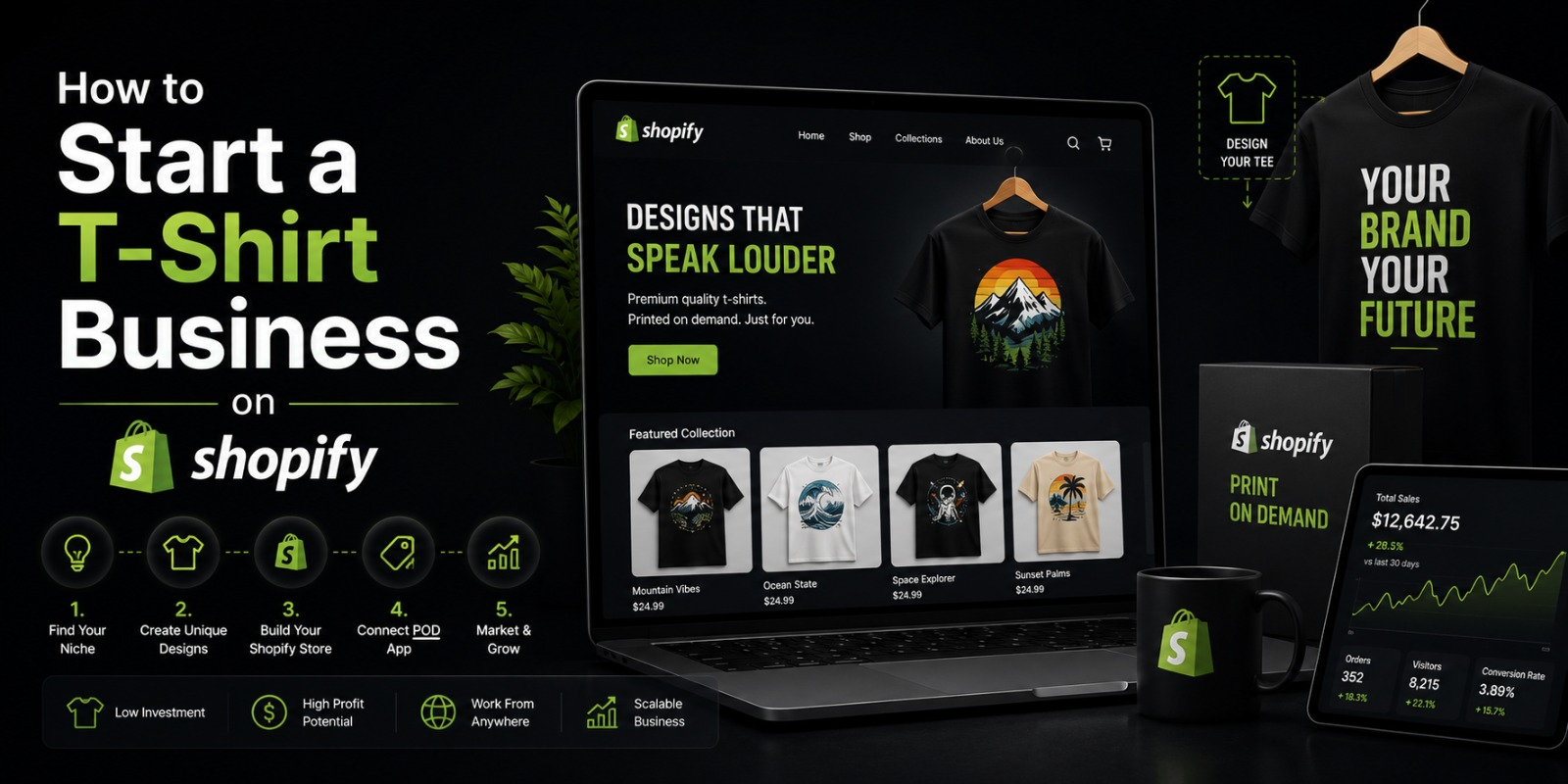
How to Start a T Shirt Business on Shopify
Your Complete Step by Step Guide to Building a Profitable T Shirt Brand From Scratch
The t-shirt business is one of the most accessible ways to start selling online. The product is universal, the demand never disappears, and with print on demand technology, you can launch without buying a single unit of inventory upfront. But here is what most beginner guides will not tell you the t shirt market is also one of the most competitive spaces in ecommerce. Generic designs on generic stores do not sell. What sells is a strong niche, a clear brand identity, and designs that speak directly to a specific group of people who feel like the shirt was made exactly for them.
This guide is going to walk you through every step of starting a t-shirt business on Shopify. Not just the technical setup but the strategic thinking that separates stores that make consistent sales from ones that sit at zero for months. Whether you are completely new to ecommerce or you have tried selling t-shirts before without much success, this guide gives you a clear path forward.
Why Shopify Is the Right Platform for a T Shirt Business
Before getting into the steps, it is worth understanding why Shopify specifically is the platform to build on.
Shopify gives you complete ownership of your store. Unlike selling on Etsy or Redbubble, where you are a tenant in someone else’s marketplace, Shopify is your own piece of internet real estate. You control the branding, the customer experience, the pricing, and the marketing. No one can remove your listing because it competes with a top seller or because an algorithm changed overnight.
Shopify also integrates cleanly with every major print on demand supplier and every major marketing tool. The ecosystem around Shopify apps, integrations, themes, developers is the most mature in ecommerce. Whatever you need to do to grow your store, there is almost certainly a straightforward way to do it on Shopify.
And practically speaking, Shopify is built for people who are not developers. You can set up a professional looking store without writing a single line of code. The back end is intuitive enough that most people figure out the basics within a few hours of exploring.
Step One : Find Your Niche and Own It
If there is one thing that determines whether your t shirt business succeeds or fails before you even design your first shirt, it is your niche.
A niche is a specific audience with a specific identity, interest, or passion that they want reflected in the things they wear. People do not just buy t shirts for warmth or coverage. They buy t shirts to express who they are, what they believe in, what they find funny, what community they belong to. Your job is to find an audience that feels underserved and design shirts that make them feel seen.
The mistake most beginners make is going too broad. They start a general quote t shirt store or a general funny t shirt store and then wonder why nobody buys. Broad does not work because it means nothing to anyone in particular. Specific works because when the right person sees your shirt, they feel like it was made just for them.
Think about the niches that have proven track records in the t shirt space. Profession based niches work very well nurses, teachers, engineers, electricians, real estate agents, truck drivers. People in these professions have strong occupational identities and love wearing something that reflects their work. Hobby niches are similarly strong fishing, hunting, gardening, hiking, woodworking, coffee obsession, book lovers. Pet niches are consistently profitable golden retriever owners, cat people, dog breed specific designs. Humor niches built around specific personality types like introverts, sarcastic people, or people who refuse to wake up before ten in the morning. Local pride niches built around specific cities, regions, or countries.
When evaluating a niche, ask yourself three questions. Is there a passionate and reachable community around this topic? Can you create designs that speak authentically to this audience? Is the niche specific enough to feel meaningful but large enough to sustain a business?
For Pakistani entrepreneurs specifically, there is also opportunity in niches that reflect Pakistani culture, humor, local professional communities, or regional pride audiences that global POD sellers are not serving because they do not understand the cultural nuance.
Step Two : Research the Market Before You Design Anything
Once you have a niche in mind, spend time researching what is already working before you invest time in creating designs.
Go to Etsy and search for t shirts in your niche. Etsy is a goldmine for POD research because it shows you bestselling products, how sellers are pricing them, what design styles are working, and what customers are saying in reviews. Look at the top sellers in your niche and study their designs. You are not looking to copy you are looking to understand what the audience responds to.
Look at Amazon Merch on Demand in the same way. Amazon is an even larger t shirt marketplace and the bestseller rankings tell you a lot about demand.
Search your niche on Google and see what comes up. Are there Facebook groups, Reddit communities, or YouTube channels built around this topic? The size and activity level of these communities tells you how passionate the audience is and gives you ideas for designs that would resonate.
Look at Instagram and TikTok hashtags related to your niche. What content gets the most engagement? What humor, language, and cultural references does this community use? The more you understand how a niche community talks and thinks about their passion, the better your designs will connect with them.
This research phase feels like it is slowing you down but it is actually the fastest path to a store that sells from day one rather than one that you launch and then spend months trying to figure out why nothing is moving.
Step Three : Create Designs That Actually Sell
Good design is non-negotiable in the t-shirt business. You do not need to be a trained graphic designer but you do need designs that look intentional, print cleanly, and connect emotionally with your audience.
Here is what separates designs that sell from designs that sit:
Designs that sell are specific. A shirt that says Dog Mom is fine. A shirt that says Golden Retriever Mom with a design that captures the specific personality of golden retriever owners is much better. The more specific and recognizable, the stronger the emotional pull.
Designs that sell are simple and bold. Complex designs with many small details look great on a computer screen and terrible on a shirt. The print process, especially direct to garment printing, does not preserve fine detail well. Simple, bold designs with clear contrast print beautifully and read well from a distance.
Designs that sell use the right typography. Font choice communicates personality. A fishing niche needs rugged, outdoorsy fonts. A book lover niche might use elegant serif fonts. A sarcastic humor niche might use bold sans serif with attitude. Match your font to your niche’s aesthetic.
Designs that sell evoke a reaction. The goal is that when your target customer sees the design, they either laugh out loud, feel strongly seen, or immediately think of someone they need to send it to. If the design does not provoke that reaction, it is not ready.
Tools for creating t shirt designs
Canva is the most accessible starting point. It is free, has a huge library of fonts and graphics, and has templates sized for common POD products. It is not the most powerful tool but it is enough to create good designs, especially when combined with the right fonts and graphic elements.
Kittl has become one of the favorite tools among POD sellers specifically because it has excellent vintage and retro design effects, strong font pairing tools, and a style that lends itself naturally to t-shirt design. It is significantly more capable than Canva for this specific use case.
Adobe Illustrator is the professional standard for vector design. If you have the skills or want to invest in learning it, Illustrator gives you the most control and produces the highest quality files. Vector files scale perfectly regardless of print size, which is important for clean printing.
If design is not your strength, consider hiring a freelance designer on Fiverr or Upwork to create your initial designs. Brief them specifically on your niche, share examples of designs that work, and give detailed direction on the feel you are going for. A good designer who understands your vision can produce designs that would take you weeks to create on your own.
Technical requirements for t shirt designs
Print on demand suppliers have specific requirements for design files. Most require PNG files with a transparent background. Resolution should be at least 150 DPI at the actual print size, with 300 DPI preferred. The print area dimensions vary by product and supplier always check the specific requirements in your supplier’s app before uploading.
Never upload a low resolution design and assume it will print well. It will not. Blurry or pixelated prints are the number one reason customers leave bad reviews on POD stores.
Step Four : Set Up Your Shopify Store
With your niche defined and designs ready, it is time to build your store.
Go to shopify.com and start a free trial. You will be asked to enter an email address and some basic information. You do not need to have everything figured out immediately you can adjust your store name, design, and settings at any point.
Once inside your admin dashboard, here are the key things to set up before you go live.
Store name and domain
Your store name should be memorable, relevant to your niche or brand identity, and ideally available as a .com domain. If you are building a niche specific store, the name can reflect the niche directly. If you are building a broader t shirt brand that might expand beyond one niche over time, choose something more brand-like that is not locked to a single topic.
Purchase a custom domain through Shopify or through a domain registrar like Namecheap. A custom domain looks significantly more professional than the default mystore.myshopify.com address and builds customer trust.
Choose and customize your theme
Shopify has a range of free themes and a marketplace of premium paid themes. For a t shirt store, you want a theme that puts product images front and center, loads quickly on mobile, and has a clean checkout flow.
Good free options include Dawn, which is clean and modern, and Craft, which has a handmade feel that works well for independent t-shirt brands. If you want to invest in a paid theme, Prestige and Impulse are popular choices among apparel sellers because of how well they showcase product photography and support storytelling through the homepage layout.
When customizing your theme, focus on creating a homepage that immediately communicates who your store is for. Your hero image or banner should speak directly to your target customer. The navigation should be simple. The overall aesthetic should match the personality of your niche.
Set up your brand colors and fonts
Consistent branding across your store builds trust and makes your store feel intentional rather than thrown together. Choose two or three brand colors and a primary font that matches your niche aesthetic, and use them consistently across your homepage, product pages, and marketing materials.
Step Five : Connect a Print on Demand Supplier
Your print on demand supplier is the backbone of your fulfillment operation. They make the shirts, handle quality control, and ship directly to your customers. Choosing the right one matters.
The two most popular choices for t-shirt businesses are Printful and Printify.
Printful is the better choice if you want consistent quality and a smooth experience from day one. They operate their own facilities, which means quality control is more reliable. Their Shopify integration is excellent. The trade-off is that their product costs are higher than some alternatives, which means thinner margins unless you price at the premium end.
Printify gives you access to a network of print providers and often has lower product costs, which means better margins. The trade-off is that you need to research and vet providers within their network, and quality can vary. Order samples before committing to any provider.
Other solid options include Gelato for stores with international customers, SPOD for fast fulfillment on apparel, and CustomCat for high-volume sellers who want the best possible pricing on t-shirts specifically.
To connect your supplier, go to the Shopify App Store, search for your chosen supplier, install the app, create an account if you do not already have one, and authorize the connection. From there, you can browse their product catalog, upload your designs, and create product listings that sync directly to your store.
Step Six : Create Your Product Listings
How you present your products in your store has a huge impact on conversion rates. A great design in a poorly put together listing will not sell as well as it should. Here is how to create listings that convert.
Product titles
Your product title should include the key descriptive terms a customer would search for, but it should also be readable and human. Something like Golden Retriever Mom T Shirt Funny Dog Owner Gift Unisex Tee works better than just Golden Retriever Shirt because it includes natural search terms while also communicating the product’s purpose.
Product descriptions
Your product description should do two things. First, it should speak to your target customer emotionally describe who the shirt is for and why they will love it. Second, it should give the practical information customers need fabric composition, fit type, sizing guidance, and care instructions.
Do not just write a generic description that could apply to any t shirt. Write it as if you are talking directly to the specific person this shirt was designed for.
Product images
In a t-shirt store, your product images are doing most of the selling. Use lifestyle mockups wherever possible images that show the shirt being worn by a real person in a natural setting rather than just a flat product shot. Lifestyle images help customers visualize themselves in the shirt, which significantly increases purchase intent.
Most POD suppliers have mockup generators built into their apps that produce decent quality product images. For a more premium look, services like Placeit offer a wide range of lifestyle mockup templates.
Aim for at least three to four images per product a front view, a back view if relevant, a closeup of the design, and a lifestyle mockup.
Pricing
Pricing your t-shirts correctly is one of the most important decisions you will make. Price too low and you either lose money or make so little per sale that you cannot afford to market effectively. Price too high without the brand equity to justify it and conversion rates suffer.
A standard direct to garment t-shirt from Printful might cost you around twelve to fifteen dollars. A reasonable retail price for a niche t-shirt is twenty-five to thirty-five dollars. That gives you a margin that allows for some marketing spend and still leaves profit.
Do not try to compete on price with mass market retailers. You will never win that game as a POD store. Compete on specificity and design instead. Someone who feels like a shirt was made exactly for them will happily pay thirty dollars for it.
Step Seven : Set Up Payments and Shipping
Before your store can accept orders, you need to configure your payment and shipping settings.
For payments, go to Settings and then Payments in your Shopify admin. Shopify Payments is the built-in option and the simplest to set up if it is available in your country. For Pakistani sellers, Shopify Payments is not currently available directly in Pakistan. Common alternatives include PayPal, which is widely trusted by international customers, and Stripe, which requires a business registered in a Stripe-supported country. Many Pakistani ecommerce entrepreneurs set up an LLC in the United States or a company in the UK to access these payment options fully.
For shipping, the most conversion friendly approach for a t shirt store is to offer free shipping and build the shipping cost into your product price. Free shipping removes a friction point at checkout and is consistently shown to improve conversion rates. Most POD sellers doing volume use this approach.
If you want to charge for shipping instead, use the rates your supplier provides as the basis for your shipping configuration in Shopify.
Step Eight : Set Up the Essential Apps
A few additional apps will make your store significantly more effective.
Email marketing is non negotiable. Klaviyo is the gold standard for Shopify email marketing. At minimum, set up an abandoned cart sequence an automated email or series of emails that goes out to customers who added a shirt to their cart but did not complete the purchase. This sequence alone recovers meaningful revenue that would otherwise be lost.
A reviews app lets customers leave feedback and photos, which builds social proof for future buyers. Loox and Judge.me are both excellent options that integrate cleanly with Shopify. Make it a habit to follow up with customers after their order arrives and invite them to leave a review.
A size guide app or built in size chart is important for apparel. Sizing confusion is one of the top reasons people abandon t-shirt purchases. Make sure every product page has a clear size guide with measurements in both centimeters and inches if you are selling internationally.
An upsell or cross sell app can meaningfully increase your average order value. When someone buys a t-shirt, suggesting a matching mug or a complementary design from your store is a low-friction way to increase revenue per customer.
Step Nine : Build Your Marketing Strategy
Having a great store with great designs is not enough if nobody knows it exists. Marketing is what turns a store into a business.
Organic social media
Instagram and TikTok are the most powerful organic channels for t shirt businesses. Instagram works well for lifestyle product photography and building a visual brand aesthetic. TikTok is powerful for behind the scenes content, design process videos, niche community content, and anything that entertains or resonates with your target audience.
The key to organic social is consistency and relevance. Post content that your niche audience finds genuinely valuable or entertaining, not just product photos. A fishing niche account that posts fishing tips, funny fishing moments, and relatable fishing content will build an audience much faster than one that only posts product shots.
Pinterest is worth mentioning as an underrated channel for t shirt stores. Pins drive traffic for months or years after being posted, making it an excellent long-term traffic source that compounds over time.
Paid advertising
Facebook and Instagram ads are the most direct way to get targeted traffic to your store quickly. The advantage of paid ads is that you can target people based on exactly the interest or passion your niche is built around.
Start with a small budget even five to ten dollars a day and test different creatives and audiences before scaling. The most common beginner mistake with paid ads is spending too much too quickly on untested combinations. Test small, identify what works, and then put more budget behind it.
TikTok ads are also worth exploring, particularly if your niche skews toward a younger demographic.
SEO and content marketing
Search engine optimization takes longer to produce results than paid ads but the traffic it generates is free and compounds over time. At minimum, make sure your product titles and descriptions include the keywords people would search for when looking for shirts in your niche.
Starting a blog on your Shopify store and writing content that serves your niche community is a longer-term strategy that builds organic traffic and establishes your store as an authority in your space. It is not essential from day one but it is worth investing in once your store is established.
Influencer marketing
Micro-influencers in your niche accounts with five thousand to fifty thousand followers who post content directly relevant to your niche — can be incredibly effective for t-shirt stores. Send a free shirt in exchange for a post or story, or negotiate a small paid partnership. An authentic recommendation from a trusted voice in a niche community reaches exactly the audience you want at a fraction of the cost of broad paid advertising.
Step Ten : Handle Operations and Customer Service
As orders start coming in, your operational processes become important. Here is what to have in place.
Set up a clear shipping policy page that explains typical delivery times. With POD, production usually takes two to five business days and then shipping time is added on top. Be transparent about this so customers know what to expect. Surprise at delivery time is a major driver of negative reviews and chargebacks.
Create a returns and refunds policy. Most POD suppliers do not accept returns for buyer’s remorse since products are made to order. Your policy should make this clear while also explaining what happens in the case of a defective product or printing error, in which case the supplier will typically reprint or refund.
Respond to customer inquiries quickly. Even if you cannot resolve an issue immediately, a fast response that acknowledges the customer and lets them know you are on it goes a long way toward maintaining satisfaction. Aim to respond to all customer messages within 24 hours.
Monitor your supplier’s quality by ordering samples periodically and by paying attention to any patterns in customer feedback. If you start seeing complaints about a particular product or print quality, investigate it quickly.
Scaling Your T Shirt Business
Once your store is making consistent sales, the focus shifts to growth. Here are the levers to pull.
Expand your product range within your niche. If your fishing niche t shirts are selling well, add hoodies, mugs, hats, and phone cases with the same design themes. Existing customers who love your brand are the easiest people to sell more products to.
Expand your design library. The more designs you have that speak to your niche, the more surface area you have for sales. A store with five designs is limited. A store with fifty well-targeted designs in a focused niche is a real business.
Scale your paid advertising on the campaigns that are already working. Once you know which ad creatives and target audiences are generating profitable sales, increase the budget methodically and watch the results.
Build your email list aggressively. Your email list is the most valuable asset your store has because it is an audience you own and can reach at any time without paying for access. Grow it through popups, post-purchase flows, and content that incentivizes sign ups.
Consider expanding to a second niche with a separate store or a separate section of your existing store, using what you have learned from your first niche to get results faster.
How TheScriptFlow Helps T Shirt Businesses Get Built Right
At TheScriptFlow, we work with entrepreneurs across Pakistan and globally who are building ecommerce businesses on Shopify. We have helped t shirt brands and print on demand stores get set up correctly from the start with fast loading themes, properly configured apps, supplier integrations, and store designs that convert visitors into buyers.
If you are starting a t-shirt business and want to skip the trial and error that most beginners go through, working with a team that has done this before makes a meaningful difference. Visit thescriptflow.com to talk with the team about what your store needs.
Final Thoughts
Starting a t shirt business on Shopify is genuinely achievable. The tools are accessible, the startup costs are low, and the market for niche t shirts is enormous and continues to grow. But the stores that make real money are the ones built with intention a specific niche, a strong brand identity, designs that speak directly to a passionate audience, and a consistent marketing effort.
Do not try to build everything at once. Start with one niche, create five to ten strong designs, set up your store properly, and start driving traffic. Learn from what happens, adjust what is not working, and double down on what is. That process of iteration is what builds a real business.
The t-shirt you design this week could be on someone’s back on the other side of the world by next month. That is a remarkable thing, and Shopify makes it more accessible than it has ever been. The only thing left is to start.