The Complete Guide to Shopify SMS Marketing
Let me ask you something that might make you think differently about your marketing strategy.
When was the last time you left a text message unread for more than a few minutes?
Be honest.
For most people, the answer is almost never. A text message arrives and it gets looked at almost immediately. It might not always get a response right away. But it gets seen. It gets read. It lands in the most personal, most always accessible space in a person’s daily life.
Now compare that to email.
A marketing email arrives in an inbox that might already contain hundreds of other unread messages. It competes with newsletters, promotional offers, order confirmations, and work emails all fighting for the same limited attention. If it does not have a compelling subject line, it might sit unopened for days. If it looks like marketing at first glance, it might get deleted without ever being opened at all.
The difference in attention between those two channels is enormous. And it is exactly why SMS marketing has become one of the most powerful tools available to Shopify store owners who are serious about driving revenue from their customer base.
The numbers tell a clear story. Email marketing averages open rates somewhere between fifteen and twenty five percent for most e commerce brands. SMS marketing averages open rates above ninety percent. Almost every text message you send will be read. Almost every one. That is a level of reach and attention that no other marketing channel can come close to matching.
Click-through rates tell a similar story. SMS click through rates consistently outperform email click-through rates by a significant margin. And conversion rates for SMS campaigns, particularly for time sensitive offers and cart recovery, are among the highest of any marketing channel in e commerce.
But SMS marketing is not just about the numbers. It is about the nature of the channel itself.
A text message is personal in a way that an email simply is not. It arrives on the same device where your customer talks to their family and their closest friends. That intimacy is a privilege. And like all privileges, it comes with responsibility.
Done well, SMS marketing builds the kind of direct, personal relationship between a brand and its customers that drives long term loyalty, repeat purchases, and genuine advocacy. Done poorly, it feels invasive, spammy, and disrespectful. It damages trust and drives unsubscribes faster than almost any other marketing mistake you can make.
This guide is going to show you how to do it well.
We are going to cover everything. What SMS marketing is and how it works for Shopify stores. How to build your subscriber list the right way. What the legal requirements are and why they matter. What types of campaigns and automations to run. How to write SMS messages that actually convert. Which tools to use. And how to measure your results and optimize over time.
By the end of this guide, you will have everything you need to launch a professional, high performing SMS marketing program for your Shopify store.
Let us start from the beginning.
What Is Shopify SMS Marketing and Why Does It Work?
SMS marketing is the practice of sending text messages to customers and subscribers who have given you explicit permission to contact them via their mobile phone number.
For a Shopify store, SMS marketing serves two primary purposes.
The first is transactional communication. Order confirmations, shipping notifications, delivery updates, and other messages that are directly tied to a specific purchase. These messages are expected, welcomed, and almost always read immediately. They create a positive customer experience and keep shoppers informed at every stage of their order.
The second is promotional communication. Marketing messages designed to drive traffic, promote offers, recover abandoned carts, announce new products, and generate repeat purchases. This is where the revenue-generating power of SMS really shows itself.
The reason SMS marketing works so much better than most other channels comes down to a combination of factors that are unique to the medium.
Phones are always present. Your customer’s phone is within arm’s reach almost every hour of their waking day. No other marketing channel has that level of physical proximity to the recipient.
SMS has no spam folder. Unlike email, where sophisticated filters can route your message to the promotions tab or the spam folder before it ever reaches the recipient, text messages arrive directly and reliably. There is no algorithm deciding whether your message gets seen.
SMS creates urgency naturally. A notification on a phone screen demands attention in a way that sitting in an email inbox does not. When a text arrives, people look at it. That immediate attention is enormously valuable for time-sensitive offers and promotions.
SMS subscribers are highly qualified. Because opting into text messages is a more deliberate and higher commitment action than signing up for email, the people on your SMS list are generally more interested in your brand and more motivated to buy than your average email subscriber. A smaller, more committed SMS list will often outperform a much larger email list in terms of revenue per message sent.
SMS complements other channels powerfully. SMS works best not as a replacement for email but as a complement to it. A customer who receives both an email and a text message about an abandoned cart is significantly more likely to convert than one who receives only one or the other. The same is true for sale announcements, product launches, and loyalty rewards. Multi-channel reach multiplies effectiveness.
All of these factors combine to make SMS marketing one of the highest-return channels available to Shopify store owners. But to unlock that return, you need to build your program on the right foundation.
And the foundation starts with compliance.
Understanding SMS Marketing Compliance and Legal Requirements
This section is not the most exciting part of this guide. But it might be the most important.
SMS marketing is regulated more strictly than almost any other marketing channel. And for good reason. Text messages arrive on personal devices in a deeply personal space. The laws governing SMS marketing exist to protect people from unwanted, intrusive messages. Violating those laws is not just an ethical problem. It is a legal one that can result in significant financial penalties.
Before you send a single marketing text message, you need to understand the rules.
Explicit opt in is non negotiable.
This is the most fundamental rule of SMS marketing. You cannot send marketing text messages to anyone who has not explicitly and voluntarily agreed to receive them.
This is not like email, where some programs interpret existing customer relationships as implicit permission. For SMS marketing, explicit consent is required. The subscriber must actively take an action that clearly indicates they are agreeing to receive marketing texts from you. A pre ticked checkbox does not qualify. Buying from your store does not qualify on its own. The consent must be clear, voluntary, and unambiguous.
This means your opt-in process needs to be transparent about exactly what the subscriber is agreeing to. They need to know they are signing up for SMS marketing messages from your brand. They need to understand roughly how often they will receive messages. And they need to know they can opt out at any time.
The CAN SPAM and TCPA frameworks in the United States.
If you sell to customers in the United States, the Telephone Consumer Protection Act, commonly known as the TCPA, is the primary legal framework governing SMS marketing. The TCPA sets strict requirements around consent, message content, and opt-out mechanisms.
Violations of the TCPA can result in fines of between five hundred and fifteen hundred dollars per message sent without proper consent. For a large-scale SMS campaign sent to thousands of subscribers without proper opt-in, that adds up to a number that could seriously damage or destroy a business.
The key requirements under the TCPA include obtaining written or digital consent before sending marketing messages, including clear identification of who is sending the message, providing an easy opt-out mechanism, and honoring opt-out requests immediately.
GDPR for European customers.
If you sell to customers in the European Union or the United Kingdom, the General Data Protection Regulation applies. GDPR requirements around consent are similarly strict and require that subscribers freely give specific, informed consent before you can send them marketing communications.
The basics that apply everywhere.
Regardless of jurisdiction, these practices should be standard in any SMS marketing program.
Always identify yourself clearly in every message. The recipient should immediately know which brand the message is from.
Always include a simple opt-out mechanism. In the United States, the standard is to include “Reply STOP to unsubscribe” or similar language. Honor opt-out requests immediately. A subscriber who texts STOP should never receive another marketing message from you.
Never send messages at unreasonable hours. Respect your subscribers’ time by limiting sends to reasonable daytime hours in their timezone.
Never misrepresent your identity or the nature of your messages.
Working with a reputable SMS marketing platform like Klaviyo, Omnisend, Postscript, or Attentive will help you stay compliant because these platforms build compliance tools, consent tracking, and opt-out management directly into their systems. But ultimate responsibility for compliance always rests with you as the sender.
Take compliance seriously from day one. The trust of your subscribers and the legal safety of your business both depend on it.
How to Build Your SMS Subscriber List
With compliance understood, the next step is building your subscriber list. And because SMS requires explicit opt-in, this requires deliberate, consistent effort across multiple touchpoints in your customer’s journey.
Here is how to grow your SMS list effectively and ethically.
Pop-up forms with SMS opt in.
Your store’s pop-up form is one of the most effective places to collect SMS subscribers. If you already have a pop-up that collects email addresses, adding an optional SMS opt-in field to the same form is a straightforward way to capture both.
The key is making the SMS opt in feel valuable. Just as with email, people need a reason to share their phone number with you. The reason they give their email address might be a discount code or a lead magnet. The reason they share their phone number needs to be equally or even more compelling, because phone numbers feel more personal than email addresses.
Consider offering an additional incentive specifically for SMS sign up. If your email pop-up offers ten percent off, consider offering an extra five percent or a different perk, like free shipping or early access to sales, exclusively for SMS subscribers. That incremental offer justifies the incremental commitment of sharing a phone number.
Make sure your SMS opt-in includes compliant consent language directly below the phone number field. Something like “By submitting your number, you agree to receive marketing text messages from [Your Brand]. Message and data rates may apply. Reply STOP to unsubscribe.” This language is required and must be visible before the subscriber completes the opt-in.
Checkout opt in.
The checkout process is another powerful opportunity to collect SMS subscribers. Shopify allows you to add an SMS marketing opt-in checkbox during checkout, similar to the email marketing opt-in.
At checkout, customers are already highly engaged with your brand. They are in the process of trusting you with their payment information. Adding an SMS opt-in here captures customers at a moment of peak engagement and converts them into subscribers at the same time as they become buyers.
Position the SMS opt-in clearly on the checkout page with a short, compelling benefit statement next to it. “Subscribe via text for exclusive deals and early access to sales” gives a clear reason to opt in without taking up significant space on the page.
Keyword opt in campaigns.
Keyword campaigns are a uniquely effective SMS list building tactic that has no equivalent in email marketing.
You promote a short keyword that people can text to a specific number to subscribe. For example, “Text JOIN to 12345 to get 20% off your first order.” You promote this keyword everywhere: your social media bio, your Instagram stories, your TikTok captions, your product packaging, your in store signage if you have a physical location, and even in your email campaigns.
When someone texts the keyword, they are automatically added to your SMS subscriber list and receive an automated welcome message with their promised incentive.
Keyword campaigns work particularly well on social media where you can reach audiences who are not yet email subscribers. Someone who sees your TikTok video and texts the keyword to get a discount becomes an SMS subscriber without ever having visited your website.
Post purchase SMS opt in.
After a customer completes a purchase, the order confirmation and post purchase experience is another opportunity to invite them to subscribe.
A post purchase SMS opt in can be delivered via email, asking the customer to reply or visit a link to also opt into text message updates. Or it can be built into a thank you landing page that appears after the purchase is complete.
Buyers who have just completed a purchase are at a high point of engagement and brand positivity. Converting them to SMS subscribers in that moment captures their attention when they are most receptive.
Loyalty and rewards program enrollment.
If your store has a loyalty or rewards program, enrolling in that program can be linked to SMS opt in. Customers who want to track their points, receive exclusive member rewards, or be notified when they have earned a prize are naturally motivated to opt into SMS where those updates can be delivered immediately and directly.
Building your SMS list takes consistent effort across all of these touchpoints. But each subscriber you add is someone who has given you direct, personal access to their most private communication channel. Treat that relationship with the respect it deserves, and it will generate disproportionate returns compared to any other channel in your marketing mix.
Types of SMS Campaigns to Run for Your Shopify Store
Once you have a growing SMS subscriber list, the next question is what to send them.
SMS campaigns for Shopify stores fall into two main categories: automated flows that are triggered by specific customer behaviors, and broadcast campaigns that you send to your full list or specific segments at a time of your choosing.
Let us cover the most effective types of each.
Automated SMS flows.
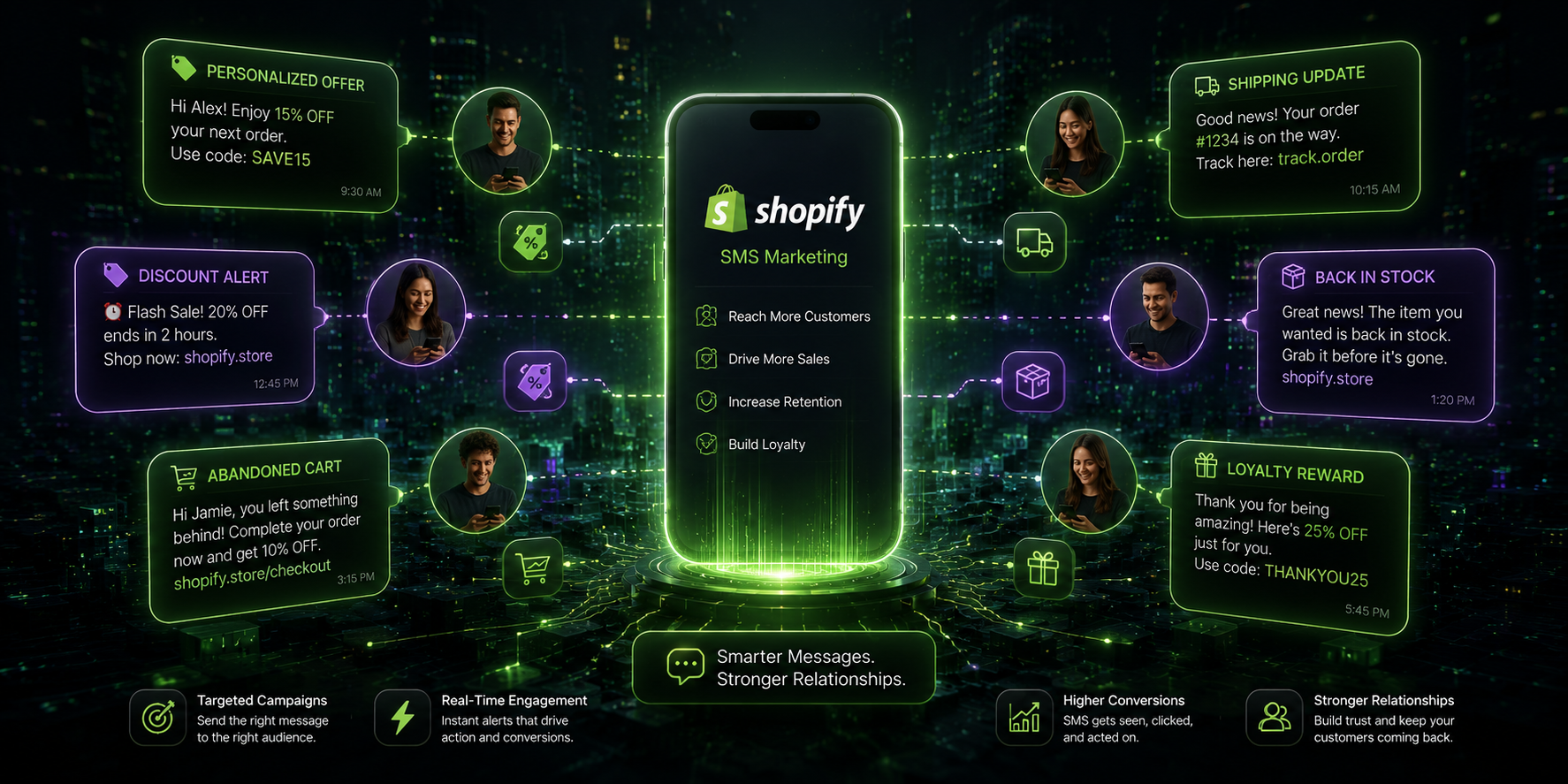
Welcome message. The moment someone opts into your SMS list, they should receive a welcome text. This message should be immediate, warm, and deliver whatever incentive brought them to subscribe. If they opted in for a discount code, that code should be in the welcome message along with a direct link to your store. Keep it short, clear, and easy to act on.
Abandoned cart SMS. This is the highest revenue SMS automation for most Shopify stores. When a subscriber adds items to their cart and leaves without buying, a text message sent within the first hour of abandonment can recover a significant portion of those sales. The message should name the specific product they left behind, create gentle urgency, and include a direct link back to their cart. A follow up message twenty four hours later with a modest incentive can recover additional carts that the first message did not convert.
Browse abandonment SMS. Similar to cart abandonment but triggered when a subscriber views a product page multiple times without adding to their cart. The tone here should be softer and more conversational. They were looking but not quite ready. A gentle “Still thinking about this?” message keeps the product top of mind without being pushy.
Post purchase SMS. A text message sent after a purchase to thank the customer, set expectations for delivery, and invite them to follow your brand on social media or join your loyalty program. Post-purchase SMS messages have extremely high open rates because they are expected and relevant.
Shipping and delivery notifications. Customers love knowing where their order is at every stage of the fulfillment process. Automated shipping confirmation and delivery notification texts are among the most welcomed messages a brand can send. They create positive experiences, reduce customer service inquiries about order status, and keep your brand positively top of mind throughout the delivery window.
Winback SMS. For subscribers who have not engaged with your messages or purchased from your store in a significant amount of time, a winback text with a compelling offer can reactivate relationships that email alone could not recover. SMS has the attention-getting power to reach people who have been filtering out your emails without realizing it.
Broadcast SMS campaigns.
Flash sales and limited time offers. This is where SMS marketing truly shines. A flash sale that is available for twenty four hours or forty eight hours is perfectly suited to SMS because the channel’s immediacy matches the urgency of the offer. A text message announcing a flash sale at nine in the morning can drive significant traffic and sales throughout the day in a way that an email might not because far more people will see the text message within hours of it being sent.
New product launches. Use SMS to give your subscribers first access to new products before they go live to the general public. Frame it as an exclusive subscriber benefit. “You are one of the first to know. Our new collection just dropped and it is available to you before anyone else.” This makes subscribers feel valued and creates genuine excitement around new launches.
Low inventory alerts. When a popular product is about to sell out, an SMS alert to subscribers who have shown interest in that product or category creates genuine urgency. “Only five left in stock” combined with a direct purchase link can drive immediate conversions from subscribers who have been considering a purchase but have not pulled the trigger yet.
Seasonal and holiday campaigns. Major shopping events like Black Friday, Cyber Monday, and seasonal sales are high-competition moments in e-commerce where getting your message through the noise is more difficult than ever. SMS, with its near universal open rates, is one of the most effective channels for cutting through the clutter and getting your best offers in front of your most engaged customers.
Loyalty and birthday messages. A personalized text on a subscriber’s birthday with an exclusive discount creates a positive emotional moment that builds genuine brand loyalty. It feels personal, unexpected, and generous. Automated birthday messages require minimal effort to set up but consistently generate strong engagement and conversion rates.
Restock notifications. When a product that someone wanted is back in stock, a text message letting them know is highly effective because it reaches them immediately with information that is directly relevant to a desire they have already expressed. Restock SMS notifications convert at very high rates because the recipient was already pre-qualified as a buyer for that specific product.
How to Write SMS Messages That Actually Convert
Writing for SMS is a skill that is genuinely different from writing for email, social media, or any other marketing channel.
The constraints are tight. The audience is intimate. The competition for attention, while lower than in email, is still real. Every word counts in a way that it simply does not in longer formats.
Here are the principles that separate SMS copy that converts from copy that gets ignored or, worse, triggers an unsubscribe.
Lead with value, immediately.
Your subscriber is reading this on their phone in the middle of their day. They have given you about three seconds to demonstrate that this message is worth their attention before they swipe away.
Do not spend those three seconds on a greeting or a preamble. Lead with the most important, most valuable piece of information in your message. If there is a discount, the discount comes first. If there is urgency, the urgency is immediately clear. If there is new product news, the news is in the first line.
Get to the point faster than you think you need to.
Keep it short and scannable.
The sweet spot for SMS marketing messages is between one hundred and one hundred and sixty characters. That is the length of a single SMS segment. Going longer is technically possible but it costs more per message, increases the chance of formatting issues across different devices, and tests the patience of the recipient.
Say what you need to say in the fewest words possible. If your message can be ten words shorter without losing any meaning, make it ten words shorter.
Always include your brand name.
Your subscriber should immediately know who this message is from. Start every message with your brand name or a clear identifier. “Hey from [Brand Name]” or simply “[Brand Name]: ” at the beginning of the message removes any ambiguity about the sender.
This is also a legal requirement in many jurisdictions. Make it a non-negotiable standard in every message you send.
Make the call to action unmissable.
Every SMS message should have one clear call to action and one direct link. Not two calls to action. Not three. One.
Tell the subscriber exactly what you want them to do. “Shop now.” “Claim your offer.” “Complete your order.” “Get early access.” Then follow it with a short, trackable link.
Use a link shortener to keep your URL compact. Most SMS marketing platforms generate short, trackable links automatically that make this easy.
Use personalization where possible.
Including the subscriber’s first name in your message, when you have it, makes the text feel more personal and less like a broadcast. “Hey Sarah, your exclusive offer is waiting” converts better than “Hey, your exclusive offer is waiting.”
Most SMS marketing platforms support personalization tokens that automatically insert subscriber names and other custom fields into your messages.
Create genuine urgency.
SMS is a powerful channel for urgency-driven messages because the immediacy of the medium amplifies the urgency of the offer. A flash sale that ends tonight feels more pressing when delivered via text than when it arrives in an email inbox.
But the urgency must be real. If you tell subscribers that an offer expires tonight and then run the same offer next week, you destroy the trust that makes SMS marketing effective. Never manufacture false urgency. If there is a real deadline, communicate it. If there is not, find a different angle.
Respect the personal nature of the channel.
Every message you send should pass a simple test. Would you be comfortable receiving this message from a brand you like?
If the answer is yes, send it. If the answer is no, rewrite it.
Messages that are too frequent, too salesy, too impersonal, or too irrelevant fail this test. And in SMS marketing, failing that test does not just mean a low open rate. It means an unsubscribe, and sometimes a complaint. Both are damaging to your program and your brand.
Choosing the Right SMS Marketing Tool for Shopify
Selecting the right platform for your SMS marketing program is an important decision that will affect everything from how easy it is to build automations to how well your data syncs with Shopify.
Here are the main options worth considering and what makes each one suited to different types of stores.
Klaviyo is the most comprehensive option for stores that want to manage email and SMS in a single, deeply integrated platform. Its Shopify integration is the strongest available, pulling in detailed customer data that powers highly personalized segmentation and automation. If you are already using Klaviyo for email, adding SMS through the same platform is a natural extension that allows you to build combined email and SMS flows in a single workflow. The pricing scales with your subscriber count and message volume but is generally well-justified for stores doing significant revenue.
Omnisend offers similarly strong email and SMS integration with a slightly more accessible interface that many store owners find easier to navigate than Klaviyo. Its multichannel automation builder makes combining email, SMS, and push notifications into a single flow genuinely straightforward. Omnisend tends to be slightly more affordable at mid-range subscriber and message volumes while still offering the core features that growing stores need.
Postscript is an SMS-only platform built specifically for Shopify stores. If SMS is your primary focus and you want a platform designed entirely around the SMS channel rather than one where SMS is a secondary feature alongside email, Postscript is worth serious consideration. Its Shopify integration is excellent, its compliance tools are strong, and its feature set is specifically optimized for e-commerce SMS marketing.
Attentive is an enterprise-level SMS platform that is best suited to larger stores doing significant volume. Its feature set is comprehensive and its deliverability is excellent, but the pricing and the minimum commitment requirements make it less appropriate for smaller or newer stores.
For most growing Shopify stores, Klaviyo or Omnisend will be the right choice if you want email and SMS managed together, and Postscript is the right choice if SMS is your primary marketing channel and you want the most specialized tool available for it.
How to Measure Your SMS Marketing Performance
Like any marketing channel, SMS marketing needs to be measured consistently so you can understand what is working, identify what needs improvement, and make smart decisions about where to invest your time and budget.
Here are the key metrics to track.
Opt-in rate measures how many people subscribe to your SMS list through each of your collection touchpoints. Track opt-in rate by source so you know which methods, pop-ups, checkout, keyword campaigns, and others, are generating the most subscribers. This tells you where to focus your list-building efforts.
Open rate for SMS is generally high across the board, but tracking it by campaign type and message content tells you which kinds of messages your subscribers are most engaged by.
Click-through rate measures what percentage of subscribers who receive a message click the link in it. This is one of the most important performance indicators for promotional campaigns. A low click-through rate despite a high open rate suggests that the message is getting opened but not compelling enough to drive action. This points to a copy or offer issue.
Conversion rate measures what percentage of subscribers who click through from your SMS message actually complete a purchase. This is the ultimate measure of campaign effectiveness and the one most directly connected to revenue.
Revenue per message is a metric that some SMS platforms calculate automatically. It tells you how much revenue each text message generates on average. This metric is useful for comparing the effectiveness of different campaign types and for understanding the overall return on your SMS program.
Unsubscribe rate is a critical health metric. A consistently high unsubscribe rate signals that something is wrong with your program, whether that is message frequency, relevance, quality, or a combination of factors. If your unsubscribe rate is rising, it demands immediate investigation and adjustment.
List growth rate tracks how quickly your SMS subscriber list is growing over time. Consistent list growth is a sign that your opt-in strategies are working and that your brand is reaching new potential customers effectively.
Review these metrics regularly and use them to inform ongoing decisions about your SMS program. The brands that achieve the best long-term results from SMS marketing are the ones that pay close attention to their numbers and continuously refine their approach based on what the data tells them.
SMS Marketing Best Practices for Shopify Stores
Before we wrap up, here are the most important best practices to keep in mind as you build and run your SMS marketing program.
Send at the right time. Timing matters enormously in SMS marketing because text messages are read immediately. Early to mid-morning, around nine to eleven in the morning, and early afternoon, around twelve to two in the afternoon, tend to be the highest-engagement windows for most audiences. Avoid sending after eight in the evening or before eight in the morning. Respect your subscribers’ personal time and their need for sleep.
Match your sending frequency to your audience’s expectations. One to four SMS messages per month is the typical range for most Shopify stores. Going beyond that, unless you have a very specific audience that has demonstrated a higher tolerance for frequency, risks driving unsubscribes. Less is more with SMS in a way that is even more pronounced than with email.
Segment your SMS list. Do not send every message to every subscriber. Use behavioral data from Shopify to segment your SMS list just as you would your email list. Buyers should receive different messages than non-buyers. High-value customers should receive different offers than new subscribers. Product category buyers should receive messages relevant to their specific interests. Relevant messages reduce unsubscribes and increase conversions.
Test relentlessly. Test your message copy. Test your offers. Test your send times. Test your opt-in incentives. Small improvements in any of these variables compound over time into meaningful revenue differences. Build a culture of testing into your SMS program from the beginning.
Integrate SMS with your broader marketing strategy. SMS works best as part of a coordinated marketing approach that includes email, social media, and paid advertising. Build combined flows where email and SMS work together rather than treating them as completely separate programs.
Always deliver on your promises. If someone subscribed because you promised exclusive deals, give them exclusive deals. If you said you would text them about new arrivals, text them about new arrivals. The trust your subscribers have placed in you by sharing their phone number is built on the expectation that you will use it the way you said you would. Honor that expectation every single time.
Final Thoughts
SMS marketing is not a trend. It is not a gimmick. It is one of the most direct, most personal, and most consistently high-performing marketing channels available to Shopify store owners today.
The brands that invest in building a quality SMS subscriber list, that take compliance seriously, that craft messages with care and respect for the personal nature of the channel, and that measure and optimize their results continuously are the ones that will generate disproportionate revenue from a relatively small investment of time and resources.
The opportunity is real. The channel is powerful. And the barrier to entry, while it requires genuine effort to do properly, is well within reach for any Shopify store owner who is committed to building a direct relationship with their customers.
Start small. Build your list consistently. Send with intention. Treat every subscriber’s phone number as the privilege it is.
Do that, and SMS marketing will become one of the most valuable assets in your entire marketing strategy.
Your customers are waiting to hear from you. Make sure what you send is worth reading.